My ‘Big Month’ of birding was even better than I’d hoped

April was the coolest month. Knowing that I had a trip to Texas scheduled and that a few warblers might eventually come my way at home, I set out on a “big month” quest to spot as many species as possible. I set 60 as my target, a reasonable expectation but not a certainty.

I’m happy to report that my total flew well past that, topping out at 83. To put that in perspective, that number is well above the 70 species I recorded in my first year of progressively serious birding, 2020, and the total isn’t far off the 102 species I logged in 2021.

From April 1 on, many of the birds I first spotted showed up at home. This chipping sparrow is Exhibit A.

The first-of-the-year chipping sparrow who showed up on my backyard feeder on April 1 was a good omen. I recorded 17 species that day, a fast but expected start that reminded me that I don’t have to head deep into the woods to find nature. I’m fortunate that it comes calling on my own half acre.

I filed 50 checklists in April from four states, the majority in New Jersey, a week’s worth in Texas and single reports from New York and Pennsylvania. I had one walk in Central Park in New York City early in the month, and I was happy to record the first pigeons of the month there. I’d also see a few at the Mercer Meadows Pole Farm later on.

The Pennsylvania stop was on the last day of the month at the Morrisville levee, just across the “Trenton Makes, The World Takes” bridge over the Delaware River. I spotted a female common merganser in the river, and I also saw a sharp-shinned hawk swoop in and out of the park at the foot of the levee.

The first surprise of the month came on April 5 on the Reed-Bryan Farm side of Mercer Meadows park: an American kestrel perched on a lone tree off the main path. I would see another kestrel (maybe the same one?) a few days later on the Pole Farm side.

Purple finch at the Pole Farm

Another early surprise came April 8, when high up in a tree at the Pole Farm I captured in my camera what turned out to be an immature purple finch.

At College Station, Texas, I added a white-winged dove and a spotted sandpiper to my life list. Returning home, I wondered when I’d log my first white-breasted nuthatch, and one finally appeared on April 17.

I hit my goal of 60 on April 19 when I heard the first house wrens of the year at Drexel Woods, a small park near home.

Big surprises awaited me in the waning days of the month. I spotted a pair of orchard orioles in a tree at the Pole Farm on April 27, and the following day would hold even more wonders.

That morning I met up with the Princeton Birding Society, a student group at Princeton University. They were on a birding walk through the Charles H. Rogers Preserve. The day set off with a bang when a flock of laughing gulls flew overhead, and shortly thereafter I spotted a bald eagle soaring on thermals high overhead.

On the trail at the Rogers Preserve with the Princeton Birding Society.

We heard a Virginia rail from the observation deck over a marsh; the calls were confirmed by the experienced birding group leaders and Jim Parrish, one of the top birders in these parts who happened to be on the deck when we arrived. He said there were two rails and he had seen one of them. I heard a rail again the next morning but never did see it.

The students also spotted a blue-winged warbler and a palm warbler, both in the bushes in front of me. I didn’t see them but am comfortable counting them; I’d see my own palm warbler two days later. The students also ID’d a warbling vireo, and I spent some quality time with one at the preserve the next morning. The bird would not sit still for photos, and I came home with five lovely frames of the tree branches it had vacated.

On the final day, I started with a visit to the Pole Farm and was overjoyed to spot at prairie warbler (another lifer) high up in a tree.

Prairie warbler at the Pole Farm

Next, I headed to the Rogers preserve and connected with my friends Mark and Laura and their great black lab, Iko. We were thrilled to get a good look at a beautiful Baltimore oriole. Laura had taken me several weeks ago to see my first Harlequin ducks, and I got to return the favor as she saw her first wood ducks, which I’d added to my life list the morning before.

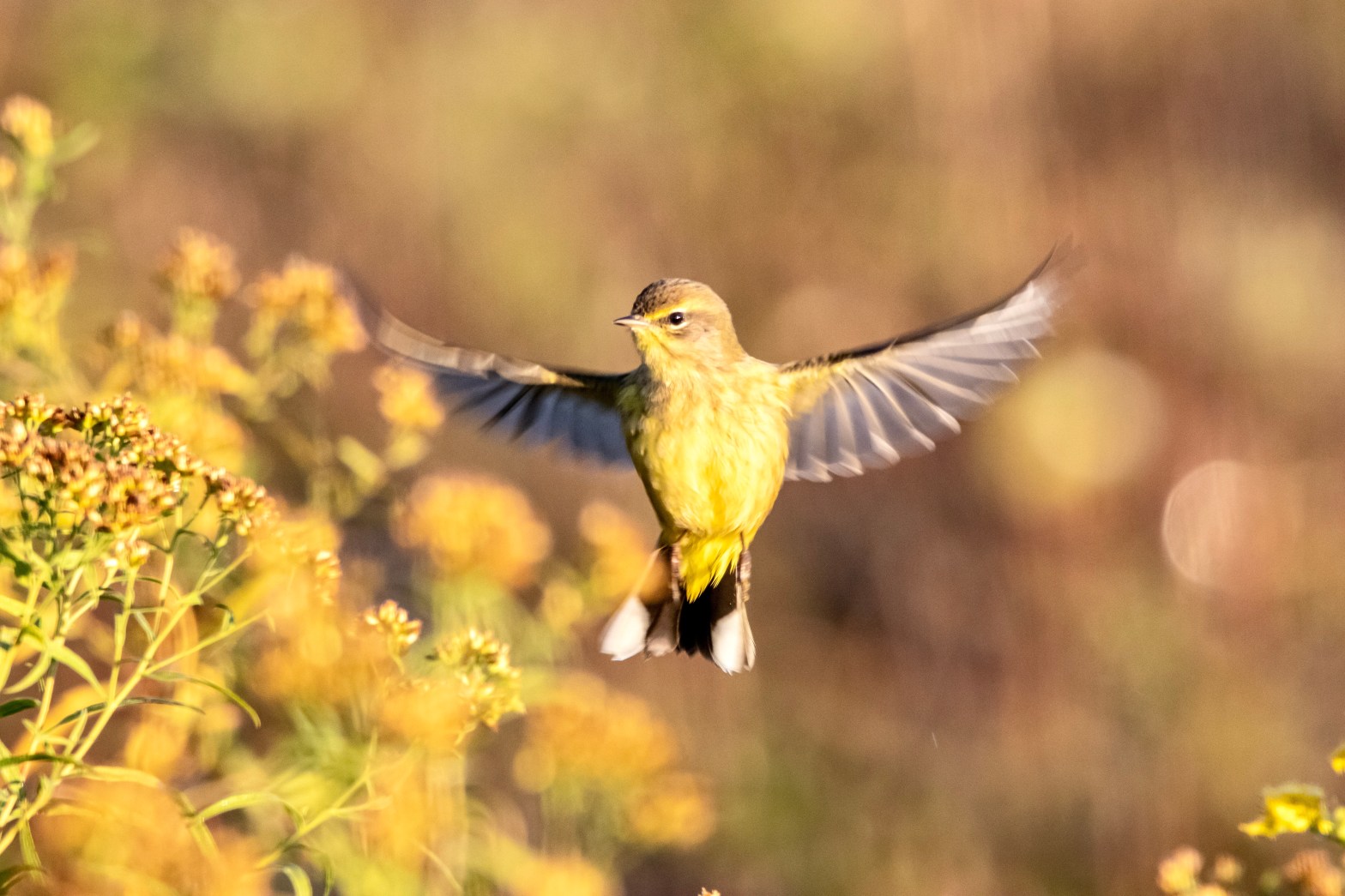
In the afternoon, I stopped at the levee in Morrisville, then headed to Abbott Marshlands back on the Trenton side of the river. There, I was treated to some in-the-leaves antics by a palm warbler, a fantastic way to close out the month.

Palm warbler coming in for a landing at Abbott Marshlands, Trenton.

I’ll admit to feeling a slight bit of relief on finishing. I birded every day, heading out on most of them. On a few days, I was limited to from-the-windows observations at home due to weather and other circumstances.

What did I learn over the course of the month?

I learned that while racking up numbers was a good challenge, it’s not really what drives me.

At one point out at the Pole Farm, I spotted a Savannah sparrow and heard myself say internally, “who cares; I’ve already logged them for the month.” Immediately, I chided myself. Seeing that sparrow was a joy just as great as seeing the first ones I’d checked off on a list a few days earlier.

So what drives me as a birder?

It’s is the pleasure of seeing birds as they are, wonderful friends and neighbors, in great varieties of shapes, sizes, colors and behaviors, inhabiting and enriching our world.

And if they hang around just a few more seconds to let me photograph them, that’s even better.

One of the big surprises for the month was this ring-necked duck and its mate, floating on Spring Lake at the Abbott Marshlands.

Everything’s bigger in Texas, and so is my life list

While I didn’t add a huge number of birds to my “Big Month” count, my trip to Texas did net me four lifers, two that I had seen before but never recorded and two that truly were new sightings for me.

I racked up a modest 21 species in College Station during the six days I was in the Lone Star state, adding six species to my count for the month.

The true lifers were a white-winged dove and a spotted sandpiper. I saw both at Gabbard Park, a small but delightful city park with a pond in the middle.

Northern mockingbirds were plentiful in Texas, including this one perched on a fence near my daughter’s home in College Station.

I also logged lots of barn swallows and great-tailed grackles, both of which I had seen before, the former many times many years ago and the latter on several visits to Houston. I never did get a photo of the males, who have more pronounced “great tails” than the more slender, brownish females. Fittingly, I got photos of the females on a “ladies night out” in the parking lot of Chuy’s, a popular Tex-Mex restaurant, at the Post Oak Mall.

My other additions to my “Big Month” list were white-eyed vireos and blue-gray gnatcatchers.

Having flown home to Newark Liberty Airport last night, I could not resist the call of the wild when I woke up this morning. I headed to my happy place, the Pole Farm, and saw my first-of-the-year ruby-crowned kinglet. It was tucked away in a thicket in the woods, and I was only able manage a fuzzy frame with my camera that wasn’t worth sharing.

I had heard a brown thrasher at Lick Creek Park in College Station one morning but never did see it. That made things extra special this morning when I spotted one high up in a tree. My photos turned out better than expected, and I’m sharing one here.

Also today, I finally saw a white-breasted nuthatch at our backyard feeder. The bird was a long time in coming, and it brought my count for the month up to 58. I’m closing in on my goal of 60. I have two weeks to go to reach it, and the warbler migration is just beginning.

I’m counting on this week bringing more surprises and even more joy.

A brown thrasher makes his presence known high up in a tree at the Pole Farm side of Mercer Meadows park.

Howdy from Texas — they have birds here

The great-tailed grackles are out in force here in the Brazos Valley of Texas, and it almost seems as if they outnumber the bluebonnets and other wildflowers blooming in spectacular clusters along the highways I drove from Houston airport to College Station.

What starlings are to many areas of the country, the great-tails are to this part of East-Central Texas. Quiscalus mexicanus is passim, that is, everywhere : strutting on street corners, chattering from the trees by strip malls, darting in and out of city parks. As I stepped out of my car at a Whataburger for an after-school milkshake break with our granddaughter, a female long-tail was in the grass about 10 feet from me while three males were jabbering in a tree nearby.

Having seen them in Houston a few years ago without realizing what they were, I knew this time I would see great-tailed grackles and add them to my life list. From scouting e-Bird listings for Brazos County and the Bryan-College Station metro area, I figured I’d also have a good shot at seeing barn swallows.

A barn swallow, on my daughter’s lawn in College Station, Texas, April 11, 2022.

I had no idea how easy it would be. As I stepped out of the front door of my daughter’s home this afternoon, two barn swallows were poking around her front lawn. As quickly and quietly as I could, I pulled my camera out of the trunk of our rental car and was able to snap a few frames while others winged their way up and down the block.

White-winged dove, College Station.

Today’s other highlight was my first white-winged dove, which my wife and I spotted early in a short walk around delightful Gabbard Park, not far from the Texas A&M University campus. (I’ve had that Stevie Nicks song “Edge of Seventeen” — “just like the white-winged dove” — stuck in my head all day.)

Although the grackles eluded my lens all day (too fast, they, and too impatient, I), I was able to get a few decent shots of mallards at Gabbard Park.

Mallard mates in the grass at Gabbard Park, College Station.

I was puzzled to note that the heads of the two of the males were purple, not the usual green. I found one seemingly definitive report earlier today on the web (no pun intended!) that it’s breeding plumage for male mallards, but I can’t seem to finding anything conclusive as I write this post. More research needed!

The purple-headed mallard, or so it would seem.

Some days, the birding gods smile upon us

One-third of the way through my “Big Month,” it’s time to assess my progress. Having set 60 as a “reach” goal, I find I have a legitimate shot.

Yesterday was a particularly encouraging day. I headed out to the Pole Farm, hoping to find one of the “should have” birds, the common grackle. I was just about finished with my route, maybe 200 yards from my car, when I spotted a black bird land in a field to my left. Was that a flash of iridescence?

It was. A common grackle for sure, one glimpse in the binoculars confirmed. Another grackle landed on a small tree, and a few more may have lurked farther back.

The biggest surprise was yet to come.

Late in the afternoon, I headed to the Abbott Marshlands at Trenton, a good spot to see waterfowl. Almost immediately after getting out of the car, I spotted three mute swans on Spring Lake to one side, and another in the nearby marsh sitting on what appeared to be a nest. I’d see two more on the day, and I was happy, satisfied to add a new bird for the month but hoping to see a bald eagle. I’d seen one the last time I was at the marsh.

Heading up the trail, I noticed a large bird high up in the distance. An eagle, I wondered, my pulse quickening.

An osprey in flight
Way up there over Spring Lake, an osprey, April 9, 2002.

No — osprey. No doubt about it. I thought I had already seen one this month, but a check of my logs would show that was in March when I last saw one.

One more bit of luck lay ahead. I decided to walk around the lake to get a better shot at the swans. That was not to be, but I spotted two duck-like birds swimming away from me. I got a fleeting glimpse of one of their bills, and I saw white. A coot or scaup, maybe. I would need to get a look from another angle.

A few minutes later and a few hundred yards down the trail, through my binoculars I could see a male to the right and what surely was its mate to the right. She was brown, he was black with white sides, and his bill had some white.

I pulled up my camera, zoomed all the way in and snapped a couple of frames. I then pulled up the image and zoomed in — a ring-necked duck! Another lifer for me.

Now it’s off to Texas. What wonders await?

Ring-necked duck, seen from a distance.
Poor photo but proof of a ring-necked duck.

Five days in, my ‘Big Month’ takes shape

Last night I finished reading the “Big Year” book on which the movie of the same title was based. I’m comfortable in reporting that I am not quite as obsessively crazed as the three competitors on whom the story is based who each sighted more than 700 species of birds in 1998.

It was on Day Two of my self-declared “Big Month” quest that I realized my birding habit is not primarily about checking off another species on my life list. Yes, I’d like to claim more birds, ideally seeing several new “lifers” over the 30 days of April 2022. But that’s not what drives me.

Ring-necked pheasants on parade at the Pole Farm on April 4, 2022.

My epiphany came at the Pole Farm on Saturday. I had just strolled along the main path out of the parking lot with Old Sam Peabody and Blonde-Crested Warbler for a good half hour and turned back toward my car. I thought momentarily that I don’t care if I don’t see any Savannah sparrows that morning because I’d already logged them the day before.

Male Northern cardinal in a tree.
Northern cardinal at the Pole Farm on April 4, 2022.

Immediately, I thought that was wrong. I want to revel daily in every species I see, either for the first or 400th time. That Northern cardinal chirruping in the tree over yonder deserves as much respect as the ones I saw in my yard as a kid in Cleveland decades ago.

So far, in just five days, I’ve managed to log 42 species in April, which, as my college pals from Massachusetts would say, is off to a “wicked fast” start (kindly drop the “r” as you say “start” aloud).

Some of the highlights include my first-of-the-year chipping sparrows, fish crows today and on Saturday, and white-throated sparrows at home, at the Pole Farm and — to my extra delight — in a construction zone on the Princeton University campus this afternoon.

In a break between raindrops in New York City on Sunday, I spotted some sort of warbler in Central Park that I could not identify. Today’s camera-confirmed sighting of an American kestrel was ample compensation.

I have yet to log a lifer this month, and I’m hoping I’ll score several in Texas next week. Meanwhile, I’m waiting for an overdue white-breasted nuthatch to show up at the backyard feeder, and I’m wondering how I’ll sneak in some sightings on what promises to be a rainy day tomorrow.

Again, numbers matter, but the satisfaction of seeing the diversity of the birds around me matters more.

Some of the 15 wild turkeys I spotted at the Reed Bryan side of Mercer Meadows park on April 5, 2022.

Big Year? I’m going for a Big Month

This is how an obsession starts. A few weeks back I watched “The Big Year,” a comedy about the crazed antics of hyper-competitive birders. Then I bought the book of the same title on which the movie is based, and I’m halfway through reading it.

I’m neither wealthy nor a man of leisure, so a “big year” of traveling the U.S, Canada and Mexico spotting as many birds as possible over a stretch of 365 days is out of the question.

But what about a “big month?”

That I can do, and I started my pursuit on, yes, April Fool’s Day.

This fool’s errand for these 30 days is to bird daily and accumulate sightings of as many species as possible. I have trips planned into New York City and Texas in the coming days, so odds are strong I can expand my totals beyond the usual suspects here in central New Jersey.

It was rainy and blustery after dawn this morning, and I decided that rather than head outdoors, I’d take my chances counting the birds that I’d observe from home.

I got off to a surprisingly strong start, spotting 15 species in our front and back yards and extending another acre or so on the golf course adjoining our property. The usual crowd arrived before my breakfast: house sparrows, house finches, robins and blue jays, and a single song sparrow. Dark-eyed juncos, not yet departed for more northerly climes, put in an appearance, too.

This chipping sparrow arrived around 8:115 a.m. on April 1,2022.

The surprises were a white-throated sparrow pecking below the front-yard feeders and, even more delightful, my first-of-the-year chipping sparrow that came ’round back. The chipper appeared during a brief burst of sunshine and parked long enough at the feeder for me to get a couple of nice photos.

The morning total was 42 birds across 15 species.

Any hesitation about doing a second count on my return from work ended before I got to the front door. As I strolled up the driveway, I heard the sweet “chick-a-dee-dee-dee” song of a chickadee. It was perched on our weeping cherry tree.

But black-capped or Carolina? Standing still, I whipped out my iPhone and triggered the Merlin sound app in time to hear another ditty from the chickadee. The app pegged it as black-capped, and that’s how I logged it on e-Bird. Of late, I usually mark them as Carolina/black-capped because we live in a crossover zone. But for my big month, I’m logging as per the app.

My late afternoon observations included 11 species and 70 individuals, with a big number of robins and starlings driving up the latter number. The afternoon count added the chickadee and some brown-headed cowbirds to my day’s species total, bringing it to 17. In all, I spent just shy of an hour actively observing.

I plan to get out to the Pole Farm in the morning and hope to pick up a few more species there. I’m banking on a trip to Central Park in New York and especially a weeklong visit to Texas to add substantially to the total.

Do I have goals? I’d like to add at least five birds to my life list, and I have this crazy notion that I could hit 60 species. That’s highly unlikely, but maybe I’ll pick up a few tips from the “Big Year” book. It calls to me now.

A walk in the woods with the experts

I was back at the Pole Farm this morning as I often am on weekend mornings, but this time I wasn’t going solo. I was a last-minute substitute for a friend on a Washington Crossing Audubon Society guided walk, and what a treat it was.

About 20 birders assembled at the Cold Soil Road parking lot at 8 a.m., and leaders Jim and Fairfax took us on a leisurely meander through the park. In three hours, we counted a whopping 31 species, by far the highest total I’ve ever logged in a visit to the Pole Farm. The count may have been higher, as a few of us split off from the main group toward the end to get back to our cars a little earlier.

A red-tailed hawk soared overhead far out on the trail. We saw at least three, by my count.

The guides were great at spotting birds and tipping us to those we might see on subsequent visits (calling all owls and snipes!). One of the highlights today was an osprey soaring overhead with a number of turkey vultures. That’s something I would never have noticed on my own, and I might also have overlooked (or, more literally, underlooked) the three great blue herons that flew overhead.

The weather was a bit odd, with copious cloud cover, limited sunshine and an occasional sprinkle of rain. I didn’t shoot a lot of photos, but that’s OK — there was plenty of chatter on the trails to keep us engaged.

A song sparrow perched atop a small tree.

One of the best things about the walk was the camaraderie and the crowd-sourcing: 20 pairs of eyeballs scanning from foreground to horizon in all directions make for better birding. That worked not only for spotting the birds initially, but helping each other locate them once someone in the group had called out “meadowlark!” or “harrier!”

I joined the Audubon Society last year and just renewed, and now I’m on mailing lists to alert me to upcoming guided tours. I look forward to the next one, and the one after that, and the one after that….

Note: My eBird count for the visit shows 30 species, but it doesn’t formally acknowledge the chickadee we logged as Carolina/Black-capped, as our slice of New Jersey is in a crossover zone between the two varieties.

One great bird: the Northern harrier

Four birds with “Northern” in their name are regular visitors in my part of New Jersey. The Northern cardinal is ubiquitous at home, and the Northern mockingbird and Northern flicker are regulars in the neighborhood. But the most thrilling of all is the Northern harrier.

To find a harrier, all I need to do is drive two and a half miles to my favorite hot spot, Mercer Meadows, either on the Pole Farm or Reed-Bryan Farm sides. Throughout the year with the exception of the warmest months, you have a fair to excellent chance of seeing at least one harrier swooping over the meadows in search of voles and other prey.

The first one I saw was three years ago in mid-February, and it was my wife who spotted her on the ground on one of the big fields that you approach as you walk into the Pole Farm area from the Cold Soil Road parking lot.

My first harrier photo, from February 2019.
The Gray Ghost soars across a field at the Pole Farm, Jan. 21, 2022. Note the white rump.

Most often, I see the harriers in flight, and they are instantly recognizable by their white rumps contrasting with their darker plumage elsewhere. The harriers often take a break between hunting forays by perching on a tree limb or sitting atop the bird boxes on posts jutting out of the fields.

If you want to see a harrier for yourself, you have a roughly equal chance on either the Pole Farm or Reed Bryan sides of the park. If you have one shot at visiting, I recommend the Pole Farm. The harriers fly during the day, and I’ve seen most of them between sunrise and 10 a.m., and in late afternoon leading into sunset. (I don’t generally go in the middle of the day, because of other commitments and also because the light for photography isn’t as warm as it is at early and late hours.)

Both sides of the park have large fields covered with native grasses most of the year, although at certain points the grasses will be mowed down to promote new growth. Each year there typically are controlled burns on several acres, alternating patches year to year, which also promotes new growth. Grass or no grass, the harriers know they’ll find prey every day.

Bird boxes serve as perches.

Most of the harriers I’ve seen at Mercer Meadows are females, but I have caught a few glimpses of the more furtive male, aka “The Gray Ghost.” I’ve only been able to snap a single photo of one, and it doesn’t do the bird justice.

I’ve been visiting the park long enough to know that patterns of the birds vary from season to season, year to year. From November of 2020 through February of 2021, scores of birders and photographers came out to the park in the hour before sunset to observe and take pictures of several harriers cruising over the fields. From last fall to now, only a few photographers come out for harrier shots, if that. Although I’ve seen more than one harrier a few times in recent months, typically I see only one.

But even one is a thrill.

Obsessive and competitive: ‘The Big Year’ birding movie

My Amazon Fire Stick must be figuring me out because its “movies you might like” prompts alerted me to “The Big Year,” a 2011 comedy about a trio of birders who obsessively pursue as many sightings as possible.

Appropriately, the odious villain — Kenny Bostick (Owen Wilson) — is a Jersey guy.

As the movie opens, Bostick frets that his record of 732 sightings will be challenged and broken by somebody else. He and his wife are trying to conceive a child, and Bostick repeatedly disappoints her by dashing out of their Montclair home every time a rare bird is sighted or a major storm brings an abundance of birds to a particular area, including a landfill in Texas.

Stu Preissler (Steve Martin) is a New York executive who can’t quite fully cut the cord to the company he runs any more than he can resist the urge to pursue a bigger bird count. In contrast to Bostick, he is devoted to his wife, who accepts and supports his incessant travel to find birds.

Brad Harris (Jack Black) is a financially challenged birder at odds with his father who decides he’s the one who’s going to overtake Bostick as the best birder in North America.

The three men each set off on a “Big Year” quest and soon enough encounter one another on the trail. Bostick and Preissler converge over a garden gnome in British Columbia in pursuit of a rare hummingbird. Harris (for whom Black nicely tones down his manic portrayals of the obsessed) enters the fray and is the first to confide, over dinner and drinks with Preissler, that he is indeed pursuing a “big year.” Bostick and Preissler play coy about their intentions but eventually reveal them.

How these three bird-obsessed men manage to finance their travels (even the wealthy Preissler) requires a bit of suspension of reality. But once you buy into it, the game is afoot and believable for an hour and 40 minutes.

The movie takes birder obsessions to extremes but there are some underpinnings of realism, at least as I’ve known in my birder development.

In one scene, a colleague doesn’t understand Preissler’s devotion to “bird watching.” Preissler replies tartly that it’s not “bird-watching” but “birding,” an active pursuit. In another scene, a British birder notes how only the Americans could turn birding into a competition.

I’d be lying if I said there’s no competitive aspect to my birding. I check to see my ranking at the hot spots and hope to move up, not so much to compete as to demonstrate that I’m gaining knowledge and experience. But that’s a mere fraction of my pursuit, which is based on a love of birds and other wild creatures and on the enjoyment of learning from and with others as we take in the natural world.

Maybe I’ll formally pursue a “big year” when I retire, but I don’t expect I’ll be flying to the Aleutian Islands or pursuing a hawk by helicopter in the Ruby Mountains of Nevada, as the characters in the movie do.

To me, every year is a big year, in its own small way.

Birding down the shore at Barnegat Lighthouse State Park

As I watch the snow fall out my window at home today, I am still glowing over the trip yesterday to Barnegat Lighthouse State Park at the New Jersey shore. My friend and colleague Laura and I had been plotting to hit the coast for a look at shorebirds, and when both of us had meetings canceled Friday, we seized the opportunity. I was hoping to see new birds, and Laura was hoping for Harlequin ducks.

In contrast to today’s wintry conditions, yesterday’s weather was sunny and flirting with warm. A short walk from the car past the lighthouse brought us onto a long concrete jetty, and we instantly had plenty of birds capturing our attention.

Several dozen long-tailed ducks were floating and diving in all directions a short way out in the water. I was so busy getting photos of them and red-breasted mergansers that I overlooked getting shots of a couple of red-throated loons. No matter — I added all three species to my life list.

Red-breasted merganser.
Long-tailed duck, with the tail trailing in the water.

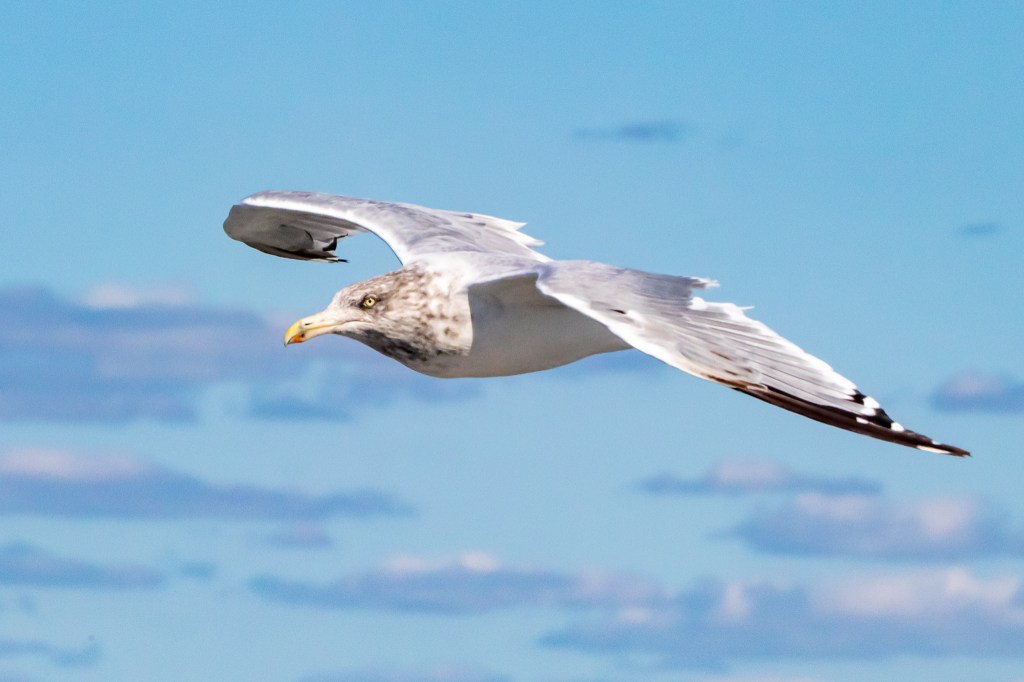
A few herring gulls flew by as we worked our way across the jetty, and at one point Laura hustled back to her car to retrieve her spotting scope. We used it to zoom in on individual birds and to see across the bay to the spit of dunes at the end of Island Beach State Park.

The scope came in handy as it helped us figure out that the intriguing black and white bird off shore was not a murre (there had been recent sightings) but a razorbill.

Look at that gnarly beak! A razorbill floats in Barnegat Bay.

We encountered a few other birders on the path, including an Audubon guide Laura knew from previous tours. We soon learned that Harlequins were swimming and sunning themselves along the boulders that extended the jetty to the bay’s edge.

We were able to see them (my first!) from afar with our binoculars, and we boulder-hopped to get a closer view. It turned out there were five, and we were careful not to spook them by coming too close. You can see them in action in the 15-second video below.

The Harlequin male is one of the most exquisite birds on the planet.

Farther down the line Laura spotted a sparrow, and I was able to get a few good photos of it. I was guessing song sparrow, but Laura was skeptical. Another birder came by and said authoritatively that it was a Savannah sparrow, a regular visitor at the park at this time of year.

I was puzzled that the bird didn’t have the usual Savannah streaks of yellow. Later in the day I determined the reason was that this was the Ipswich variety of the Savannah common to the Atlantic coast, not the standard Savannah common in the fields near home.

Savannah sparrow, Ipswich sub-species.

Laura and I spent a good portion of our walk trying to figure the different markings between the red-throated loons and the common loons, which we also saw. The IDs are trickier when the birds aren’t in their breeding coats. I did manage to catch with my camera a few of the common loons, one of which dove for a crab snack.

My ID vote is common loon for this bird, and no guess on the variety of crab on the menu.

We walked back toward the parking lot on the sand and from a distance observed a large flock of gulls milling about a stretch of water that amounted to an inland pond. Through the scope we could make out a good number of great black-backed gulls, another official first for me, mixed in with herring gulls.

A couple of brants gave us a fly-by as we finished the return walk on the concrete walkway. A single female Harlequin, with the distinct white beauty mark on her cheek, swam by. We even spotted a few song sparrows flitting at the base of the lighthouse, and a warbler — maybe a yellow-rumped — made a furtive appearance in the pines at the edge of the parking lot.

All in all, we had a 1.5 mile meander over two and a half hours and logged 11 species and 209 individual birds. I added seven lifers, and Laura got to see six Harlequins — just ducky!

View of the lighthouse from the sand. The jetty is off to the right, out of view, and the big gathering of gulls was off to the left, also out of view. Look closely and you’ll see a gull just to the right of the tower.