On Monday the week before last, I didn’t feel right when I stepped out of the car at Mercer Meadows. I felt out of whack and decided to drive home, and called in a rare sick day at work. Later that morning, I tumbled out the back door onto our patio.
This birder was grounded. I will spare you the medical details, but I made visits to two emergency rooms at hospitals, was admitted at the second, and I’m writing from a third, a rehab place where I’m undergoing physical and occupational therapy. I’m improving steadily, and the only birding i can do is by looking out the windows. While in PT yesterday, I spotted a gray catbird outside, which was reassuring.
I will undergo several more days of treatment before I can get home and back out with my binoculars and camera. I miss the birds, especially the common yellowthroat topping this post, who often sings me a morning song at the Pole Farm.
No photo tops this post because on my last birding outing I took no photos of birds. In fact, in my 30-mile drive south to Palmyra Cove late this morning, I only saw three of the meager 14 birds I observed across seven species.
That’s it. Two cardinals in flight, and a third bird (probably a red-eyed vireo) that was tantalizingly close in a tree right in front of me. I couldn’t focus my binoculars quickly enough before it flew off.
It was hot and humid. I was sweating profusely and dragged a bit on the back end of a two-and-a-quarter mile walk. Not even a single gull flew by.
A bad day, right?
Wrong!
There are no bad days in birding.
Even if I had neither seen nor heard a bird, I had the privilege of walking through wooded paths and strolling along the sandy beach of the tidal Delaware River, the Philadelphia skyline in view — on Independence Day, no less.
I’ve made a few afternoon trips out to Mercer Meadows Pole Farm and found so few birds that I returned to my car and didn’t log the visit on eBird.
But those days are rare, and although they are a little disappointing, I still appreciate them because they bring me outdoors.
I have lived my life in cities and suburbs, and I’ve always wondered what it would be like to be “outdoorsy.”
I’ve become that over the past few years, with the gear to prove it: trail shoes, hiking boots, hunting boots, floppy hats (one with a havelock), a rain hood for my camera, and more.
For my transformation, I credit the birds. They enrich every day, even if only a few of them reveal themselves to me.
For the past two weeks, a male dickcissel outside his normal range has been visiting the Reed Bryan Farm section of Mercer Meadows park, singing throughout the day to attract a mate.
So far, no females have replied, at least according to the dozens of birders who have come to the site to see this unusual visitor.
Dickcissels migrate from the Northern tier of South America through Central America and breed in the American Midwest, although some pass through sections of the East Coast.
Two years ago, one dickcissel showed up at the Reed Bryan Farm, drawing lots of birders to see what eBird lists as a rare bird for this area. Last year about this time, several dickcissels spent several weeks on the Pole Farm side of Mercer Meadows, and I was pleased to see them.
The bird most often sings from the bare branches at top right.
When the one arrived this year, I quickly went out to spot him, and he did not disappoint. He was easily seen and even more easily heard from the Reed Bryan parking lot, clinging to his favorite perch in the bare branches atop a big tree beside the lot.
I spotted him again this morning but he flew off into the fields before I had a chance to photograph him. The light was poor, and I needed to walk back to my car at the Pole Farm lot, so I didn’t stick around either to wait for him to come back or to seek him out in the fields.
Looking for love on a Sunday afternoon, July 2, 2023.
Knowing that the bird has been spotted many times in the afternoon, I kept a wary eye on the weather and headed back to Reed Bryan about 4 p.m. It’s only a 10-minute ride from home, and the moment I opened the car door after parking, I heard the bird’s clear, insistent song. He was atop the tree as expected, and I took several shots, including the one topping this post.
After a few minutes, he stuck to his pattern and flew off into the field on the opposite side of the parking lot. It took me a few minutes to spot him, eventually finding him straddling a branch about 30 yards away.
The dickcissel spreads his wings.
He flew off again, I believe to the field to the right of the trail that heads downhill from the parking lot. I milled about for a few minutes until a rain storm blew in, and I made a short dash to the shelter of my Subaru.
The dickcissel probably will stick around another week or two. If you’re looking for him, I hope you find him. And I hope he finds a suitable companion, because all of us need love.
I know you’re out there somewhere. The dickcissel seeks a mate.
Most days when I’m out birding, I’m a loner. I’ll stop to chat with passing birders, of course, sharing tips on what I’ve spotted and hoping they’ll share something I’d like to see. But I enjoy my own company, if you will, and I’m perfectly happy to pursue my birding in solitude.
But then there are mornings like today, when my friend Laura joined me on a visit to Mercer Meadows, on the Reed Bryan Farm side opposite the Pole Farm. Our mission: to make sure Laura spotted the well-traveled dickcissel that’s been hanging out at the parking lot for several days, singing up a storm.
Dickcissel singing June 25, 2023.
The moment I opened the door to the car, we heard the bird. The little Pavarotti was predictably perched near the red barn at the head of the trail, singing loudly from bare branches at the top of the tree.
The instant find took a bit of drama out of the trip, but we were perfectly fine with that. We also noticed the gathering of European starlings in and around the big tree, and then Laura spotted something new. High up in the trunk of the tree was a round hole where starlings were nesting, with the parents flying in and out.
A starling in the nesting cavity, above the Reed Bryan Farm parking lot.
I’ve parked in that lot scores of times and seen hundreds of starlings in that tree, but I’d never noticed a nesting cavity. Score one for the eagle-eyed Laura, who was just warming up.
We walked downhill from the parking lot on a path bisecting two large fields. At the bottom of the hill is a footbridge over a small creek, and after crossing it you must turn left or right. We stopped at the intersection, looking around, hemming and hawing on which way to go.
A maple tree towers over the intersection, and at some point I spotted a yellow-breasted bird that flew into its branches about the time our Merlin sound apps lit up with “great-crested flycatcher.”
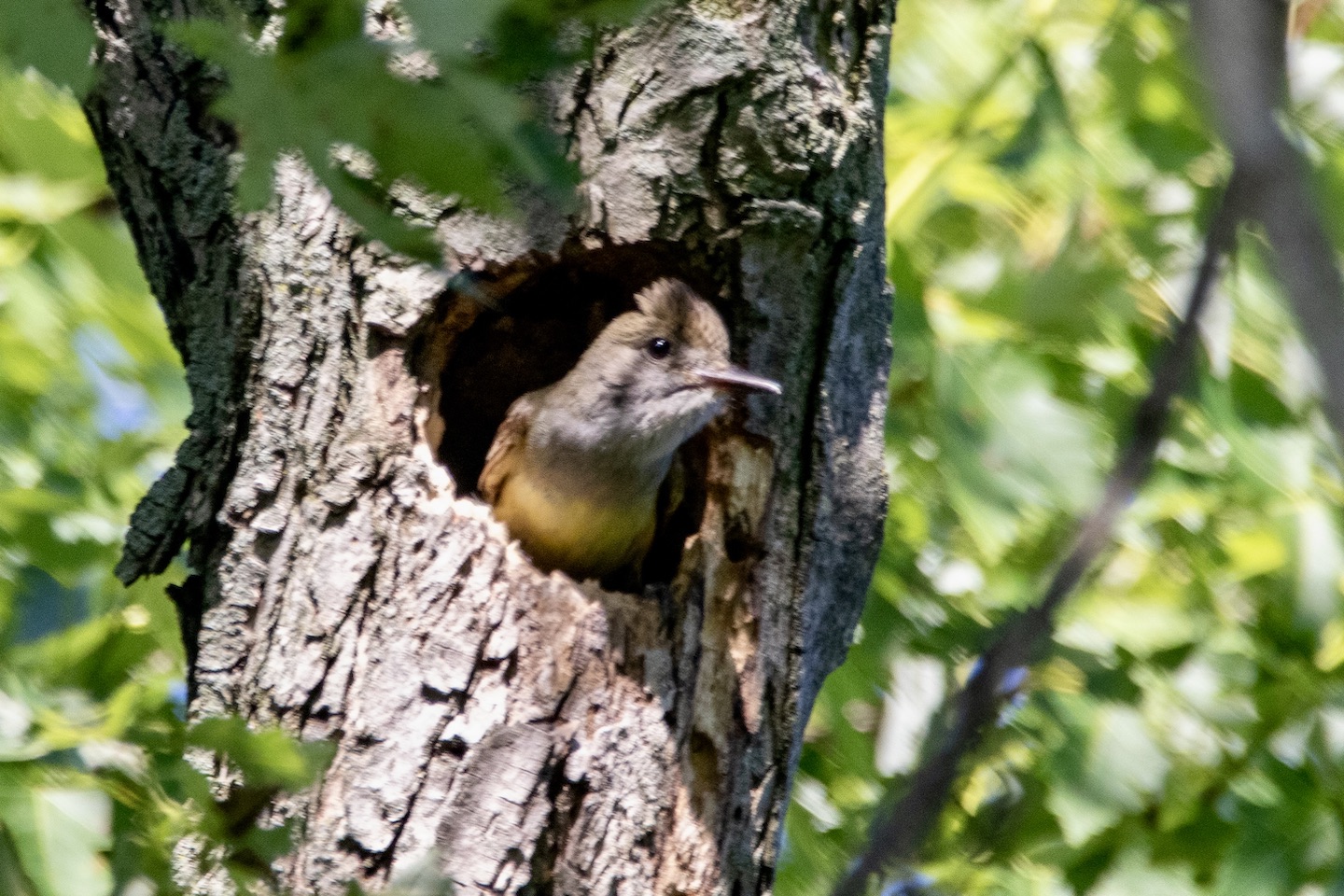
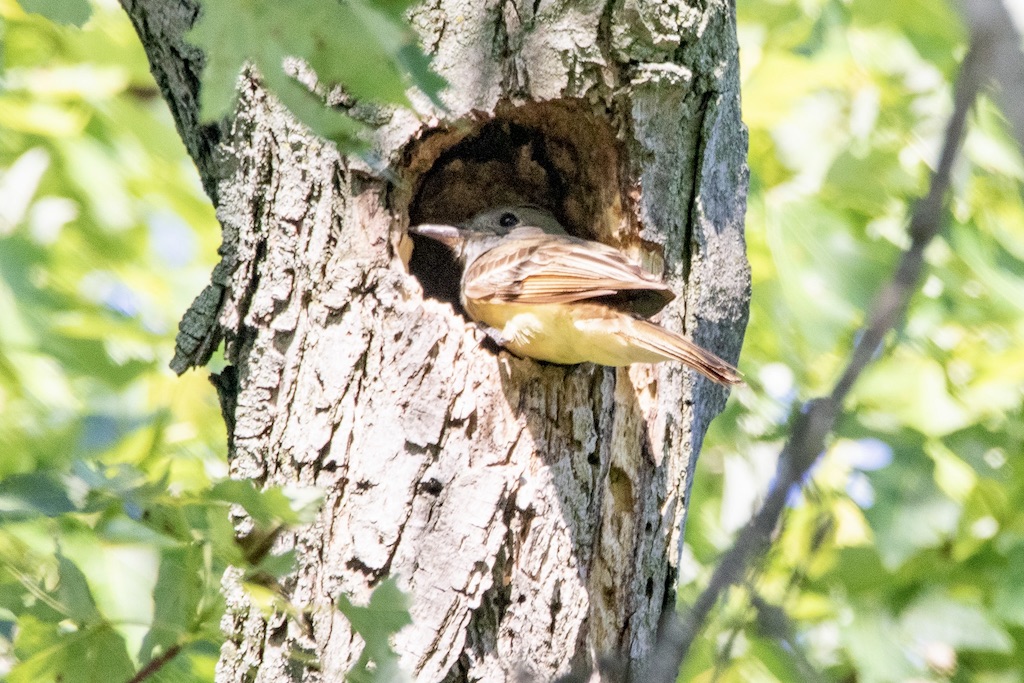
I can’t recall exactly how things played out, but it seemed there were two flycatchers coming in and out of the tree. Then Laura spotted a round opening in a dead spur of the trunk, about three-quarters of the way up the tree.
A nest!
Mom or Dad Flycatcher, perched on the edge of the nest.
The flycatchers were coming in and out to feed their young. They flew off in a couple of directions to our right and would be gone a few minutes before reappearing and popping into the cavity in the tree. We couldn’t see the little ones, but it was obvious that the parent birds were carrying food and stooping down from the edge of the nest to feed their brood. I took several hilariously terrible photos of the back half of the body and the tail of one of the parents, but I’m quite pleased with the photo at the top of this post. You can see the crest on the bird’s head as it emerges from the nest.
Would I have spotted the flycatcher nest on my own? Almost certainly not. Impatient sort that I am, I would have been wondering what the yellow-breasted bird I’d seen was as I moved on, hoping to catch a glimpse down the trail.
The same went for the starling nest. Most times, I glance up at the tree, do a rough count of the starlings, enter it in eBird and head off in search of birds uncommon and more colorful.
The lesson here is obvious. Four eyes are better than two, especially when the extra set is peering through a pair of high-end binoculars. Just as my friend Andy helped me find a scarlet tanager nest, Laura was the one who spotted the two nests today.
Even without the nests, strolling together, straining to hear a wood thrush and tapping each other on the arm to say, “Is that a …?” makes the outing more enjoyable.
A great-crested flycatcher flies out of its nest in a tall maple tree, heading out to find food for its little ones.
A surprise request came in to my mailbox several days ago. The real estate firm Redfin asked me to contribute some words of advice on how to attract birds to your yard.
I’d been considering a post on that very topic, so here’s what I submitted:
We’ve set up a triangle that attracts a colorful variety of birds to the yard at our suburban home. We started with a spring-loaded, squirrel-proof barrel feeder, the best choice if you can only do one feeder. We added a bird bath and then a double-hook pole with a finch feeder and a suet feeder. In the summer we swap a hummingbird feeder for the suet feeder, and in winter we put an ice melter in the bird bath.
The birds move from station to station as they please, and it pleases us to watch what shows up over the course of a year, cardinals and woodpeckers year-round and the occasional surprise visitor like the indigo bunting or rose-breasted grosbeak. Keep a bird book handy or get the Merlin bird ID app. You’ll be delighted with what you see!
A hummingbird buzzed our living room window last night, reminding me its time to put that feeder out. I’m actually going to put it on another shepherd’s hook we bought. I don’t dare shut down the suet feeder, as I’ll risk attack from the birds who chow down on it daily.
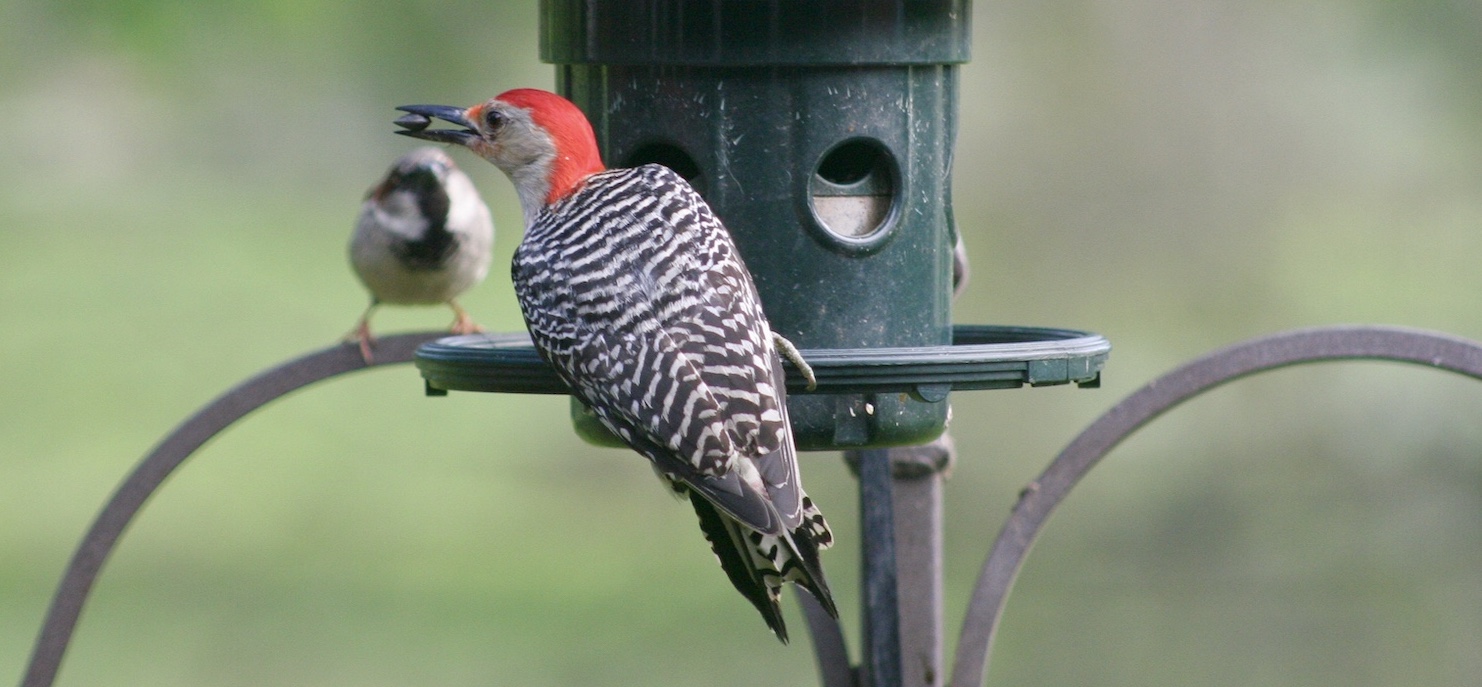
Topping this post is one of my all-time favorite photos, showing a house sparrow waiting as patiently as a sparrow can (which isn’t much!) for a red-bellied woodpecker to exit our Squirrel Buster feeder.
Here’s the Redfin blog post by Redin’s Ryan Castillo, to whom I’m grateful for the opportunity to contribute. His post includes a reference to my advice on squirrel-proof feeders.
As often as I walk the trails of the parks near home, I’ve spotted only a few bird nests. I was fortunate last week to come upon my friend Andy in the woods at the Mercer Meadows Pole Farm, who told me he knew where a pair of scarlet tanagers were nesting.
We walked over to the site and had a bit of trouble finding the nest, but eventually I spotted it about 10 feet off the trail in the middle of a horizontal branch about 15 feet up a tree.
Female tanager on nest June 15, 2023.
To our delight, the female was sitting on the nest, poking her beak above the leaves and giving us a partial view of her. After marveling at the sight, I turned to my side a few minutes later and gasped as I found the male foraging on the blacktop path only a few feet from us.
Andy and I fired off a few shots. As I recall, he got a great shot of the bird in the branches but I wasn’t as fortunate. Andy and I are enthusiastic bird photographers, and even we agreed that if we hadn’t gotten a single shot, seeing those two beautiful birds up close was worth every minute of our trekking that day.
Male scarlet tanager, June 15, 2023.
I went back to the Pole Farm on Monday, hoping to find the nest and the tanagers. I overshot the spot by probably 100 yards when I turned around to see Andy coming up the path, waving me back. I caught up to him right by the nest.
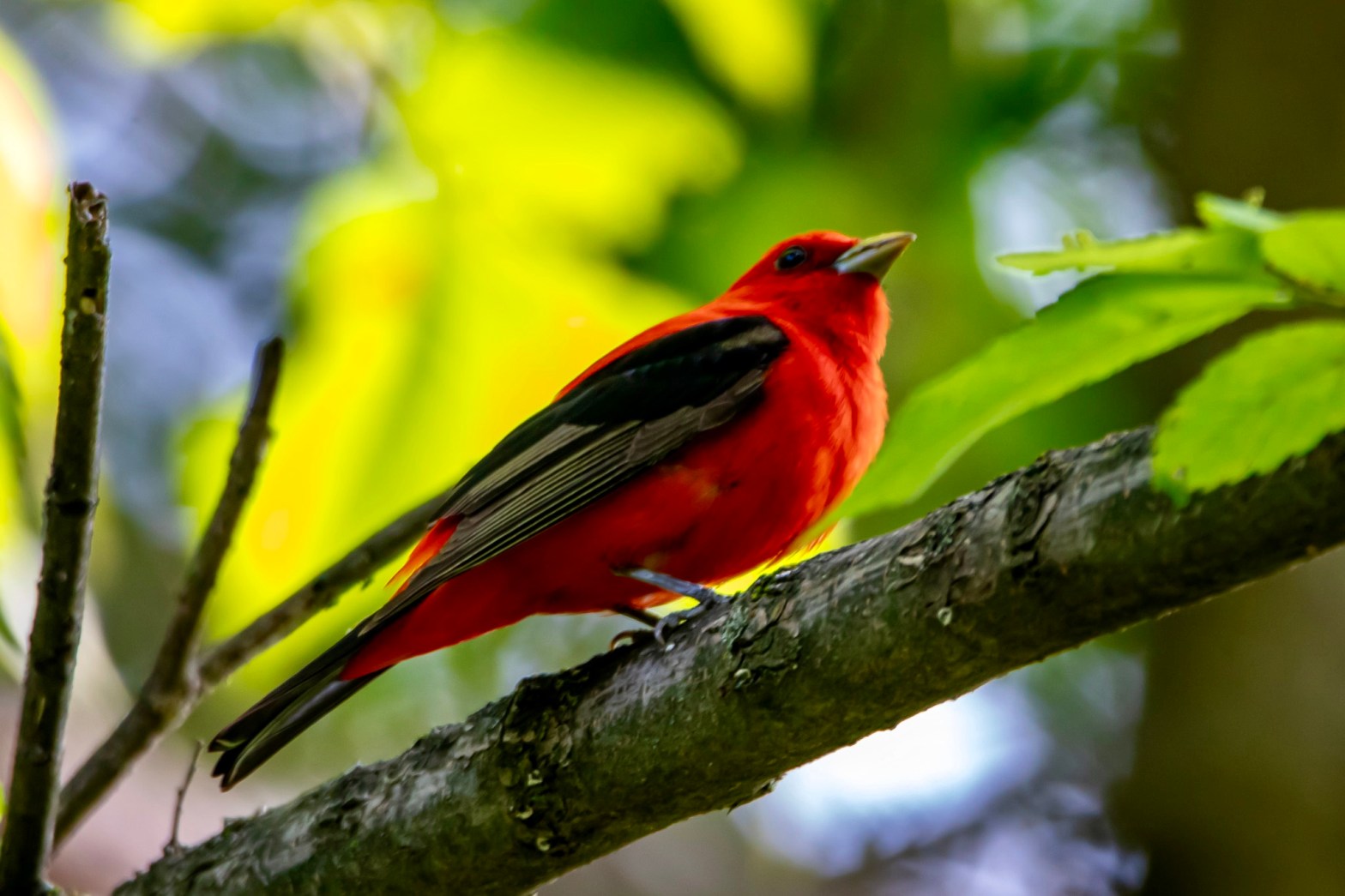
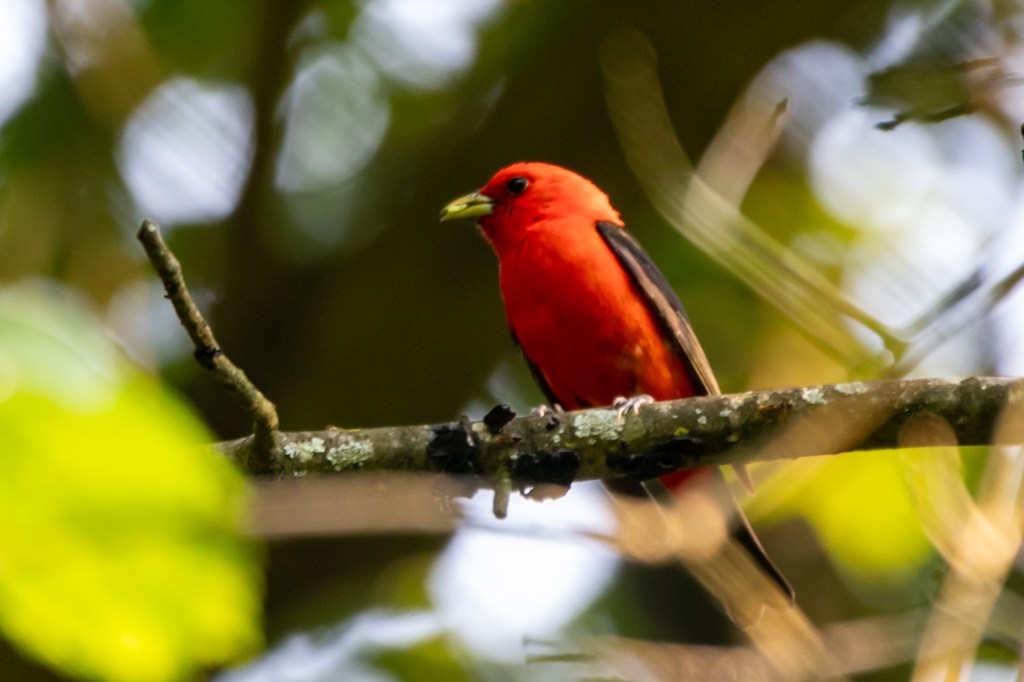
Neither parent was on it, and we scoured the trees for a sign of them. They may have been lurking, and a few other birds came in and out. After about 10 minutes, I heard one of them singing close by, and the Merlin sound app lit up. It wasn’t long before Mr. T landed on a branch just long enough for me to get what I thought was a good shot. The bird bounded about and I squeezed off several more frames. The best of the lot tops this post.
Male scarlet tanagers are striking in their vivid red and black plumage, and whenever I see one I have a sense of intense pleasure and privilege. The yellow females are beautiful, too, in their own way.
Alas, I learned from another birder this morning that the tanagers have abandoned the nest. Apparently their little ones didn’t make it, possibly victims of predators or maybe just plain bad luck.
I hope the couple have moved on to another site and get another chance at raising their young. With luck, maybe some day I’ll spot those offspring as adults, brightening the day with their vivid and thrilling colors.
We birders — most of us, anyway — are happy to share tips on where and how to spot the various birds that come calling in our little corners of the planet. Today’s tip from me is unusual. I’m offering advice on how to avoid a bird, not how to find one.
Last week I was walking the main leg of the red trail at the Charles H. Rogers Preserve in Princeton when a gray catbird to my left started chattering excitedly.
Catbirds are common in my sector of New Jersey. They are frequent visitors to our home (there’s one in the back yard as I type) and to the woods I walk in Mercer and surrounding counties much of the year. Catbirds seemingly pay me no heed, and it’s not unusual for me to see a dozen or more over the course of an hour, often only a few feet away.
I don’t know what was agitating this particular bird, but it seemed to follow me down the path, flying from one tree to another. All of a sudden, the bird darted into the trail from behind me at about a 45-degree angle and buzzed my head. I kept walking, a little faster, and it swooped around and came at me again. I ducked and kicked my stride into overdrive to head down the trail.
After 50 yards or so I stopped at a point where the trail veers to the left at a water company pump house. The catbird was no longer hectoring me and was nowhere in sight. I breathed a sigh of relief.
I didn’t have enough time to take the trail the long way around to get back to my car, as it was a work day and duty called. So I summoned up a bit of bird-resistant courage and started walking resolutely back the way I came, keeping my head down and staying on the far side of the path.
I walked well past where the catbird had attacked and finally slowed to my normal pace, and I started wondering what had set the bird off. My first guess was that I had wandered close to its nest, but if that had been the case, it should have pestered me as I made my way back.
It also could have been coincidence that I appeared at a time it was agitated at another bird or other threat, and I wandered into the crossfire. I’ll never know the reason.
So I will close with this advice: if you hear birds getting agitated as you approach, keep a wary eye out. Should one of the birds come zooming at your head, duck and high-tail it out of the danger zone as quickly as you can.
Saturday morning arrived cool and very, very overcast gray in my part of the mid-Atlantic region. Those conditions can occasionally make for great photos, but often they leave me with dull, muddy images.
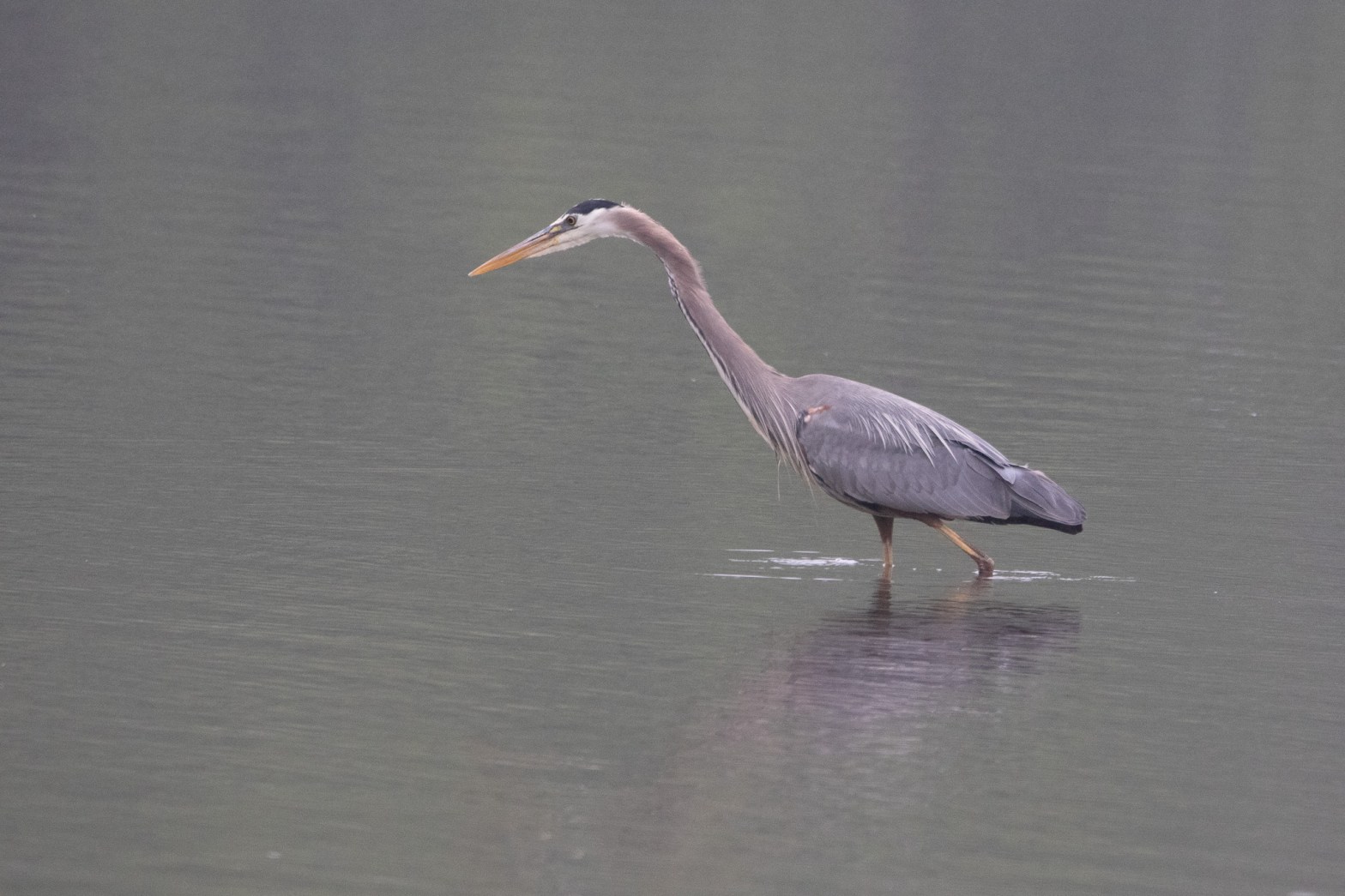
The photo above of a great blue heron stalking in Colonial Lake just off Business U.S. 1 in Lawrence Township is what my camera captured about 7:15 a.m. Other than cropping in about 15 percent of the frame in Adobe Lightroom, what you see is virtually identical to what I saw when I snapped the shutter: a gray heron against a dark surface of water.
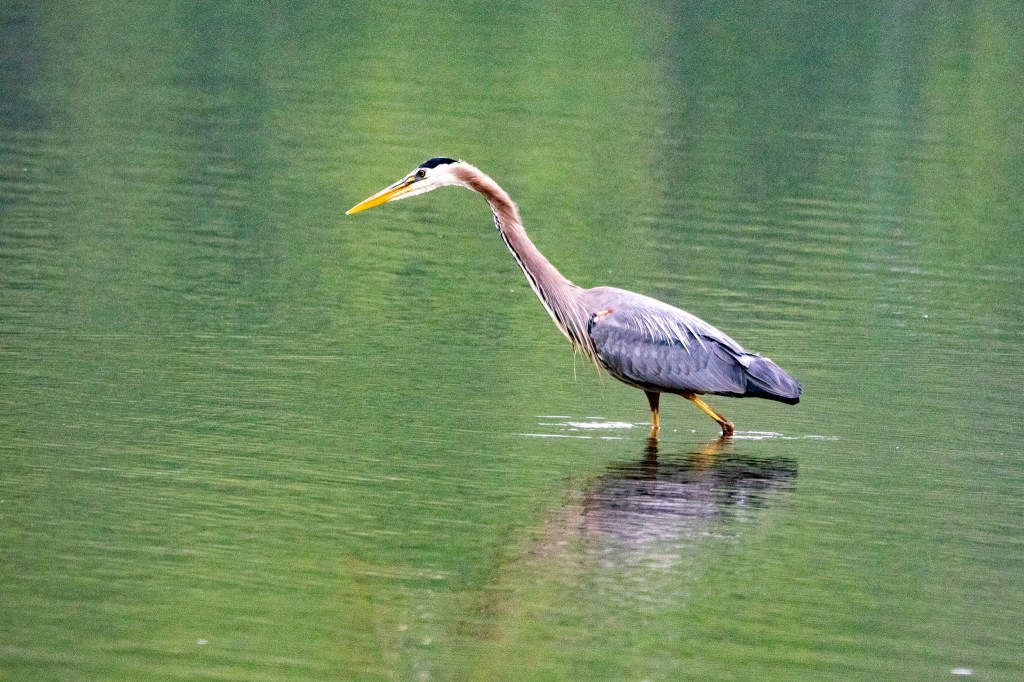
Compare that to what came up when I hit the “auto” button in LightRoom.
Big difference! The bird is a bit brighter but what surprised me was how the surface of the lake has a green sheen. Unless I’ve suddenly gone colorblind, this “corrected” photo gives a false impression.
Since I switched to shooting RAW from jpeg a couple of years ago, I’ve used LightRoom to edit my photos. Under most conditions, I use LightRoom’s sliders to enhance my photos to some degree in an attempt to get an accurate depiction of what I saw in real life.
While I studied art photography in college and graduate school and have a deep appreciation for it, I also trained in photojournalism. While never a news photographer full-time, as a reporter and editor I’ve taken many news photos, usually when I happened onto the scene or took my camera to an event because a “real” photographer wasn’t available.
While I’ve managed to take a few abstract or otherwise arty shots, my style is journalistic. In shooting birds and other wildlife, I try to get the lighting and color right to portray the subject truthfully.
As I scroll Instagram, I repeatedly see ads for apps that will excise exes and cut out other “distractions” from photos. I won’t and don’t do that, although I do crop to remove distracting branches or other elements that draw the eye away from the subject. I’ve also learned to clean up digital noise that shows when I crop in on a distant subject. The noise isn’t part of nature.
Where does one draw the line?
That’s up to each photographer, informed by the purpose of the image. With my photos, I want you to see the bird as it really is, or at least get as close to that ideal as I can.
Spring migration has been a bit of a disappointment for me this year, as I haven’t seen as many warblers as I did last year. I’ve heard them, or more accurately the Merlin sound app has heard them clustered around me, but I’ve had relatively little luck spotting them.
As of the start of this week, I had yet to see a scarlet tanager, not a warbler but a migrant who shows up in these parts in fair numbers year to year. So when I set out on a morning walk the other day at the Pole Farm, I was hoping it would be the day I’d finally spot one.
To change my luck, I decided to walk one of my regular routes counter-clockwise, which I rarely do. I was about 45 minutes into my trek when I turned the corner that set me on a path through a short stretch of woods that would lead me toward my car in the parking lot.
I looked ahead on the trail, and an Eastern cottontail was snacking on the path. The rabbit seem unconcerned about my approach, and as I stepped closer I said aloud: “Hello there, bunny. Where are my birds? Where are the warblers?”
The rabbit then dashed into the bush, but I hoped he’d send a message to the birds that I was eager to catch a break.
One hundred yards or so later, I emerged from the woods into the main meadow where the observation deck is. As I cleared the trees on my left, I looked back and up into the trees.
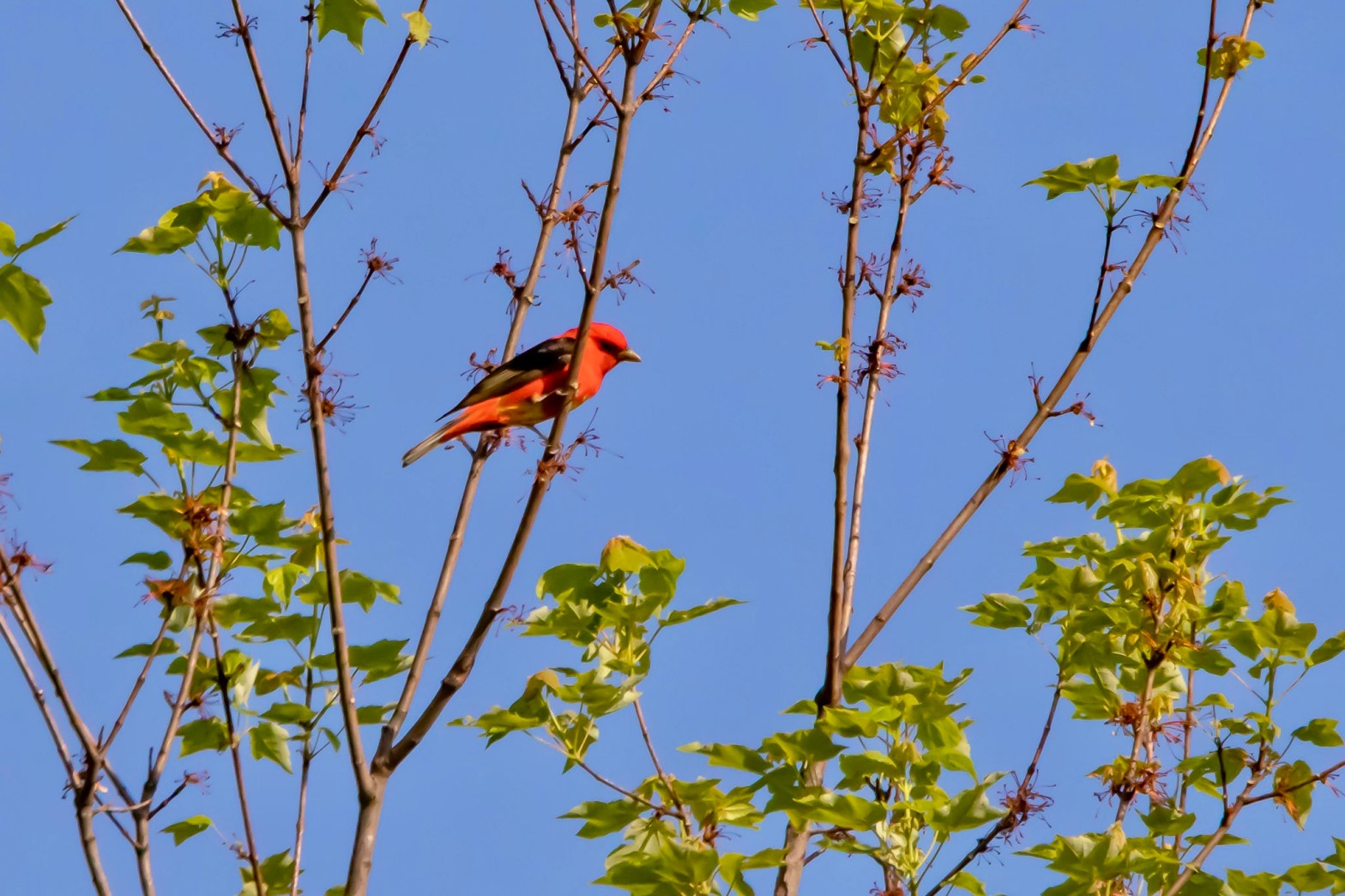
Way up high was a dash of red — could it be a tanager? It might be a cardinal but — no! — it’s a scarlet tanager on a treetop branch swaying in the breeze. The bird was in profile, and the black wing contrasted clearly against the rest of its plumage, a deep, lush red.
The top photo shows the tanager in broader context; this one, cropped heavily, was the best I could get.
I brought my camera up and squeezed off several frames before the bird flew off, and a quick peek in playback gave me hope that I’d have at least one good shot.
I smiled at the thought that the rabbit might have somehow been responsible for the sighting — I’ll take help however I can get it! — and headed down the trail toward the car and home.
The shots were not as sharp as I’d hoped, and I concede that I should have expected that result. The bird was high up and far from where I was standing. My camera and my lens have their limits.
But the photo results are secondary. I finally saw my first scarlet tanager of the year, and I hope to see more.
My 2023 Spring “Big Day” was a lot of fun as I logged 51 species in e-Bird, doing my part to contribute to the crowd-sourced science that makes these annual counts so important in preserving our avian friends.
Unlike last year when I traveled to Cape May County during the World Series of Birding, I stayed close to home this year, never venturing out of Mercer County. But variety abounded, from my own backyard and the Mercer Meadows Pole Farm to the Millstone River Impoundment and the Charles Rogers Preserve in Princeton and the Dyson Tract along the Delaware and Raritan Canal.
The day started at the impoundment, where, thanks to a tip from a fisherman that the bird was headed in my direction, I got the post-topping shot of a great blue heron preparing to land.
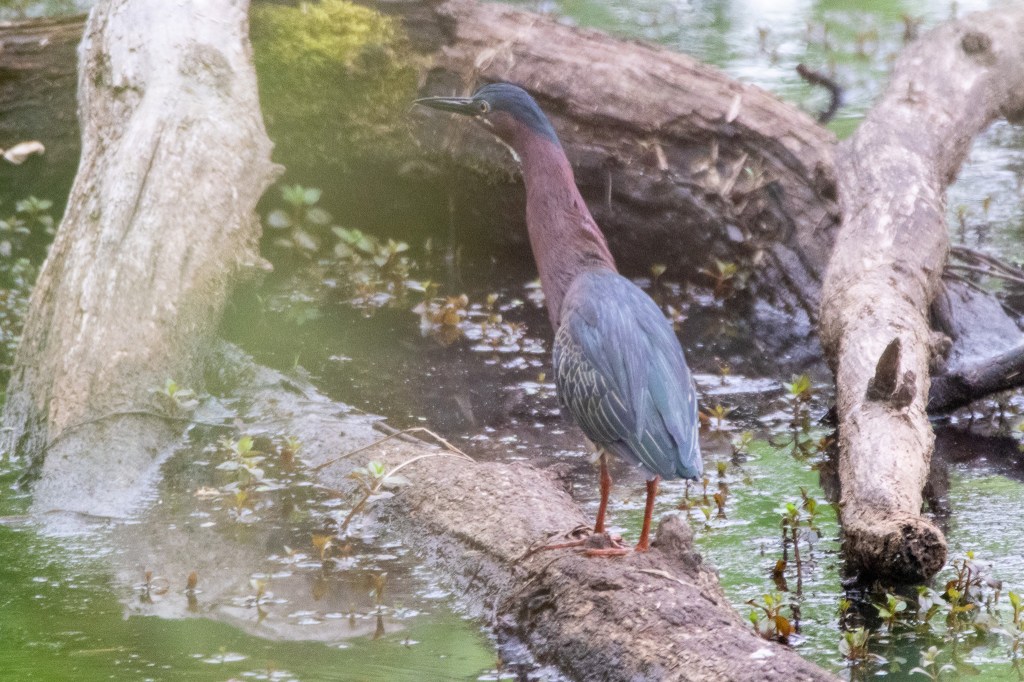
One of two green herons spotted at the D&R Canal Dyson Tract.
Next up I made two stops with my birding buddy Laura, first to the Dyson Tract along the canal to see the prothonotary warbler, a lifer for her and a second sighting for me. We also spotted two green herons in the marsh, our first sightings for the year, nearly a year after we had our first sighting of one together last year.
From there we drove to the Pole Farm — my home court, if you will — and in the parking lot ran into Laura’s friend Joe. The three of us meandered up the central fields to the woods and back down the paved Lawrence Hopewell Trail. We were disappointed that the “warbler wall” at the old AT&T Building One site was quiet other than for catbirds. Laura stalked a blackpoll warbler in the evergreens there, and we heard it repeatedly but never saw it.
We recorded it but could not justify doing the same for the Wilson’s warbler that popped up a few times nearby on the Merlin sound app. A bird for another day, if not another year!
A couple of surprises awaited us as we made our way back to the parking lot. First up was the buzzy call of the willow flycatcher, one I’d been hoping to hear since they flew away last summer. We heard the call several times and settled on reporting two of them. I am eager to go back and spot one.
The final surprise came as we reached the car in the parking lot. Something big flew past us and landed on a bare, spikey tree. It then flew into the large tree to the right of the trail out of the lot, and by then Joe had nailed the ID: another green heron.
Late in the afternoon, I made one more foray into the woods, at the Charles Rogers Preserve, tucked behind graduate student apartments on the outskirts of the Princeton University campus. Not much was happening there, although I did spot a female wood duck flying across the marsh from the observation deck at the parking lot.
Twenty-four hours later, I reflect on the day and note that as much as I enjoy my solitary walks, birding is better with a friend, and even better when you make a new one.
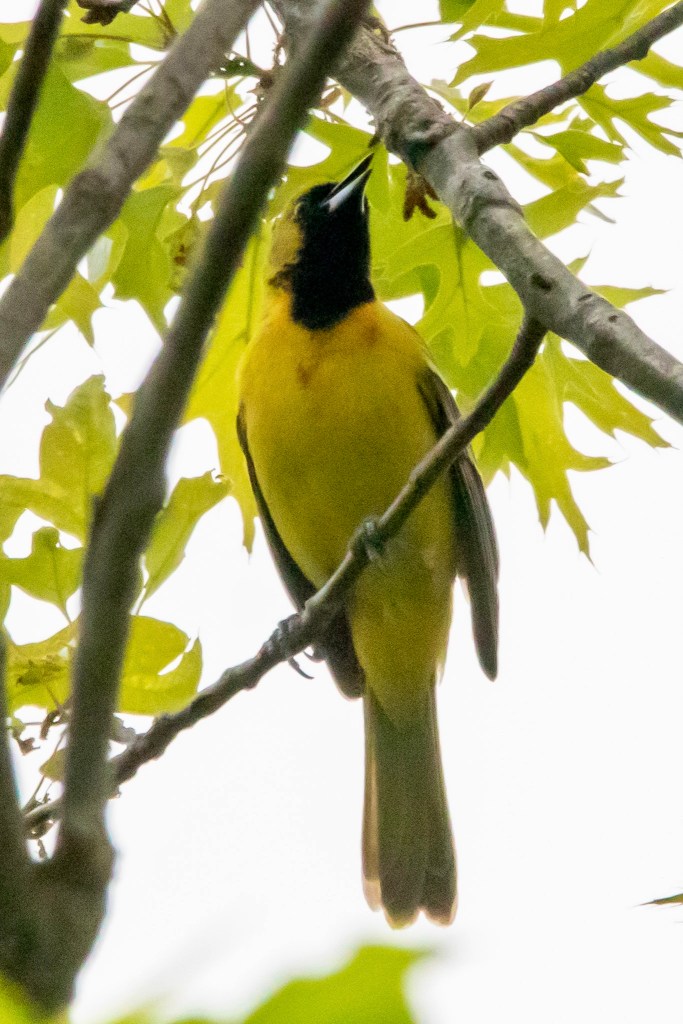
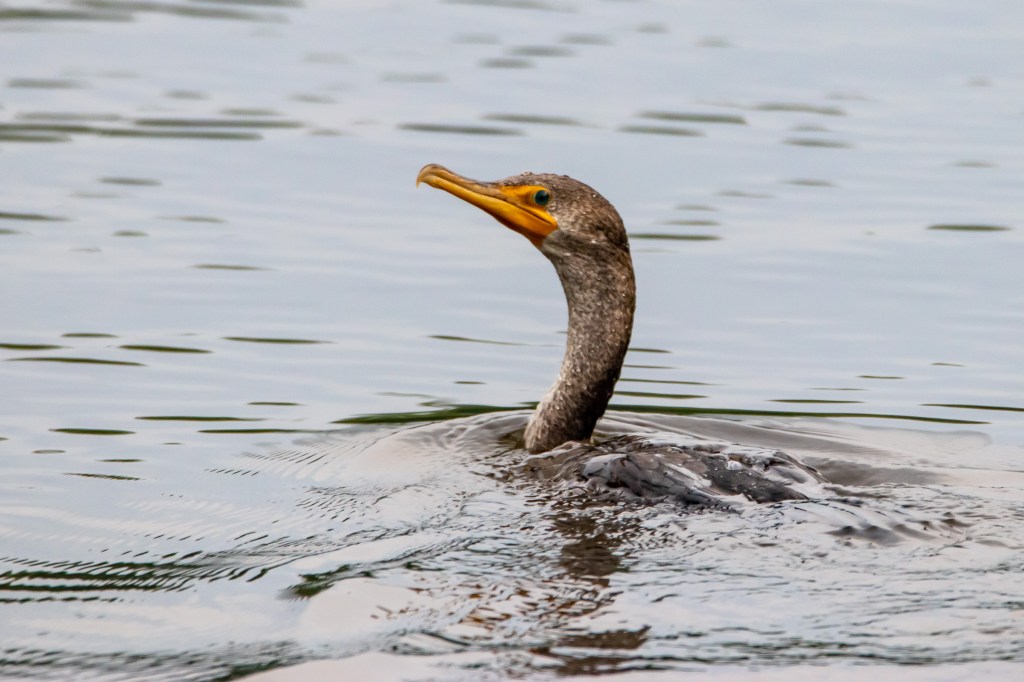
A Northern cardinal shows his color at the Charles Rogers Preserve.A young male orchard oriole at the Rogers preserve.A double-crested cormorant plies the waters at the Millstone River Impoundment.A gray catbird grooms itself at the Dyson Tract.












 The Jersey Birder