Well before dawn, the robins in our neighborhood start singing. I don’t think they’re trying to wake me up or spur me to get out of bed, but in whatever message they’re conveying, they are persistent.
This morning, I listened to them for 5 or 10 minutes, and when I heard a cardinal start singing counterpoint in the distance, I decided it was time to rise.
After getting the coffee maker going, I settled into my easy chair that affords me a good view of our backyard feeders. A house sparrow was the first to appear, a little earlier than usual, I thought, figuring the cardinals would come next.
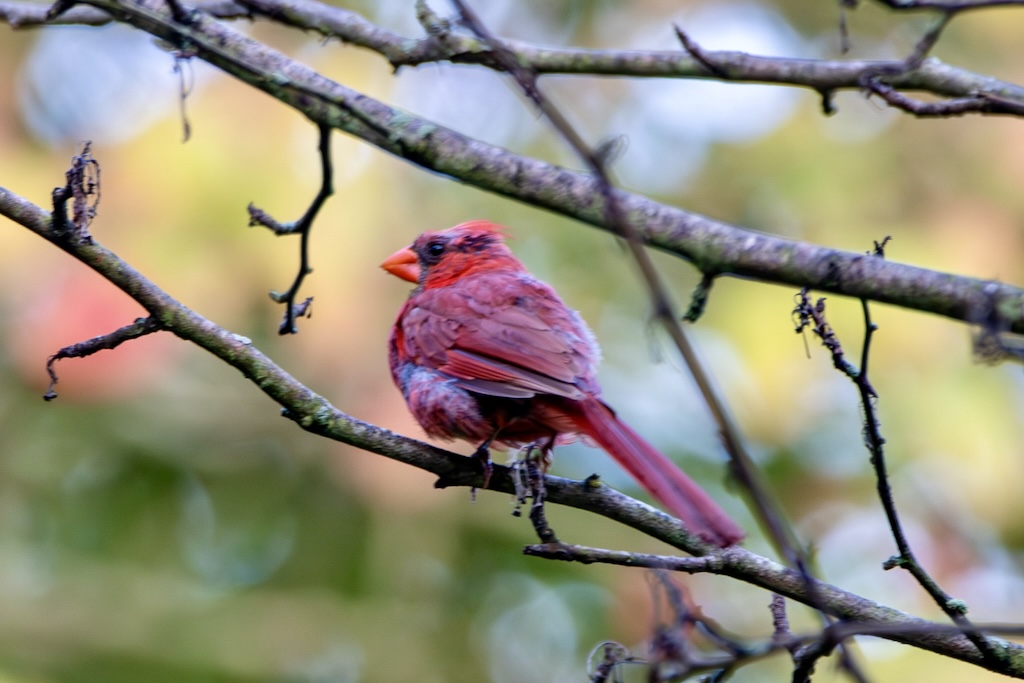
A moment later, a female cardinal appeared on the main feeder, and her mate soon followed, perching atop my smoker. Then, right on cue, a Carolina wren started singing. I couldn’t see the tubby little creature, but I could hear it, its usual outsized volume-to-size ratio readily apparent.
I could also hear some gentle rainfall tinkling on the metal topper on our chimney, a clue that I will have to delay my morning outing until after the showers stop and a reminder that it’s time to close the flue.
Now that the sun is up, I’m waiting for the goldfinches to start flocking to the nyjer feeder. The suet cakes need replacing in the little house that holds them, and I need to refill the main feeder. I don’t want to disappoint the those voracious sparrows or get side eye from the cardinals.
“What bird is that?” The question, posed by my wife, came at about 2:20 a.m.
“What bird?” i asked groggily, awakening from a deep sleep.
“THAT bird,” she said. “Can’t you hear it? It woke me up.”
“No, I can’t.,” I said, glancing at the clock. I took a few seconds to debate whether it was worth getting up to turn on the Merlin app on my iPhone, which was on the charger next to the open window a few feet away in our bedroom.
“Why not?” I said to myself. When I got to the window, I could hear the bird, which was singing distantly in a low, trilling song at steady intervals. It wasn’t the classic hoot of a great-horned owl that we had heard after sunset a few nights prior.
I listened and listened some more, wracking my brain to see if I could dredge up a memory of a song that I was virtually certain I’d never heard before. Is it even a bird? I wondered. I’d heard a fox crying the night before. No, this a bird — a cuckoo, perhaps? No, definitely not. Then I looked down at Merlin on my iPhone, and there was the ID: Eastern screech owl!
Merlin lit up “screech owl” for several series of songs of the owl, the only creature making a sound in the still of night, save for, briefly, a distant emergency vehicle siren in the distance.
As a check on the ID, I switched to the “explore” section of Merlin and went to Eastern screech owl. The first recording of one there was not a great match, but the second* — Song (Northern) — was a near dead ringer.
Excited to add the owl to my life list, I tossed and turned before falling. back to sleep. That I started this post shortly after waking up about four hours later underscores my excitement. I’m also grateful that my wife’s hearing is better than mine!
*(I listened to the recording again just now and grabbed a screen shot, which tops this post. Also, I thought I had recorded a minute or so of the owl’s song on Merlin, but it seems I forgot to save the recording, alas.)
The sun shone bright this morning, and I was optimistic for a trip to the Mercer Meadows Pole Farm. It’s still a bit early for warblers to be passing through, but the Eastern towhees are back and I spotted a couple of brown thrashers earlier in the week.
Today’s highlight was more about encountering my friend Andy than any particular bird. Andy and I hadn’t crossed paths for several weeks, but we arrived at the park within minutes of each other and had a great time catching up as we walked the trails.
We got to observe a bit of drama on the dirt trail that bisects the main Pole Farm fields as you walk up from the Cold Soil Road parking lot. As tree swallows whirled overhead, we spotted a couple of bluebirds perched on tall stalks. A little farther up the trail, we stopped near a couple of bird boxes and watched as a pair of bluebirds tried to fend off swallows threatening to move into their nesting box.
An Eastern bluebird defends his turf to keep a tree swallow away.
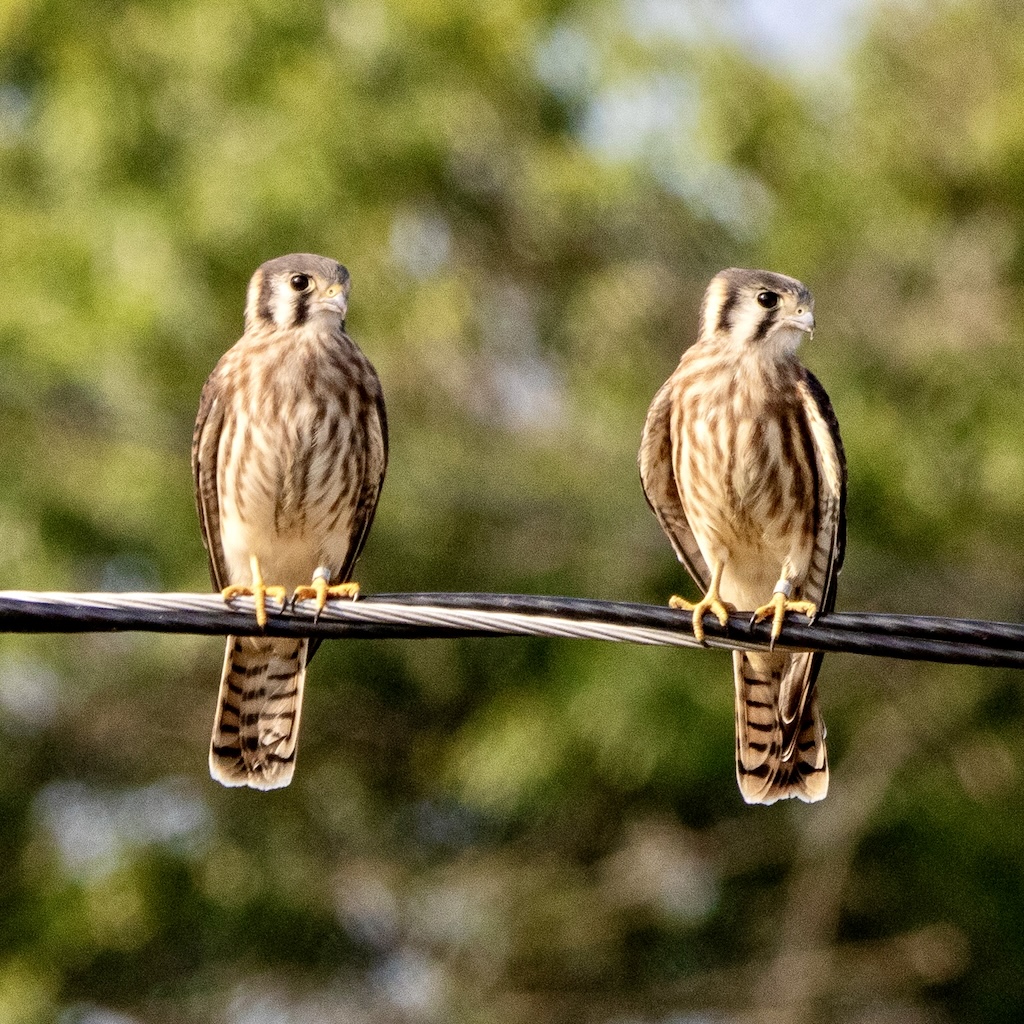
We walked a little over half a mile before turning back toward our cars. We could see a pair of kestrels on a bird box off in the distance. They were out of range for my gear, but Andy probably got a few decent shots on his Nikon with a 700mm prime lens and a 1.4x teleconverter.
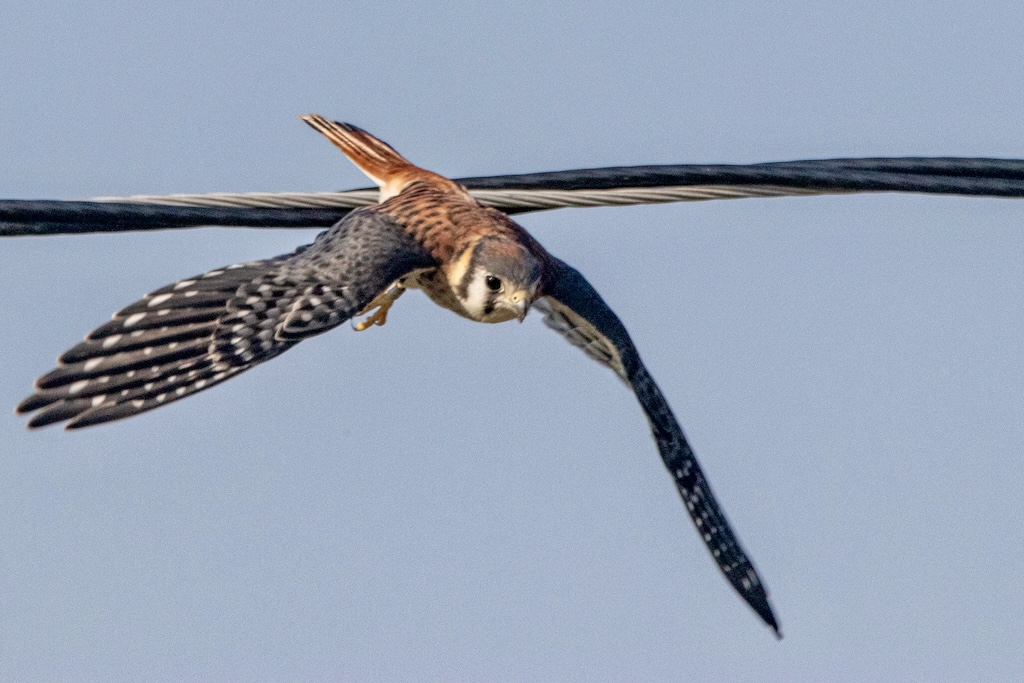
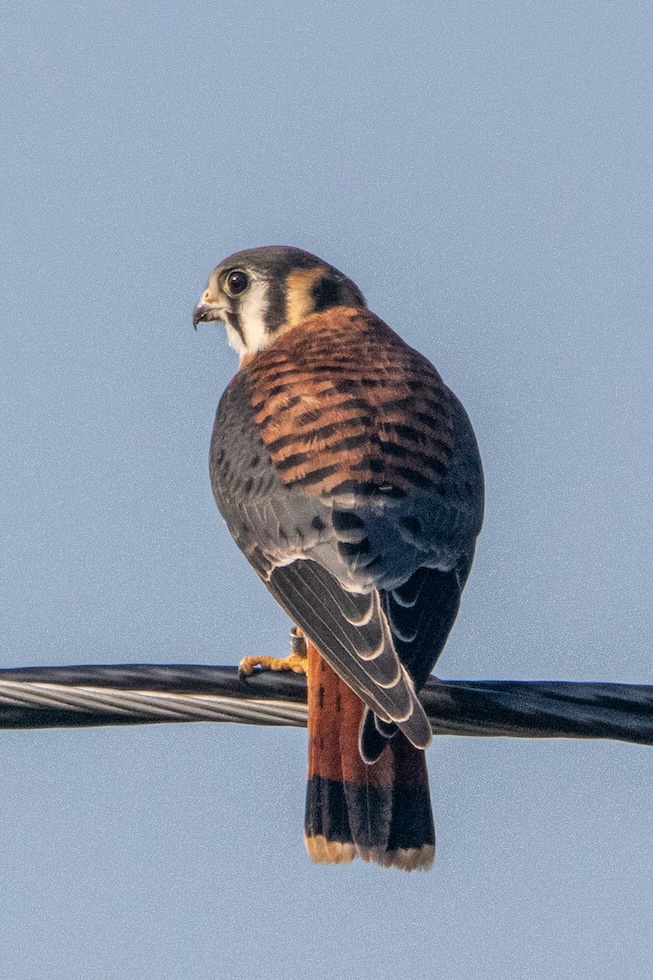
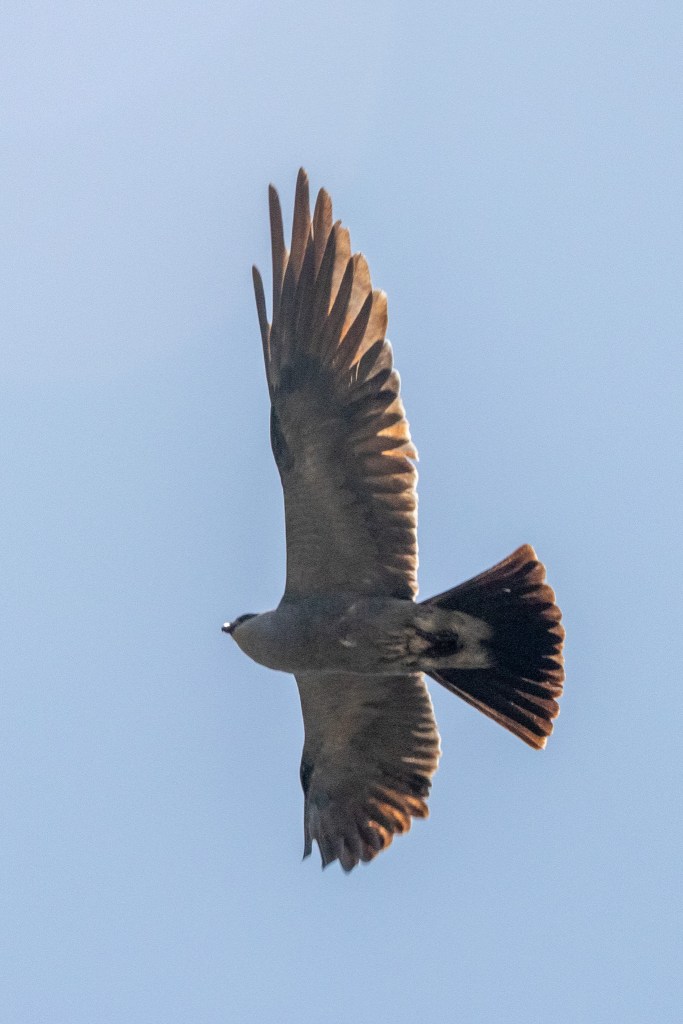
As we drew closer to the parking lot, I spotted another kestrel on a stalk off the side of the trail. The bird took off and soared high over the field, then hovered in a couple of spots while Andy and I, side by side, blasted away on our cameras.
Those were the closest looks at a kestrel I’ve ever had, and I was pleased with the photo topping this post and the one below. I can’t wait to see the results Andy got, and I hope to find him again soon.
After enduring three dreary days of rain, I was pleased to wake up to a clear sky this morning. Lifting my spirits higher was the sight of an Eastern bluebird perched atop one of our backyard feeders. Although bluebirds are common in parks near home, it’s a rare day when I see one in our yard. I took that as a good sign.
After completing my chores as coffee-wallah for my wife, I drove out to the Mercer Meadows Pole Farm. Within a few minutes, I heard a bird chattering loudly nearby. My first thought was that it was a Northern mockingbird, but in about half a second I realized that it was a brown thrasher.
The thrasher, in a not-quite-sharp photo.
The bird was up in a tree, partly obscured by branches. But there was no mistaking its coloring, size and song. This was my first thrasher sighting of 2024, and I wanted to memorialize it with a photo. I took a few shots, hoping for the best, although I’d later discover that optical stabilization had been switched off on my lens.
I continued walking, hoping a might spot Wilson snipes in an area where another birder had spotted them a few days ago. I walked out to that area, near the observation deck, but only saw a Northern harrier and a good number of robins.
Several white-tailed deer were grazing in the field, and at one point they got spooked and started running. I was able to catch one of them bounding across the field and I was lucky that my shot (which tops this post) was sharp.
Some of the deer hanging out at the Pole Farm this morning.
On my walk back to the car I was in for one more delight — the “twee!” call of an Eastern towhee. I heard the bird — another “FOY 2024” observation — a handful of times but never did spot it.
April is always a month when birding counts start climbing as the migrants begin passing through. I look forward to many encounters with thrashers and towhees in the months ahead.
When I stepped out of the car at the Pole Farm parking lot, it took only a few moments for the sound to register. There it was, the unmistakeable dropping-Ping-Pong-ball song of the field sparrow.
Field sparrows may actually hang around all year long in this part of the country, but they stop singing sometime in the fall, and I have to wait for them to crank it up again as Spring approaches.
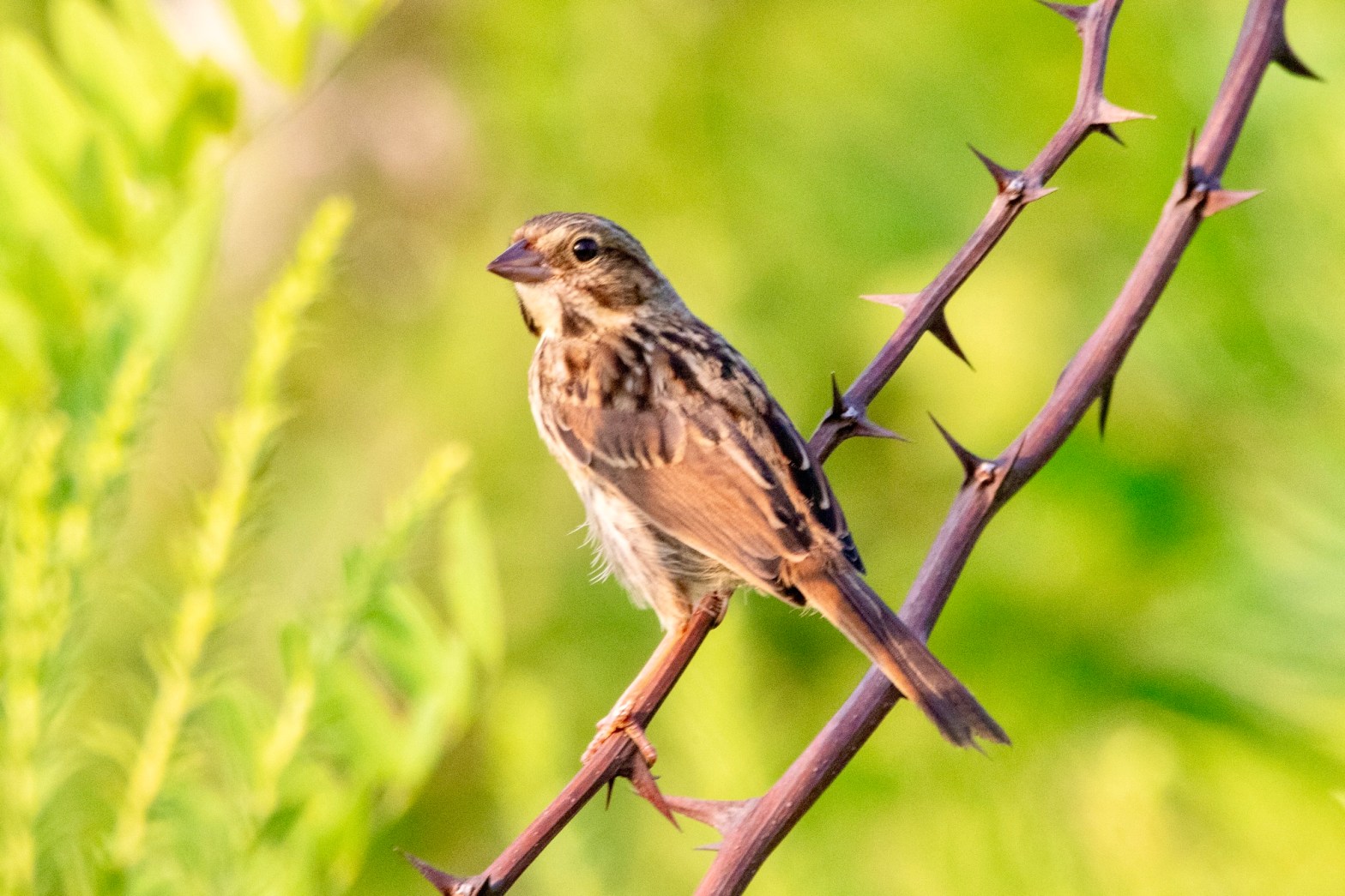
The first field sparrows I heard this year emerged Wednesday morning. I was able to get a peekaboo photo of one of them overhead. Back at the Pole Farm this morning, I heard them again and spotted the one atop this post not far from my parking spot.
The birds in both photos are partially obscured. I look forward to many opportunities for clear shots to come.
Meantime, even if I can’t see them fully, their clear, sweet song tells me that more and more nice days lie ahead.
A field sparrow sits up in a tree, its telltale salmon beak poling out from behind a limb.
That grin on my face emerged with that gesture of triumph this morning at the Mercer Meadows Pole Farm, where for the first time in many months I went birding on my own two feet, without a cane.
Since troubles with my knees crossed into acute territory over the summer, I’ve been trying hard to regain my normal gait and wean myself from walking with a cane. This morning was the first time I tried it at the Pole Farm, strolling a little over a mile roundtrip on one of my favorite trails, the one that goes through an alley of trees on the way to an observation deck and the stretch of woods connecting the Pole Farm and Reed Bryan Farm.
I went through the alley and thought about turning around, but the sun was shining and I decided to go a bit farther, setting my sights on edge of the woods another several hundred yards up the trail. I was rewarded with spotting an Eastern meadowlark in one of the fields and getting a fair side view of a Northern flicker, not to mention lots of robins.
Eastern meadowlarkNorthern flickerOne of many robins
I turned around from there and made my way back to the car, only taking one short break to sit on a bench. I’ll continue to build up my endurance, and I’m hoping warm weather in the spring — plus the allure of migrating warblers — will take me deeper into the trails in the coming months.
Scaup patrol: Round 2
If today’s birding theme was slow and steady, yesterday’s was sprint. My friend Laura texted me once we got a report of a greater scaup — unusual if not rare in these parts — spotted on the Delaware River at an overlook off Interstate 295 at Trenton.
Laura soon drove us to the overlook, and once we parked we saw nothing but wide open water. No sign of a scaup, greater or lesser, not even a single gull overhead in an area where they often swarm. After a few minutes, I spied two common mergansers diving on the far side of the river, and as we drove off I wasn’t sure I should even bother filing an eBird report.
But wait! As we rolled past the overhead pedestrian bridge, through the bare trees Laura spotted birds and stopped the car on the shoulder. Three scaup-like birds — two males and a female — were swimming along with a good number of ring-necked ducks.
We didn’t confirm a scaup ID on scene, and both of us had a lot of things to do so we turned toward home.
When I got my photos up on screen at home, sure enough, the three mystery birds were scaups, but an even tougher question arose: greater or lesser?
The best view I had of one of the lesser scaup drakes.
The birders who spotted the greater scaup shared a photo on GroupMe, and after a lot of Googling and cogitating I concluded, somewhat tentatively, that they had indeed spotted a greater scaup while ours were lessers.
This was my second go-round with scaups, and it appears I’ll need to wait until another time to add a greater to my life list.
It took me more than half a year to shed the cane. I’ll take that greater scaup in stride whenever it reveals itself.
One of the pleasures of birding is when you suddenly realize that the bird you’re seeing isn’t what you thought it was but something surprising. American tree sparrows have that effect on me, and it happened again with my two most recent visits to the Mercer Meadows Pole Farm.
The other day, I spotted a bird above me and couldn’t quite make out what it was. Goldfinch? Sparrow? The light wasn’t great that morning, and after snapping a few photos I wandered off, figuring I’d fix the ID once I got home.
Although you can almost always see or hear song sparrows at the Pole Farm, and Savannah sparrows are around much of the year, American tree sparrows are not spotted nearly as often.
As you have probably already deduced, that mystery bird, when brought up on my laptop screen, turned out to be a tree sparrow. Instant joy, followed by an update to my eBird checklist. One of the photos tops this post.
A song sparrow welcomes me to the Pole Farm, or so I believe.
This morning, as I walked up the central path toward the tree line, I didn’t realize I was heading into a sparrow parfait.
First and predictably came the song sparrows, singing in the morning sun.
Fifty or so yards farther, I encountered a trio of Savannah sparrows grazing on the trail and ducking off into the brush.
As I drew closer to the tree line, I looked ahead at another cluster of sparrows on the path. Up went my binoculars and, expecting more Savannahs, I was startled to realize they were American tree sparrows. A wave of pleasure washed over me. I didn’t have to wait for the recognition to come on screen.
One of the birds flew up onto the branches of a small, bare tree, and, thanks to the ample sunlight shining on it, I got a couple of nice shots full of feather detail.
I love the American tree sparrows for their bi-colored beaks and rufous caps, a sporty look that always makes me smile.
An American tree sparrow shows off its fine feathers.
Because of work and other complications, I figured I wasn’t going to get in any birding — let alone bird photos — on this “Leap Day,” the quadrennial 29th of February.
After a quick run to campus and the bank this morning, as I pulled back into my driveway, beyond the roof of our house I spotted a red-tailed hawk perched on one of the large branches of our backyard larch tree.
Trying to make as little fuss as possible, I got out of the car, stepped quickly into the house and made a beeline for my camera. Luckily, when I got to the sliding back door leading to our patio, the hawk was still perched above me.
I pulled the slider aside and, leaning against the door frame, took a dozen or so shots. The sun was beaming in from the southeast, lighting the hawk up nicely. My two favorites shots are above and below.
I finished the month with 66 species spotted in Mercer County, one more than I did last year, and 67 in the state, one less than last year. Now, on to March and migration. Birdcast.info resumes its reports tomorrow!
Looking slightly googly-eyed, the hawk checks me out.
Bright sunshine held sway all day today, and my friend Laura and I took advantage of it and headed out this morning for a couple hours of birding. Our first stop was at a scenic overlook along the Delaware River off Interstate 295 near Trenton.
We’d stopped there once previously, only to find a big, distant glob of gulls a long way off in the middle of the river. That day, we didn’t bother to file an eBird report, but we did today.
Under a swirl of ring-billed gulls, we looked out into the river and not far off shore were several scaups. The question was, were they greater or lesser scaups? Either way, I was going to add a new bird to my life list. Our initial assessment was that they were greater scaups, which are infrequent visitors to our part of the world. The light was good, and the birds were close enough that I managed some decent photos of them, including the one topping this post.
Lesser (or at least I believe so) scaups — five males and a female — float on the Delaware River.
When I got the images up at home, I consulted several websites to determine the difference between greater and lesser scaups. I changed the ID to lesser, as the bird heads seemed a bit more high and narrow than the more rounded greater scaup heads in the photos I saw online. I asked the Central Jersey birding Facebook group for help, and the one answer I have received so far agreed that lesser was the proper call.
One other bit of evidence, as you can see in the photo at top, the “nail” — that black spot on top of the beak — is a narrow rectangle, typical of the lesser scaup. On the greater scaup, the nail is wider and flange-like. So to me it all adds up to a lesser scaup ID, q.e.d.
The overlook visit was a quick one, and we moved on to John A. Roebling Park at Abbott Marshlands in Trenton. We were determined to find Northern shovelers, a relatively good bet at the marsh this time of year.
Alas, no shovelers were to be found, nor did we find any wood ducks as we’d hoped. But we did find ring-necked ducks, gadwalls, green-winged teals and American wigeons.
In a row: a wigeon in front of a Canada goose, with a mallard at rear.
It took a while, but after several attempts to catch quick-flitting winter wrens on camera, we found a cooperative one near the edge of the parking lot. I was able to get a couple of shots of one for the first time.
With 30 species spotted at the marsh on top of the lifer sighting on the Delaware, we declared the day a roaring tweeting success.
A winter wren, posing just long enough for me to focus and snap.
At today’s annual Alumni Day at Princeton, John Fitzpatrick received the university’s highest honor given to a graduate school alumnus or alumna, the James Madison Medal.
Fitzpatrick, who received his Ph.D. from Princeton in 1978, led the Cornell University Lab of Ornithology from 1995 to 2021. Under his leadership, the lab developed eBird, the voluminous database into which birders worldwide report their sightings.
Fitzpatrick give a lecture before receiving the medal this morning, and I was fortunate to hear it.
Fitzpatrick charmed the audience of several hundred alumni, faculty, staff and students in Richardson Auditorium, recounting highlights from his career and noting some of the alarming findings on declining bird populations, statistics gathered with considerable help from eBird. Fitzpatrick said eBird is believed to be the largest citizen-science research project in existence.
In a brief question-and-answer session after the lecture, Fitzpatrick was asked what individuals and society as a whole can do to reverse the devastating decline in birds.
His quick reply? Keep your cats indoors.
Cats are believed to cause more than 1 billion bird deaths each year in the United States alone. While many of the cats responsible are feral, Fitzpatrick called cats let out of doors by their owners to prowl neighborhoods “subsidized recreational killers.”
Brightly lit buildings are another major killer of birds, which by the thousands crash into buildings at night during spring and fall migration. Data gathered from eBird and other sources can help predict migration peaks and help cities determine what nights its best to dim their lights.
Fitzpatrick also encouraged people to stop using lawn chemicals, many of which are harmful to birds. Not only that, pesticides also decimate insect populations, a major source of food for birds. So don’t coat your lawn with chemicals, he said, but plant native plants or “xeriscape,” that is, use materials that don’t need to be watered (or coated with pesticides).
Fitzpatrick, who once stood in front of a bulldozer to stop a development in Florida, also recommended that supporting local conservation organizations as a good way to help the cause.
The Madison Medal, by the way, is named for James Madison, fourth president of the United States and is considered by Princeton its first graduate student.