The catbird’s seat

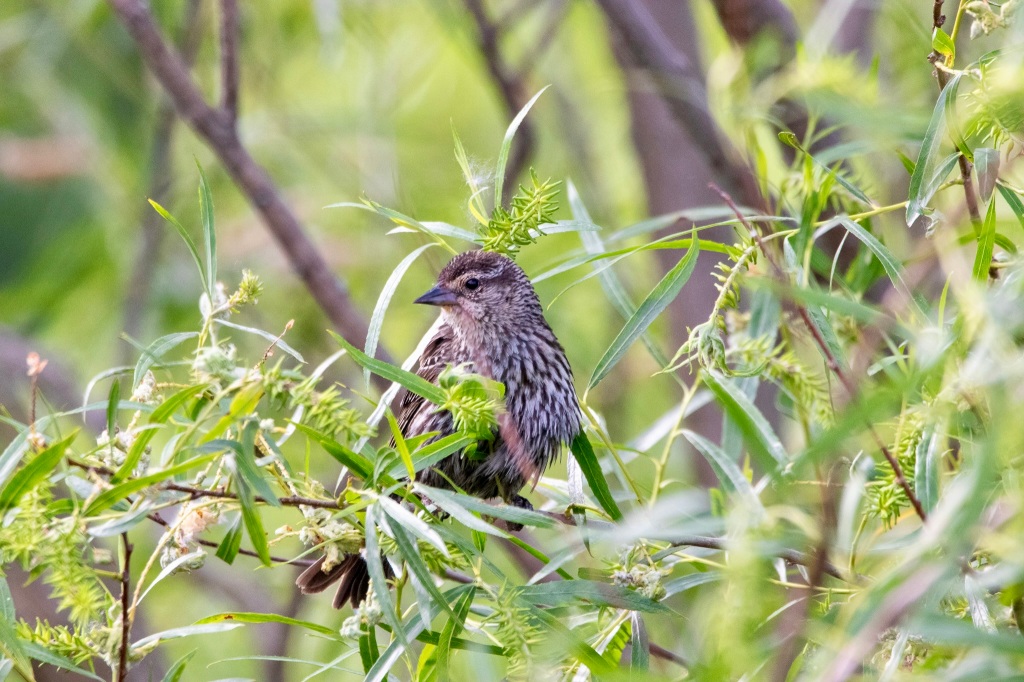
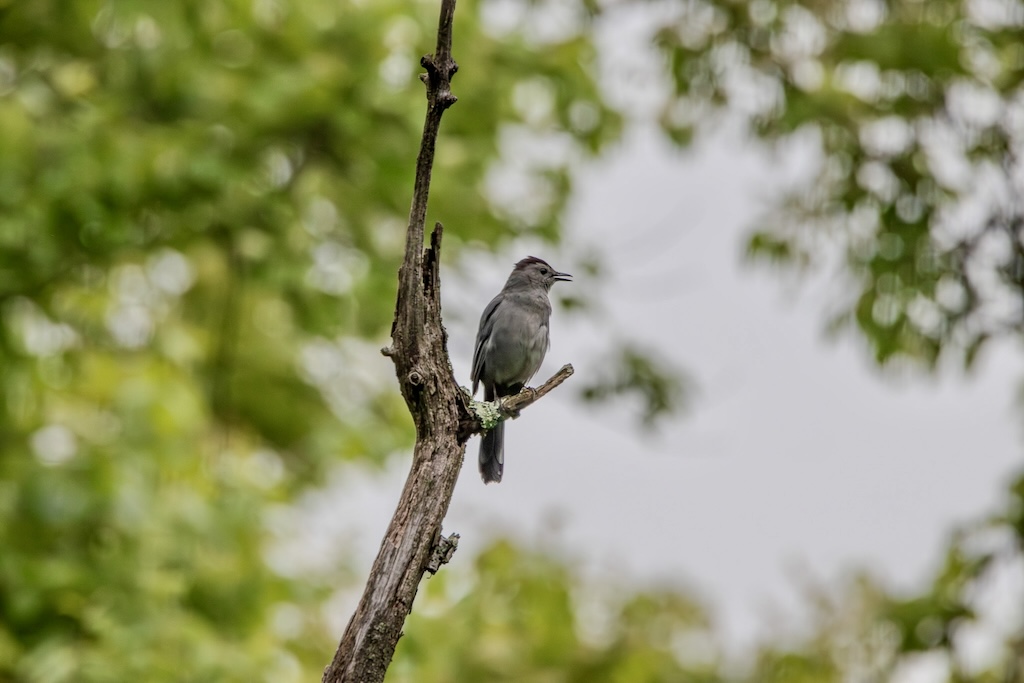
Catbirds are ubiquitous in my part of the world. With their Mohawk hairdos, they show up at the feeders at home and chatter away in the trees whenever I venture out to the parks nearby and beyond.

This morning, the gray catbird pictured above was perched on a bare tree — in the catbird seat, so to speak — as I approached on a trail at the Mercer Meadows Pole Farm.

I got to wondering, where did the common expression about someone being in the catbird seat originate? Off to Wikipedia I went, and I found an entry that traces the phrase’s origin to the American South in the 19th Century. The first printed reference, the entry says, was from a 1942 short story by American humorist James Thurber, long a favorite author of mine.

There’s even a baseball angle, according to Wikipedia. Hall of Fame broadcaster Red Barber used the phrase liberally when calling games, which is probably where Thurber picked it up. Barber (1908-1992) grew up in Mississippi and Florida, where the phrase was presumably in vogue.

Whether they’re cackling or mewing, catbirds add a dash of humor to daily life. As another great baseball broadcaster, Mel Allen, was fond of saying, “How about that!”

On a gray day, a black and white warbler shines

One of the pleasures of birding is meeting birders from other territories, and I had that pleasure again Sunday. My birding buddy Laura and I met at the Mercer Meadows Pole Farm with a couple from Quebec to whom we’d been introduced by another work colleague.

Under an overcast sky and drizzling rain, the four of us strolled for two and a half hours along some of the main trails, much of it spent comparing notes on the birds we commonly see and those we don’t. While field sparrows are ubiquitous at the Pole Farm, for our visitors they were lifers.

When we transitioned from the fields along the central path into the back woods, full of wood thrush song, we were on alert for warblers. But other than hearing a couple of ovenbirds, we didn’t see any flitting among the trees until late in our walk.

Then just ahead and not far overhead, a black and white warbler appeared. In typical warbler fashion, it darted from branch to branch before heading off. I took several shots, most of them blurry. But I managed to get one in focus,. It tops this post and will serve as a reminder of a memorable day with new friends, with whom I hope to do more birding north of the border some day.

The magnificent blue jay

As ubiquitous as the blue jay is in much of this part of the world, I’ve taken relatively few photos of them in wild, especially when compared with many less common species. Early in my walk this morning at the Mercer Meadows Pole Farm, I spotted one sitting regally atop a tree and snapped away.

I’m pleased with the result.

Late this afternoon after a short rain shower passed through, I headed out to the Dyson Tract along the Delaware and Raritan Canal, and I got a surprise — from my camera.

As I walked out of the parking lot, I immediately spotted a plump Eastern phoebe in bushes along the canal. I raised the camera to focus but it wouldn’t fire. The camera screen showed a message that the SD card was locked.

I started searching the menu for a control to unlock the SD card, a situation I never anticipated or even knew was possible. Not finding anything in the menus, I used Google on my iPhone to search for a solution for my Canon camera. The answers said the lock control was on the card itself, so I pulled it out and tried to find it. No luck, so I headed back to the car and went to the backup card I keep in the vehicle.

The camera worked again, and after my walk I found the YouTube video below on how to salvage the card by wrapping a bit of cellophane tape on it. I had all my images downloaded from that card, and I’m not going to bother with trying to fix it. I’ll order a new one and thank my lucky stars that I was smart enough to keep that spare in the car.

Welcoming back the common yellowthroats

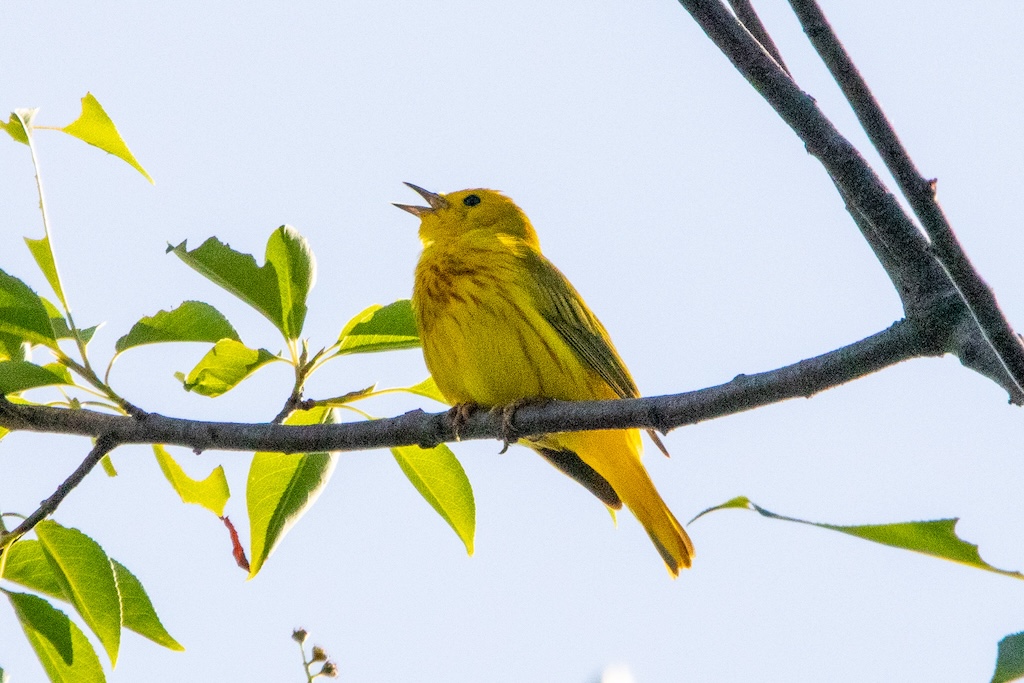
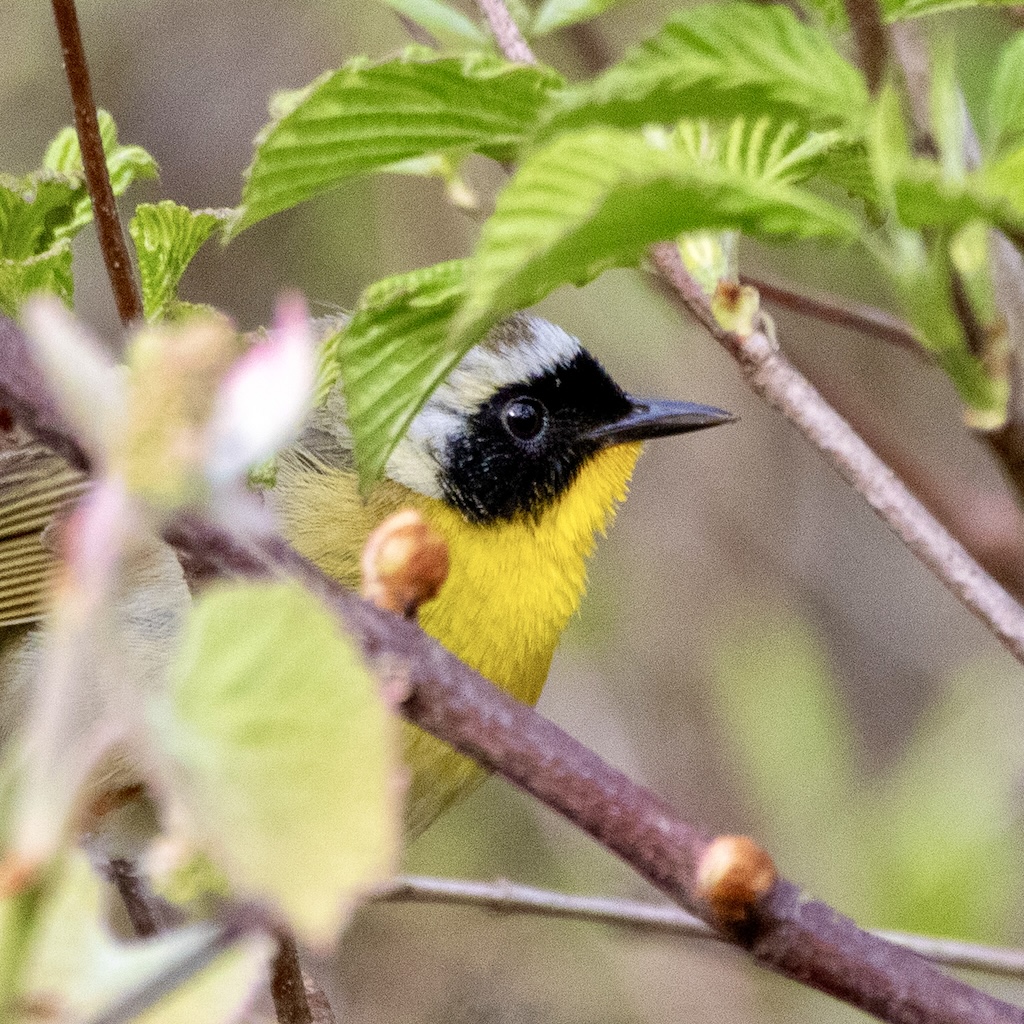
I love too many types of birds to pick a favorite, but common yellowthroats are in the mix if you ask me to pick a handful of birds that bring me maximum joy. The yellowthroats began returning to New Jersey over the past couple of weeks, and this morning my birding friends and I got our best opportunities so far to photograph them out in the open.

Typically, we hear the yellowthroats for a week or two before we see them regularly. When they arrive, they typically stay inside the bushes and trees, out of sight to birders. We may catch a fleeting glimpse of them flitting amid the emerging tree leaves, such as the peek-a-boo view I got of one the other day, as shown in the photo atop this post.

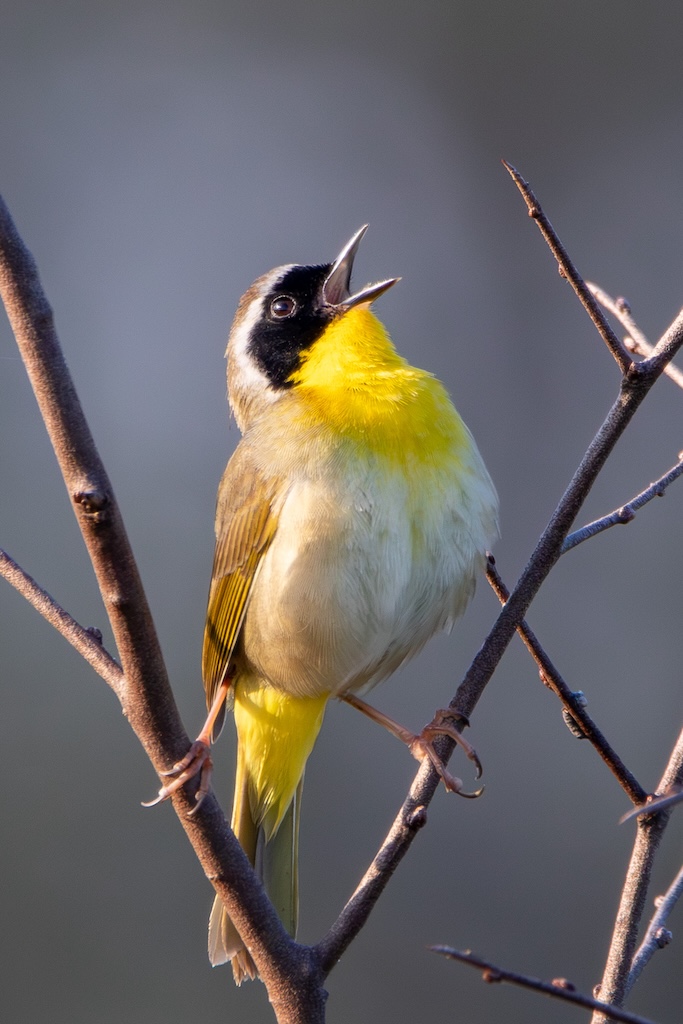
This morning, though, they appeared to have decided as a group that they were comfortable enough to pop out of the brush and sing from tree branches and stalks at the Mercer Meadows Pole Farm.

Common yellowthroat singing loudly from a tree branch.
A common yellowthroat bursting into song.

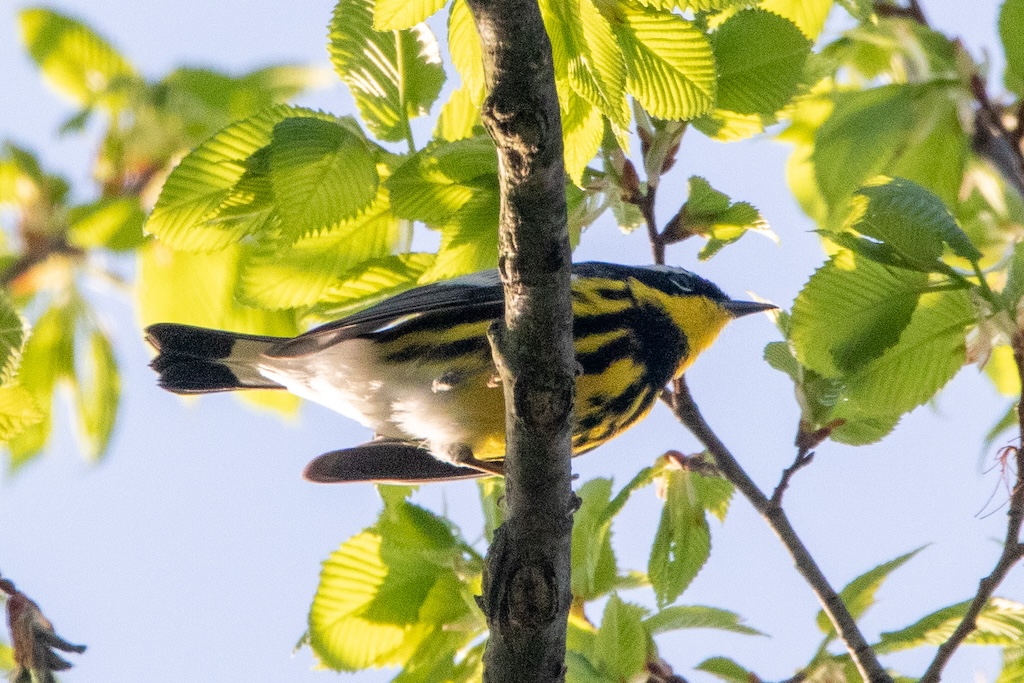
The yellowthroats weren’t the only yellow birds we got to see. American goldfinches also appeared to have received the “come out into the open” memo. Our bonus bird was a beautiful magnolia warbler that dashed about the canopy of trees above us at the entrance to the woods off the park’s central, dirt trail.

We also heard a grasshopper sparrow singing and got a quick look at it flying away. A photo of one of those will have to wait for another day. Meantime, I’m reveling in yellow and black.

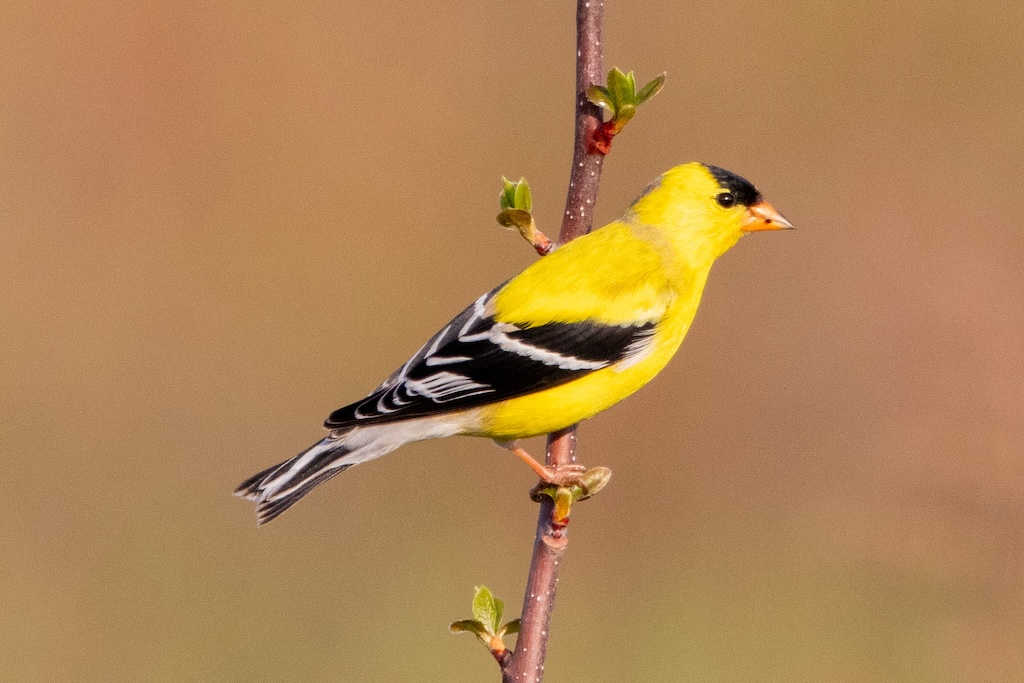
American goldfinch out in the open.
Magnolia warbler high up in a tree.

A great day for hawks

It was another sunny morning at the Mercer Meadows Pole
Farm, and my friend Andy and I set off for adventure about 7:20 a.m. I’ve been in a hawk drought of late, having seen just one red-tailed hawk a few days ago but otherwise having gone weeks without seeing any, let alone another variety.

That would soon change. After traipsing along our usual route out to the old AT&T Building One site where, tricked by some blanching on a tree, I temporarily thought I’d spotted the great horned owl we’d seen the other day. We walked a bit farther, finally spotting a single common yellowthroat after hearing several, and then reversed our route.

Andy was walking slightly ahead of me as we emerged from the AT&T oval and suddenly he stopped and pointed. Straight ahead, perched openly on a tree branch was a Cooper’s hawk, its striped white chest and banded tail clearly on display.

Cooper’s hawk standing tall.

The hawk posed long enough for us each to take several shots, and as I moved forward for a better angle, the bird flew off. Neither of us captured that moment, alas. But another hawk encounter was soon to come.

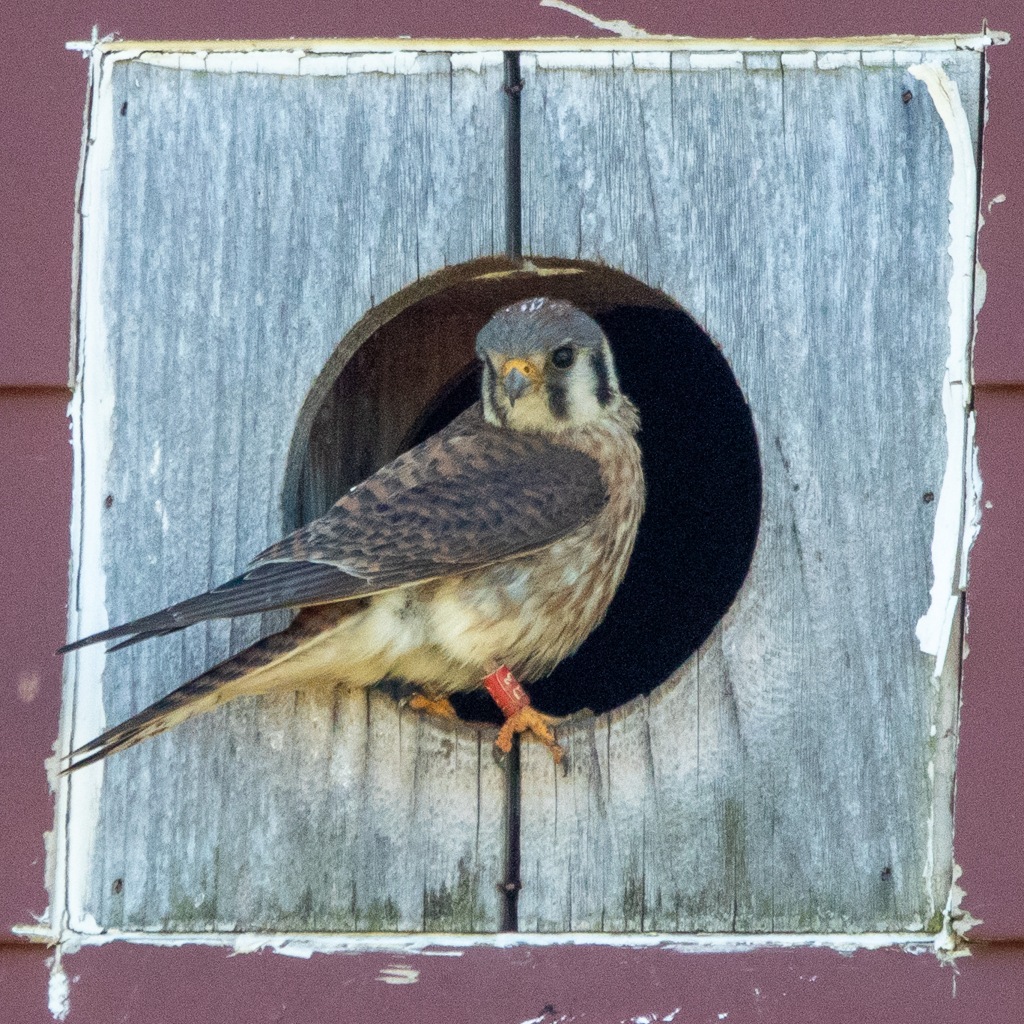
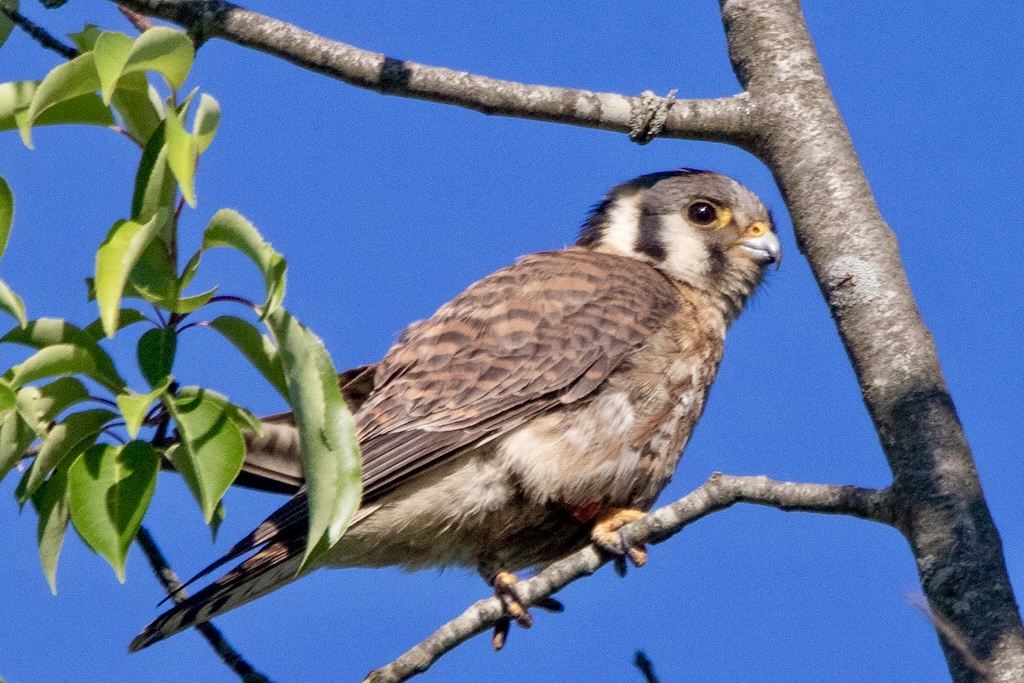
We went down the trail toward the parking lot, hoping to spot one of the American kestrels that have been nesting in the big red barn at the parking lot. One was perched in the hole near the peak of the roof, and Andy and I moved in closer to take several shots. I turned toward my car and missed a chance to catch the kestrel leave the barn. Andy missed it, too.

Kestrel peeking out of hole in barn.
Kestrel peeking out of its hole in the barn.

Then, unexpectedly, I saw a big, dark bird fly into the large tree nearest to the trailhead at the end of the parking lot. Hawk, I thought — no, wait, it’s big and has a huge beak — immature bald eagle. Actually, it was a red-tailed hawk, as my photos would clearly prove.

The hawk flew out of the tree, chased by a blackbird or two, then reversed direction and flew low over the field straight back to the tree. I took several blurry shots but got the one topping the post, one of the best airborne bird shots I’ve ever taken.

The hawk stuck around as Andy and I reached our cars, and then it flew into another nearby tree. Andy and I snapped off some more images. The gallery below shows the highlights from both trees. What an exceptional day!

A magnificent surprise: a great horned owl

As we headed up the trail this morning at the Mercer Meadows Pole Farm, my friends Jim and Andy and I had no clue of the wonderful surprise awaiting us in the woods.

We were hoping we’d see a few of the warblers that have been trickling into the park this week. The weather was cool and breezy, which was likely responsible for the relatively few birds we saw in the fields as we walked up from the parking lot,

As we entered the woods, we spotted a blue-gray gnatcher and heard a couple of towhees. A little farther ahead, we heard an ovenbird (my first for the year), a couple of Eastern towhees and some white-throated sparrows. A Northern flicker called from far off.

Jim wandered ahead of Andy and me, then suddenly turned around and blurted out excitedly: “Holy sh**! It’s a great-horned owl!”

Great horned owl sitting on a branch.
A photo from our second pass.

Yes, it was. Nestled into a thick branch jutting out from a large tree, the owl was not obvious at first but plain to see once my eyes locked onto it, The owl was probably at least 50 yards away, and we were in no danger of spooking it, even after we pointed our cameras at it.

We admired the bird and our good fortune for five minutes or so, then moved on in search of common yellowthroats and whatever else we might find. We circled back to the owl and took a few more shots before wishing it well and turning toward our cars.

While I had heard great horned owls a few times at home, I had never seen one until today. I’m grateful to the birding gods for giving me such a privilege. 🦅

Great horned owl sitting on a branch in a big tree.
Wider view of the owl in tree.

An unexpected milestone: 1,000 Mercer County checklists

I reached a birding milestone today, submitting my 1,000th e-Bird checklist in Mercer County, New Jersey. By happenstance the day before I discovered I had completed 998 checklists, and I added No. 999 yesterday afternoon with a short visit to Colonial Lake Park in Lawrence Township.

It was an easy decision on where to go for No. 1,000: the Mercer Meadows Pole Farm, where I’ve done nearly the majority of my birding since taking up the hobby — 492 checklists on e-Bird since I filed my first report there Feb. 17, 2019.

American robin in a small tree.
American rovin

I hoped I might find something special today, but I didn’t get anything I hadn’t seen before. But in a sense, all birds I observe are special, be it a common one like the American robin or a seasonal visitor like the Eastern towhee.

Having seen my friend Andy at Colonial Lake yesterday, I knew he would be at the Pole Farm this morning. He arrived shortly after I did, and I missed him waving at me to draw my attention to the American kestrel that’s been perching in a tree next to the Cold Soil Road parking lot.

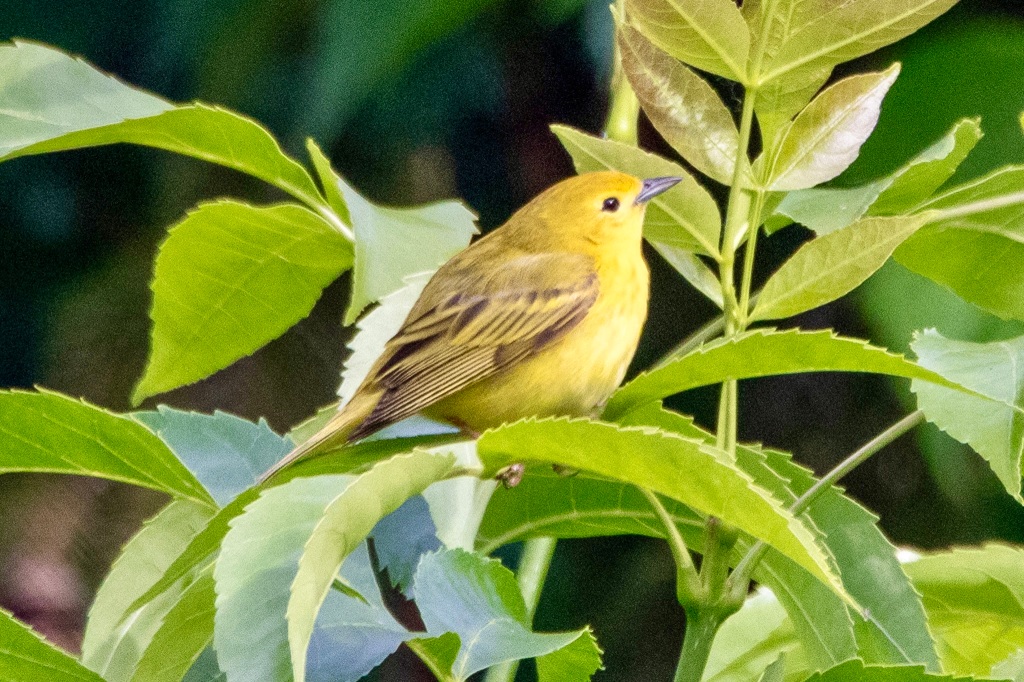
We saw a couple of kestrels perched on far off bird boxes, and we hoped we might find a yellow warbler as Andy had seen the day before. We had some nice bluebird encounters, and their predominant color seemed a deeper blue today under the overcast sky.

Eastern bluebird perched on a branch
Eastern bluebird

On our way back to our cars, we came upon the delightful birding couple of Old Sam Peabody and Blonde-Crested Warbler, who have taught me much about birding these past few years.

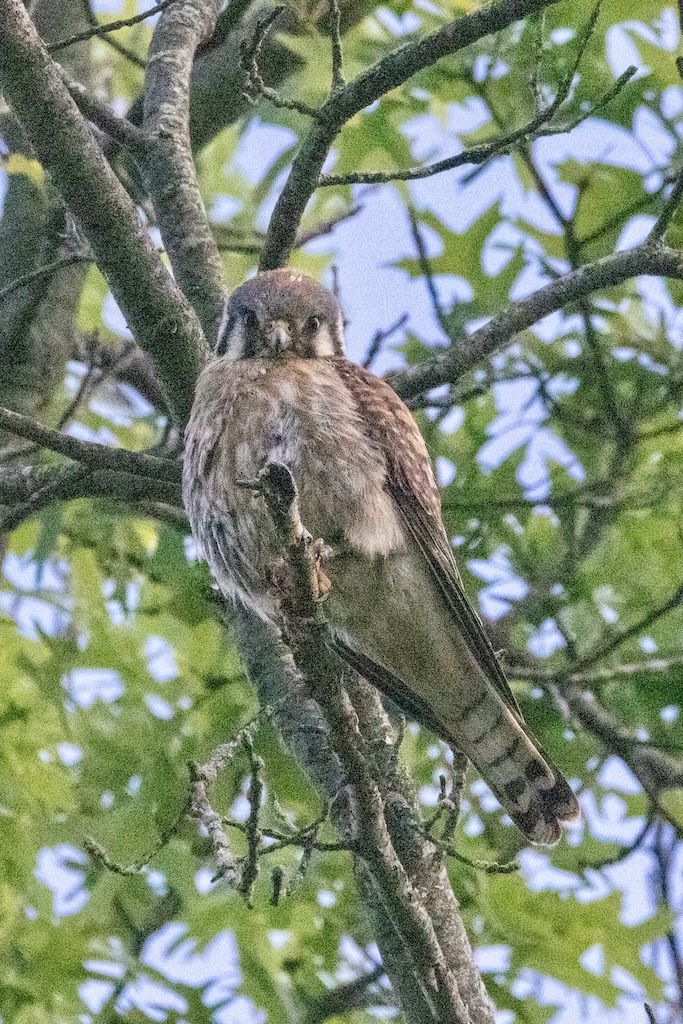
Jim Parris, the top birder at the Pole Farm, was, like the yellow warbler, not to be seen. But as Andy and I returned to our cars another Pole Farm regular, Nancy, was aiming her lens at a hole in the maintenance barn. Kestrels have moved in, and one was peeking out at us.

American kestrel peeking out of the round opening on a barn.
American kestrel in the barn.

Another kestrel, Andy and Nancy alerted me, was perched on a branch of one of the big trees at the trailhead. The light wasn’t great, so my photos aren’t anything special. But outing No. 1,000 at the Pole Farm sure was.

American kestrel perched on a tree branch.
Kestrel perched near the parking lot.

Awaiting the warblers but still having plenty to see

While my social media feeds are awash in warblers, I have been waiting to see them in my neck of the woods. I went to the Mercer Meadows Pole Farm today with high hopes to spot one.

My friend Andy caught up with me shortly after I arrived, and — to relieve you of the suspense — I’ll say right now that we did not see or hear or any warblers. But it was a fine day nonetheless.

I was greeted by an Eastern meadowlark singing from the top of a tree just up from the Cold Soil Road parking lot. The sun was spotlighting the bird, and I was delighted to get clear shots (one tops the post) through the branches, which are beginning to leaf out.

Eastern bluebirds were nearby, and I was pleased to get a couple of clear looks at them.

Eastern bluebird in a tree.
Eastern bluebird

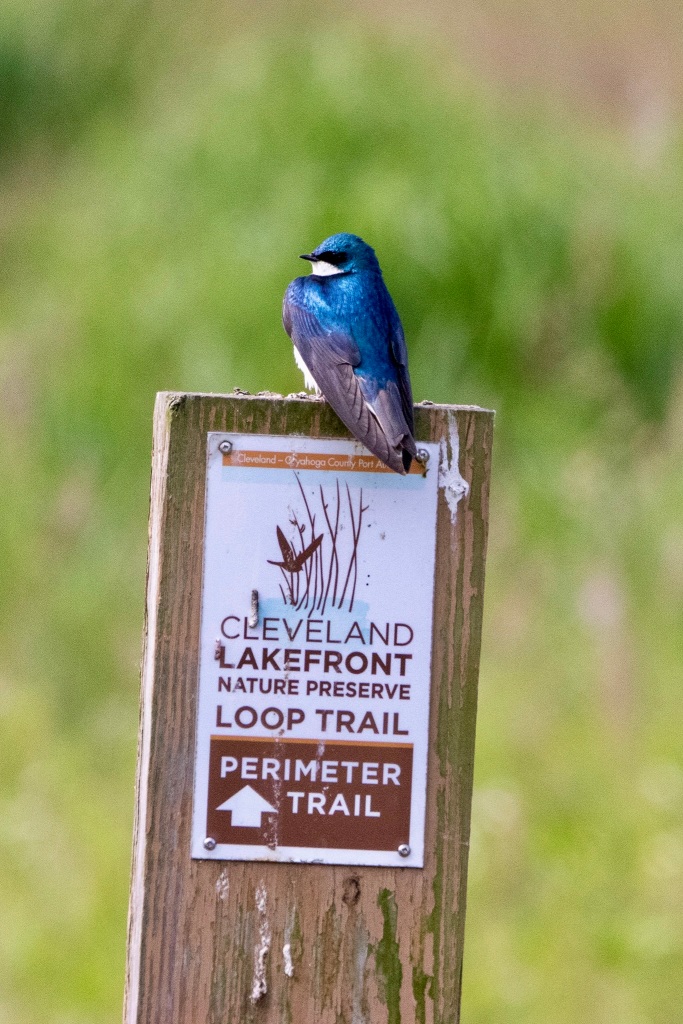
Andy and I staked out a couple of bird boxes that tree swallows call home, and we hoped to capture the iridescent beauties in flight. Andy got a nice one, and I got the fair one below.

A tree swallow returns to its home.

We saw a pair of American kestrels on a bird box far across one of the fields, and Andy used his long Nikon 700mm prime lens to get some decent shots, no doubt. I need to be some yards closer before I can get a shot I’m proud to post here.

I spotted a blue-gray gnatcher in a tree near the old AT&T Building One site. The bird was too quick for my shutter finger, but I was still charmed to see it, my first of the year.

White-throated sparrows are still around, and I was fortunate to spot one just after the gnatcatcher flew off.

White-throated sparrow on a tree.
White-throated sparrow.

As we were on our way back down the trail, some passing birders spotted a brown thrasher on the ground. I was happy to get the one sharp shot I got.

All in all, it was a fine outing.

Brown thrasher standing on the ground.
Brown thrasher on the ground.

Waking up to the robins

Well before dawn, the robins in our neighborhood start singing. I don’t think they’re trying to wake me up or spur me to get out of bed, but in whatever message they’re conveying, they are persistent.

This morning, I listened to them for 5 or 10 minutes, and when I heard a cardinal start singing counterpoint in the distance, I decided it was time to rise.

After getting the coffee maker going, I settled into my easy chair that affords me a good view of our backyard feeders. A house sparrow was the first to appear, a little earlier than usual, I thought, figuring the cardinals would come next.

A moment later, a female cardinal appeared on the main feeder, and her mate soon followed, perching atop my smoker. Then, right on cue, a Carolina wren started singing. I couldn’t see the tubby little creature, but I could hear it, its usual outsized volume-to-size ratio readily apparent.

I could also hear some gentle rainfall tinkling on the metal topper on our chimney, a clue that I will have to delay my morning outing until after the showers stop and a reminder that it’s time to close the flue.

Now that the sun is up, I’m waiting for the goldfinches to start flocking to the nyjer feeder. The suet cakes need replacing in the little house that holds them, and I need to refill the main feeder. I don’t want to disappoint the those voracious sparrows or get side eye from the cardinals.

In the middle of the night, a screech owl pays a call

“What bird is that?” The question, posed by my wife, came at about 2:20 a.m.

“What bird?” i asked groggily, awakening from a deep sleep.

“THAT bird,” she said. “Can’t you hear it? It woke me up.”

“No, I can’t.,” I said, glancing at the clock. I took a few seconds to debate whether it was worth getting up to turn on the Merlin app on my iPhone, which was on the charger next to the open window a few feet away in our bedroom.

“Why not?” I said to myself. When I got to the window, I could hear the bird, which was singing distantly in a low, trilling song at steady intervals. It wasn’t the classic hoot of a great-horned owl that we had heard after sunset a few nights prior.

I listened and listened some more, wracking my brain to see if I could dredge up a memory of a song that I was virtually certain I’d never heard before. Is it even a bird? I wondered. I’d heard a fox crying the night before. No, this a bird — a cuckoo, perhaps? No, definitely not. Then I looked down at Merlin on my iPhone, and there was the ID: Eastern screech owl!

Merlin lit up “screech owl” for several series of songs of the owl, the only creature making a sound in the still of night, save for, briefly, a distant emergency vehicle siren in the distance.

As a check on the ID, I switched to the “explore” section of Merlin and went to Eastern screech owl. The first recording of one there was not a great match, but the second* — Song (Northern) — was a near dead ringer.

Excited to add the owl to my life list, I tossed and turned before falling. back to sleep. That I started this post shortly after waking up about four hours later underscores my excitement. I’m also grateful that my wife’s hearing is better than mine!

*(I listened to the recording again just now and grabbed a screen shot, which tops this post. Also, I thought I had recorded a minute or so of the owl’s song on Merlin, but it seems I forgot to save the recording, alas.)