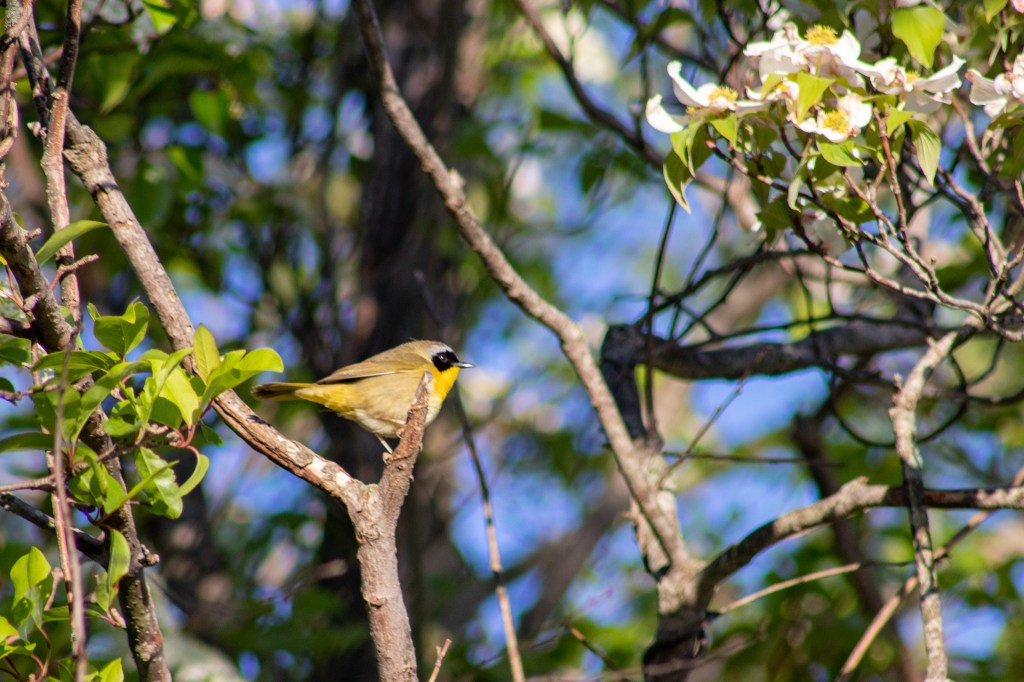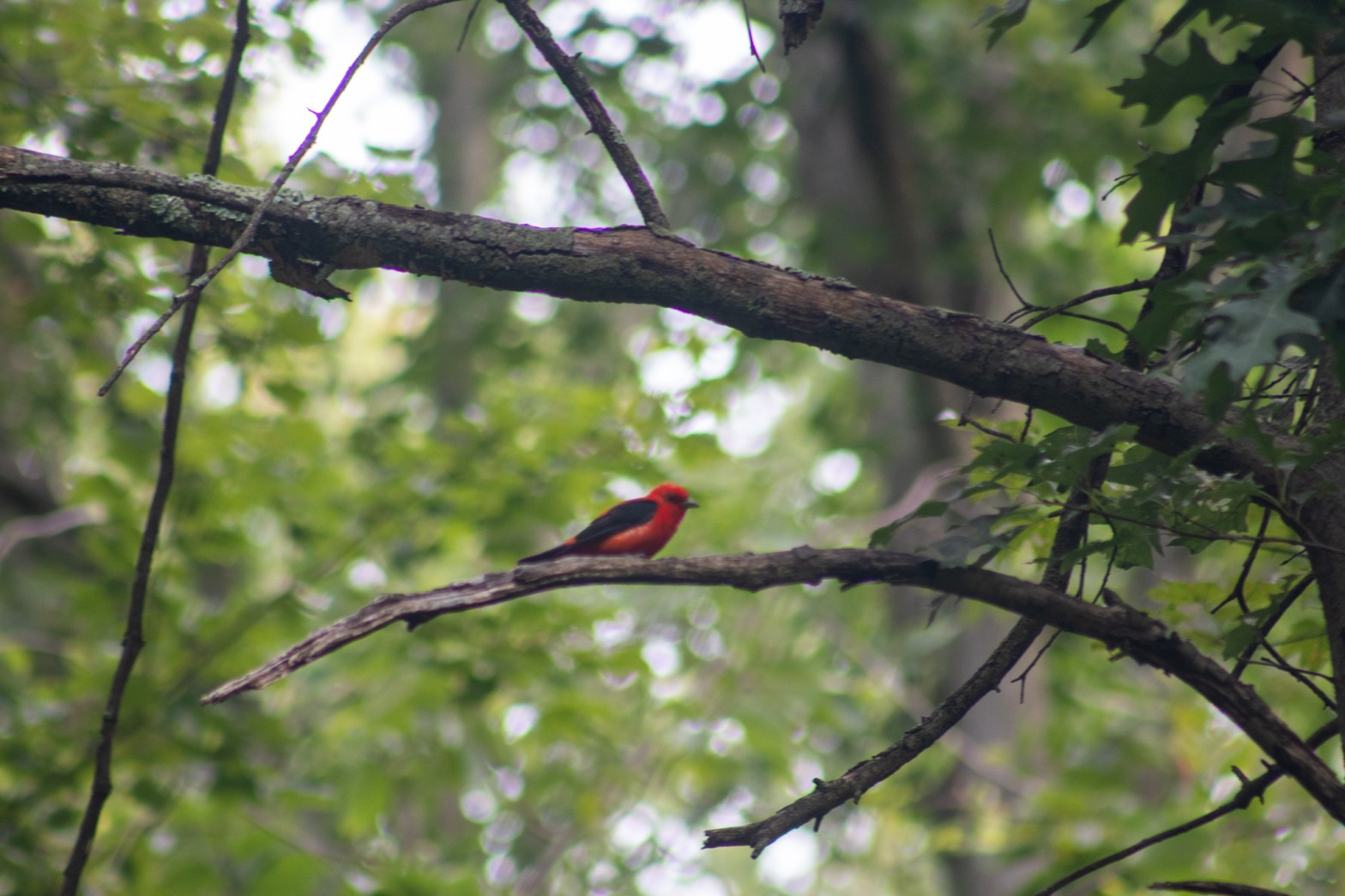
All hail the New Jersey state bird, the American goldfinch

A male American goldfinch, in its splendid plumage, perched on a shepherd’s hook, Lawrence Township, New Jersey, 2017.

The American goldfinch — the New Jersey state bird, dazzling with yellow in mating-season plumage — is not easily overlooked.

I’ve lived 15 years in this state in two incarnations: six years in Union County in the northern tier, and the last nine in Mercer County in the central section.

In all my north Jersey years, I can’t recall seeing one single goldfinch, the brilliant yellow male or the more green-hued female, in our yard. Fortunately, that’s not the case where I live and work now, the Princeton-Trenton area.

The goldfinches flock to our feeders. They are a continuous joy, particularly in the spring. That’s when the males transition from subdued winter coloring to vivid yellow contrasting with sharp black wings accented by bright white wingbars, like the fellow in the photo above.

The goldfinches dart from the trees at the side of our property to peck at the nyjer seed in the tube feeder in the center of our back lawn. It’s not unusual for us to see half a dozen or more of them on the tube, sometimes sharing a meal with house finches or a downy woodpecker.

When I see photos of brilliantly colored birds in other lands, I wish I had the opportunity to see them for real. As I watch the goldfinches flit and flash, I realize how privileged I am to observe them year round, knowing that somewhere far away somebody else is looking at a photo of one, wishing he could be right here in my yard.

You meet the nicest people on the birding paths

A not quite sharp photo of an Eastern towhee, my first of the year, spotted April 17, 2021, at the Mercer Meadows Pole Farm in Lawrence Township, New Jersey.

On-the-trail etiquette is a bit skewed these days because of COVID pandemic restrictions. Midwestern native that I am, I’m usually one to say “hello” or “good morning” or to wave to passersby.

Nowadays, each encounter with an oncoming pedestrian triggers the questions, do I put my mask on, and will the runner/walker do the same? Usually, my answer to the former is yes, even when on a path that’s wider than the six-foot standard for social distancing.

With more and more people getting vaccinated, I expect to see masking expectations and the accompanying tensions ease a bit. That’s good.

This morning at the Mercer Meadows Pole Farm, I came across two women who not only said hello, but upon seeing my camera, wished me good luck in shooting and even asked where I post my images. Surprised and flattered, I mentioned that I had started this site yesterday. (Ladies, if you’re reading, thank you for that and for brightening my morning.)

A bit later, I encountered a gentleman birder whom I’ve chatted with a few times before. He comes down from a county north of here, and each time we’ve crossed paths, he’s taught me something new. Today, he spotted a blue-gray gnatcatcher, and I was able to get a nice view through my binoculars. He also helped me identify the call of the field sparrow (“like a dropped Ping Pong ball“), which I’d been hearing all along my walk.

While I venture out to commune with the birds and other critters in the woods, it’s a bonus to encounter birders like those above, freely and amicably giving advice and trading notes on what we’ve seen or hope to see.

Phoebes in our midst

Eastern phoebe, Bowman’s Hill Wildflower Preserve, New Hope, Pennsylvania, 2019

This has been Infrastructure Week in our neighborhood, as the streets are being repaved. Our three-block enclave has been beset by enormous machines grinding down the old road surface and splaying out the new, kicking up dust and making an awful lot of noise.

Amid that cacophony, I took a walk the other day and heard a faint call that sounded like “fee-be, fee-be.” In more than five years at my current location, I’ve never seen or heard an Eastern phoebe, so I figured I was mistaken.

A day or so later, my wife spied a bird near one of our feeders and asked, “What kind of bird is that?” It flew off a split second later. Noticing its dark top and white underside, I was a bit puzzled but figured it must be a dark-eyed junco, either one who was late in heading north than the usual reverse snowbirds we see or maybe one migrating from farther south.

Back on the golf course on June 7, I had my camera with me and was able to take this fuzzy shot of an Eastern Phoebe, probably the same bird I saw earlier this spring. This time he gave me a signature tail flick before taking off.

This morning, while walking along a pond on the golf course behind our street, I watched a great blue heron to my right fly away once it sensed my approach. Then I heard clearly the trochaic call of “fee-be, fee-be.” There, about 15 feet away on the edge of wooden bridge over a creek just off to my left, was a no-doubter Eastern phoebe. It flew into a tree, another and then another before take its leave of me.

What a thrill! I’ve rarely seen phoebes, and I only recently got acquainted them on a beginner’s bird-watching class my wife and I took at Bowman’s Hill Wildflower Preserve just over the Delaware River near New Hope, Pennsylvania. On a subsequent visit, the phoebe shown at the top above presented himself to me near the parking lot as I was about to head home.

I think it’s likely that our backyard visitor was a phoebe, and it’s even more likely that the one I heard around the block was one because that’s near the woods of the golf course.

Come and stay awhile, little bird. You are welcome here always.

Editor’s note: one of the hazards of learning to be a better birder is mistaken identifications. While I properly identified the phoebe in the wild, when I initially wrote this post I wrote “peewee” instead. I have corrected that. So if you’re looking for infallible advice here, you won’t find it. Should you spot anything in error, dear reader, please don’t hesitate to let me know.

Hello, world!

Eastern Bluebird at Mercer Meadows Park, Lawrence, New Jersey, 2021

Inspired by a renewed acquaintance with an old friend who is a wonderful nature writer, I’ve decided its time to do what I’ve been contemplating for months: create an outlet for my observations on the natural world around me.

Since switching to remote work in March 2020, I’ve spent virtually every day at home, and many of those days venturing out to some of the wild places nearby. New Jersey life is self-evidently wild, but I’ll be concentrating on the natural spaces and places I frequent.