On the hunt for that Superb Owl shot

Finally I got back to the Mercer Meadows Pole Farm for a late afternoon visit this weekend and got a fair look at a short-eared owl. Although I continue to visit regularly in the morning, I had stayed away on weekend afternoons because it was difficult to find parking as photographers on the prowl for owls were jamming the park.

After paying a visit Saturday morning at the bitterly cold 8-degrees sunrise, I took advantage of the late afternoon sunshine and relatively balmy mid-20s temperature to head back. Objective: short-eared owl photo.

The lot was nearly full, but cars were not parked willy-nilly along the driveway to it as they had been previously. Still, there were plenty of photograhers lugging tripods and long lenses out on the paved section of the Lawrence-Hopewell trail running through the park.

A Northern harrier made an initial appearance, and I was hopeful a “shortie” would soon follow. I was maybe a third of the way up the trail from the entry curve to the woods when suddenly a bird popped out of the brush back down the trail.

It was indeed a short-eared owl, and it flew up and over the central section of the park before heading off toward the parking lot and who knows where beyond that.

After tracking the bird in my binoculars for a few seconds, I picked up my camera and took a few shots. What showed up on screen at home was better than expected, and the sharpest image and the only one worth sharing tops this post.

I put in the “pretty good” category, but I still have a long way to go before getting an owl shot of which I can truly be proud.

At least this year I’m seeing the occasional owl. I had not seen one in the wild — anywhere, ever — before December, so my odds are improving.

I should add sporadic sightings of a barred owl and even a couple of long-eared owls have come in several times in recent weeks at the Pole Farm. The barred owl has typically been spotted on the left side of the woods that begin after you’ve walked half a mile up the central, dirt path coming out of the Cold Soil parking lot.

I’ve looked and looked but haven’t been able to spot the barred owl or the long-eareds, either. I haven’t heard of any sightings on the Reed Bryan Farm side of Mercer Meadows, if you were wondering about that.

If you want my advice on finding those owls, go to the Pole Farm when I’m not there!

Sometimes, the birds come to us

You can tramp for an hour through the woods and fail to find a bird to photograph, and sometimes all you have to do is look up from the kitchen table to find something magnificent paying you a call.

The latter happened yesterday as my wife and I sat down to lunch. I was one or two bites into my ham salad sandwich when my wife blurted out, “Hey, it’s the big one!”

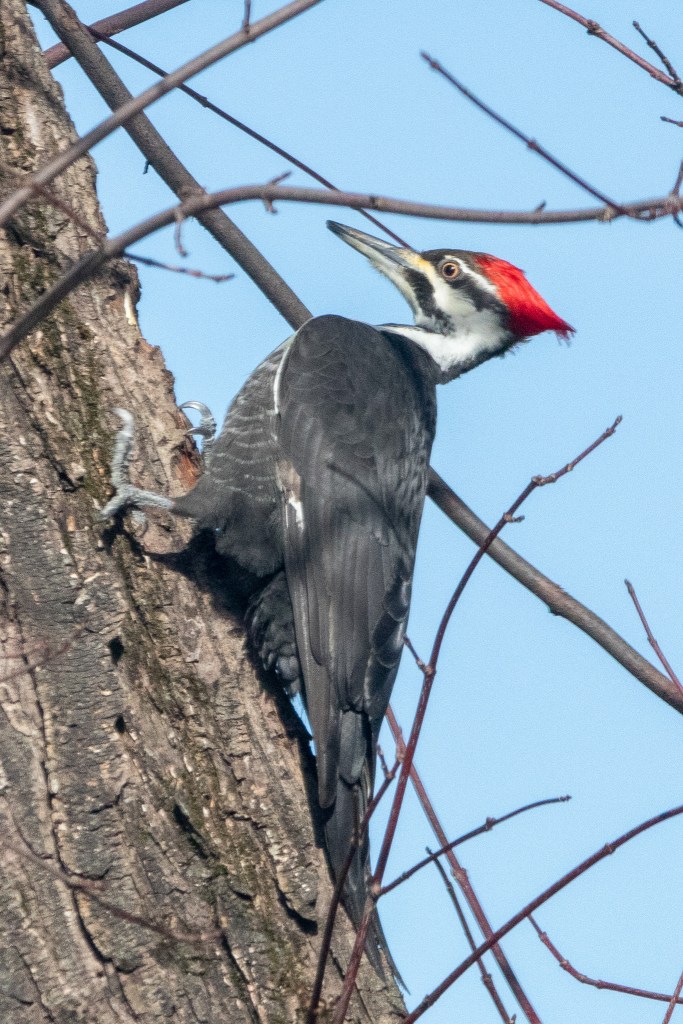
The “big one” was a pileated woodpecker, chipping away at one the maple trees at the back edge of our property line. Our back yard is wide, not deep, so the bird was only about 75 feet away.

I grabbed my camera and shot a few frames out the dining room window. As quietly as I could, I slipped out the back door to shoot some more.

The best of my first few shots.

The bird suddenly dove toward the ground, then flew over to a cluster of trees at the back corner of the lot. I took a few more photos, then came back inside to get ready to head out for the afternoon.

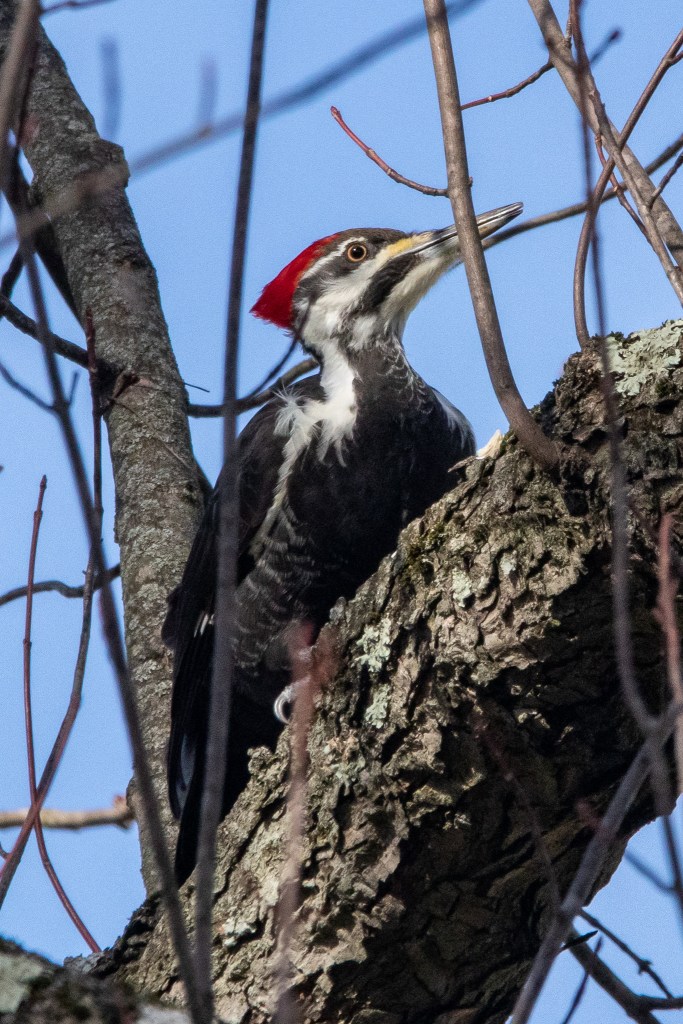
As I was gathering my things, the woodpecker was still banging away in the tree cluster. I couldn’t resist taking a few more shots. As my wife noted, at that point, the bird was facing toward us, and the sunlight was favorable.

Any visit by a pileated woodpecker is a cause for elation. It may be hard to believe, but we’ve seen many more bald eagles fly over and around our home than pileated woodpeckers. By my recollection, this was only the third time a pileated has visited, while we’ve seen bald eagles here at least a dozen times.

We welcome all avian visitors to our property, with one exception. Canada geese come by the hundreds to the golf course that our property adjoins. Should any one of them cross the line into our yard, my wife brings out her bullhorn and orders them to back off. I handle the fertilizing of our yard.

The best of the second batch of shots.

Patience pays off, in birding and nature photography

On most Saturday mornings, I start my day at the Mercer Meadows Pole Farm. I don’t have the pressure of having to get back in time to catch a bus to work, so I have more time to wander the fields.

This morning, I arrived before dawn, hoping to catch sight of the short-eared owls that have been visiting this winter. I also thought I might have a chance to spot a woodcock that had been reported this week on the Reed Bryan Farm side of the park.

I would strike out on both of those counts, but I did make one fortuitous decision. As I looped around the park, I came to an intersection with a turnoff to Reed Bryan. I had been in too much of a hurry to get out of the house to put on my knock-off Bean hunting boots, and as I stood in my low-rise, slip-on Merrell hiking shoes, I hesitated to make the turn that would take me across a long run of muddy trails.

But the temperature was a notch or two above freezing, and I figured the ground would still be frozen enough for me not to get stuck in the muck.

That call turned out even better than I’d imagined. Immediately after turning onto the trail, I saw a Northern harrier sailing ahead of me. I kept along the trail and at spot where the woods stopped and the terrain was mostly open field, I could see the harrier parked in the stubble a hundred yards ahead.

I walked up slowly, took a few shots from a distance and slowly crept up to a trail-marker post to steady my camera. Anticipating that the bird would sense me and take off, I switched my camera dial to shutter priority and aimed. On cue, Ms. harrier took flight, and I pressed the shutter. The bird landed another hundred yards or so away, too far for me to get a fair shot of her on the ground.

About that time, my friend Mark — whom I often encounter on the trails on Saturdays — came up from behind. We walked the remainder of the circuit back to the parking lot, and at some point on the way I mentioned that I was still hoping to get a killer harrier shot. I’ve shot many previously, but never one when the light was just right and the bird was within a decent range and facing me. I said I knew that shot would come eventually, as long as I remained patient and persistent.

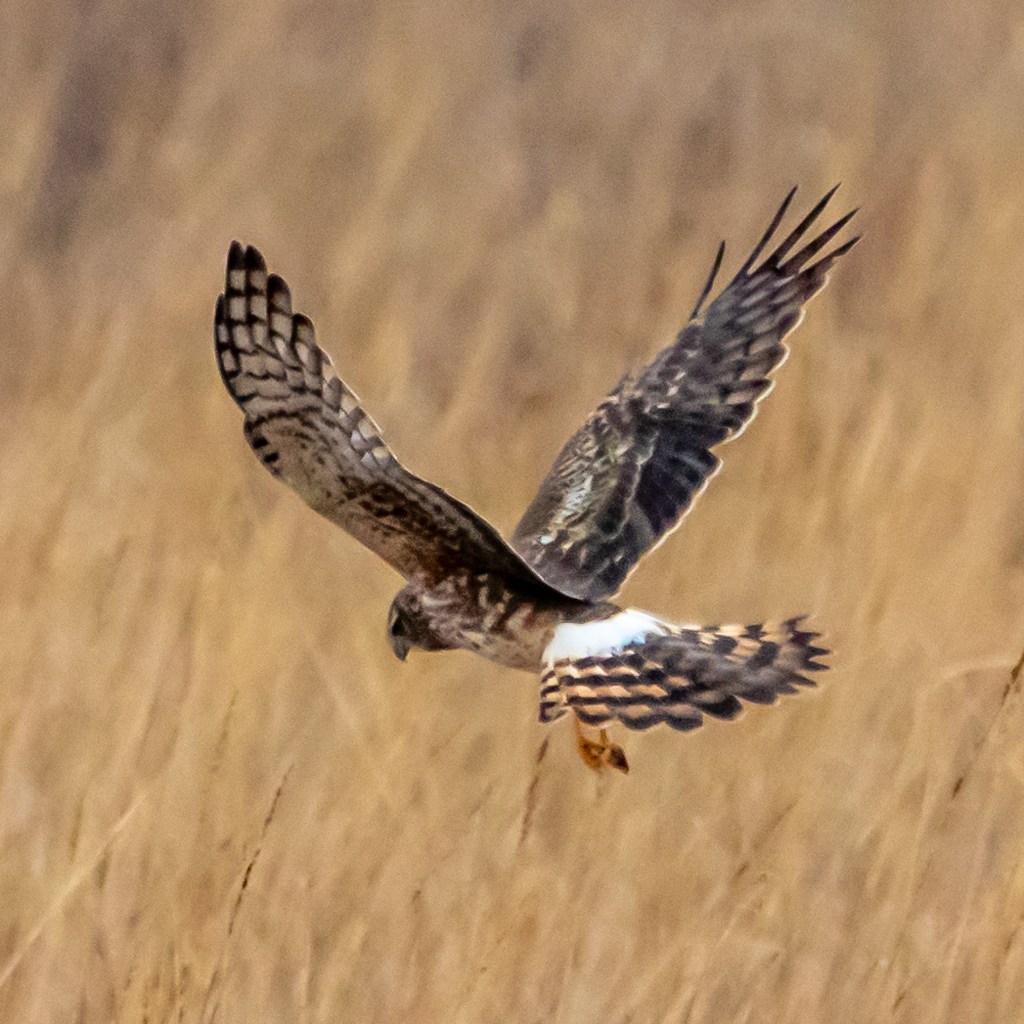
When I got home and brought the day’s catch of shots up on screen, one frame stood out, and it tops this post. I had managed to get this one sharp frame of the harrier as she was looking back toward me. Because of the warm, low-angle light, the detail on her feathers was good, and her wingtips were nicely displayed. There was also a catchlight in the eye. With a few minor adjustments in Lightroom, I could happily point to the best harrier photo I’ve ever taken.

Now to go back out and get a better one!

Appreciating the quiet times of birding

It’s a relatively quiet time for birding in my part of the world, as I’m keenly aware every morning I walk the fields and woods of the Mercer Meadows Pole Farm or the nearby locations that I frequent.

It would be different if I lived closer to the Jersey shore, which is teeming with wild birds hanging out in their coastal winter quarters. By comparison, the Delaware River valley an hour’s drive to the west is at its lowest point of activity of the year during these cold, gray weeks in January and February.

Yet there are sights to see and appreciate, such as huge flocks of blackbirds and long strings of snow geese flying overhead. Dark-eyed juncos dart from path to brush as I approach them. Save for the papery tan leaves of the beech trees, most of the woods are bare, affording clear views of the woodpeckers — downy, hairy and red-bellied — tapping and hammering above me.

A male hairy woodpecker stops on a branch just long enough for me to snap a photo.

Yesterday I spotted a pileated woodpecker making an undulating flight across the woods that I undoubtedly would have missed were the canopy full of leaves as it is during most of the year.

In the relative quiet of the woods, what calls and pecks I do hear stand out. Last week as I stopped on a wooden bridge at a crossroads of two main Pole Farm paths, my Merlin app lit up with the cry of red-shouldered hawk.

I looked in vain to find the bird, presumably the one that I’ve seen several days over the past few weeks. I saw no hawk but as I kept looking in the changing directions of the cry, I kept seeing a blue jay.

It slowly occurred to me that what I was hearing was the blue jay imitating the hawk. A short while, after I’d moved a few hundred yards along the trail, the red-shouldered hawk flew overhead.

The bare woods of winter provide new opportunities to observe the avian action, just as they prompt us to anticipate Spring when the warblers arrive and the vireos and thrushes fill the greening trails with song once more.

This red-shouldered hawk has been hanging out at the Mercer Meadows Pole Farm the last few weeks. I’ve named it Shakey for the way it shakes its tail side to side when perching.

Birding joy: Finding the unexpected on your camera roll

It happens frequently on my outings that I point my binoculars at a distant bird and can’t figure out what it is. If I’m lucky, I have enough time to point my camera and capture a few frames, hoping that the bird’s identity will be revealed once I get the images up on screen back home.

The past three days are cases in point. On Saturday, I went to John A. Roebling Park in Trenton to see what was happening at Abbott Marshlands. A lot of birds were out on Spring Lake with the two mute swans who have been in residence for many months.

A couple of birders making their way back to the parking lot had a seen a redhead through a scope. I wouldn’t find it but I was able to learn from the birders that the birds floating in the center of the lake were mostly gadwalls. I couldn’t figure out exactly what they were by peering through my binoculars but I squeezed off several frames in my camera, hoping they’d reveal what was out there.

Drake (left) and hen American wigeons on Spring Lake.

When I got home, I was able to confirm that several gadwalls were floating near the swans, but as I zoomed in, I spotted a pair of birds that clearly weren’t gadwalls. One had a two-tone head, appearing green and brown through the grainy image on my screen. The image I cropped was too poor for the Merlin app to assess, so I put the image up on the Central New Jersey Birding Facebook group and hoped for an expert to weigh in.

Within minutes, I had the answer: it was a pair of American wigeons, something I wasn’t expecting to see.

My camera paid off again Sunday on the Reed-Bryan Farm side of Mercer Meadows. As I came down the path from the parking lot, I spotted a bird atop one of the dead trees spiking out of the gully to the left. The bird was in shadow and I had no chance at an id through my binoculars. Maybe a kestrel, I thought, but I hadn’t a clue. I pointed my Canon and hoped for the best.

As I returned to the parking lot, two big black birds came swooping in. One flew overhead and the light was right, so I raised by camera and blasted off a few frames. Turkey vultures, I figured, with just a nagging touch of uncertainty in my head.

Home I went, and I first called up the putative vulture images on my laptop screen. Not so! It was a common raven, a bird that isn’t often spotted at Mercer Meadows.

Merlin at Mercer Meadows.

I moved down several frames to the bird in shadow, and my decision about 18 months ago to switch to shooting RAW images paid off again. A quick auto-fix of the image revealed the bird was a merlin, which made perfect sense. Merlins often sit atop those dead trees in that part of the park.

With Monday off for the Martin Luther King holiday, I did a morning Pole Farm visit, drove up to Somerset County to look in vain for sandhill cranes and made a final outing in the afternoon at Colonial Lake and Park near home.

It was all mallards and ring-billed gulls, or so it seemed until I started making my way back to my car. Across the lake I spotted a small group of birds on the water. Through my binoculars, I could make out a male common merganser to my left and a male hooded merganser to my right. In between were a few brown birds, which I figured were females. But of which type of merganser?

The camera again captured enough detail so that when I got home and brought the images on screen, I could make out the puffy heads of what clearly were female hooded mergansers.

Many birders get by on the naked eye and binoculars. I suppose I could, too, but for me, the camera and my zoom lens are essential equipment that bring more joy of discovery day after day.

Not a vulture: a common raven soars above me at the Reed Bryan Farm side of Mercer Meadows.

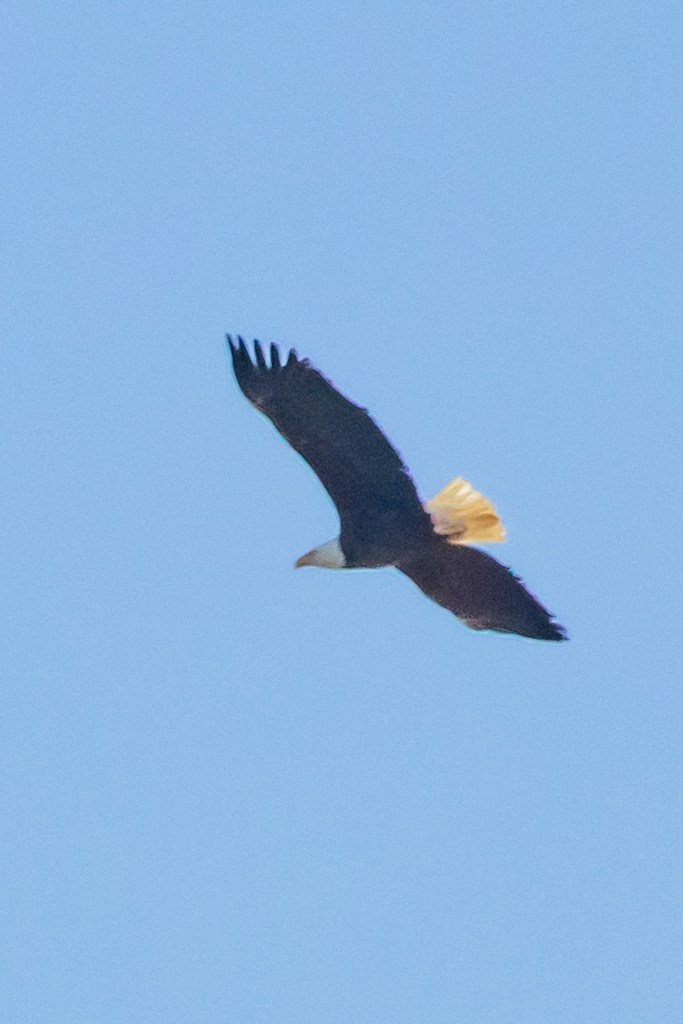
The bald eagles living next door

Although I generally head to the Mercer Meadows Pole Farm for most of my morning outings, I occasionally switch my destination to another nearby park. I did so today and was rewarded with an encounter with two bald eagles.

I headed to Colonial Lake and Park, which is a mile and a half from my home. A suburban housing development surrounds the lake, which is just off Business U.S. 1 as it runs through Lawrence Township toward Trenton to our south.

Seeing several dozen Canada geese as I approached the park, I parked in the main lot, guessing I might have some birding luck if I walked all the way around the lake. My first surprise was a pair of hooded mergansers swimming and diving in the center of the lake. I had not seen them previously at Colonial Lake, and I had not seen any previously this month. A good start!

When I got to the far side of the lake, I came upon another photographer. We chatted briefly and I continued on before suddenly coming to a stop. Two big birds were ahead in one of the trees overhanging the lake, a few yards apart on separate branches. A quick check in my binoculars left no doubt what I was seeing: a pair of mature bald eagles. I hollered to the other photographer, and we each shot from a distance.

I kept walking slowly toward the eagles and ultimately spooked them, to the annoyance of the other photographer. I shouted back “sorry” and kept walking. The eagles had flown across the lake and landed together high up in a tree close to the homes ringing the east side of the lake.

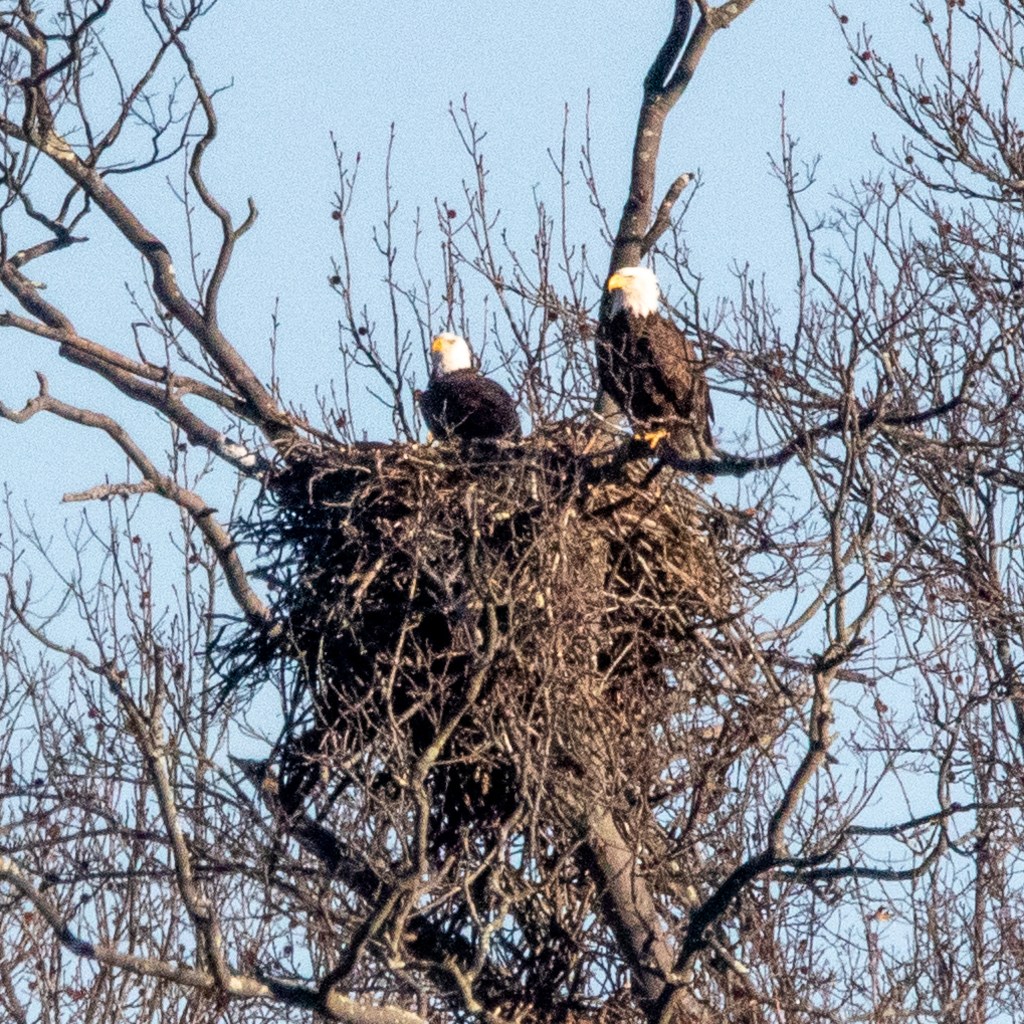
Two bald eagles, as shot from across Colonial Lake. Through the viewfinder, I didn’t realize I had captured them with their beaks open. It was a pleasant surprise to find when I brought the image up on screen at home.

From the trail, I took several shots across the lake and completed my circuit to the parking lot. The eagles were still perched next to one another, and I started walking toward the lake’s edge to get closer for a better shot. I was hoping to catch the two of them in profile, but as I maneuvered into position, one of the birds stirred and flew out over the lake. I snapped off three frames, and the best of them tops this post.

I had seen bald eagles flying over Colonial Lake before, including one directly above me last month. But never I had I seen them perched and positioned where I could take a decent photo.

I suppose I could whine that the light wasn’t better than it was, and who knows what I might have seen at the Pole Farm had I driven that way. Today the birding gods smiled upon me, and I am grateful to have taken a couple of memorable shots.

Too much of a great thing: Owl overload at the Pole Farm

Reports of owls — short- and long-eared — have been filed from the Mercer Meadows Pole Farm multiple times during the last few weeks, and crowds are gathering.

I’ve spoken with several birders on my last few trips, and as thrilled as we are that owls are about, it is becoming a challenge to find parking in the late afternoon. This morning, one birder told me the main lot at the intersection of Cold Soil and Keefe roads was full on a recent day by 2:30 p.m. Another told me it was almost full at 1:30 p.m. on one of his prior visits.

I know from my own experience around 4 o’clock last Thursday afternoon that the lot was full; I was lucky to find a spot on the driveway. The next day, I went back about 3:50 p.m. and not only was the lot full, but the driveway was cluttered with cars. Frustrated, I drove on to neighboring Rosedale Park.

A short-eared owl flies at the Mercer Meadows Pole Farm. I took this shot in the fading light just before sunset Dec. 29.

At the Pole Farm, the biggest gaggle of photographers stakes out the area where the paved Lawrence Hopewell trail makes a big curve once you walk past the restrooms and the red arches marking the location one of the original AT&T buildings. The short-eared owls have been appearing shortly before sundown, and I’ve twice seem them in what appeared to be aerial combat with Northern harriers. (I’ve yet to see or hear a long-eared owl.)

I expect the crowds will persist for a while. Should you wish to go, expect that you might have to get creative to park. Should there not be space for you in the lot and drive, you can head down Cold Soil Road, park on the side and walk back into the park. There’s no parking along Keefe Road near the park entrance.

Another option would be to park in the Reed-Bryan Farm or Blackwell Road parking lots at the other ends of the park and walk the trails to the Pole Farm side. That’s a good hike of more than a mile, and you’d need to walk back in the dark after sunset.

Whatever you do, please stick to the trails as stipulated by park rules and don’t wander into the woods. That’s not good for the owls.

Ringing out 2022 with one last birding outing

I could not let this final day of the year pass by without heading out with my camera and binoculars, even if the weather was less than ideal. Heavy fog rolled in before sunrise and remained with us the entire day.

Hoping I might catch a few waterbirds that were unlikely to appear at the Mercer Meadows Pole Farm, I drove out to the Plainsboro Preserve about 20 minutes from home. Lake McCormack, the centerpiece of the park, was socked in with fog. Through the trees on the main trail I could faintly make out scores of Canada geese, although I had no trouble whatsoever hearing them. They were making their presence known liberally.

I walked the main trail and turned right onto the blue trail, then turned right again onto Maggie’s Trail. I like that trail because it’s on a spit jutting into the lake, and it has views on each side. While previous warm-weather trips gave me sightings of Baltimore orioles and warbling vireos, no songbirds were present this day, and I could only see maybe 100 feet off shore in either direction.

But surprises were in store. First, I spotted three birds in the water off to the right. I assumed I was seeing three ring-necked ducks. I took a few quick photos before they slipped into the fog.

I continued walking and reached the end of the trail, telling myself the trip was worth it just to see those ring-necked ducks. I turned back and quickly spotted a small, duck-like bird to my right. It hung around long enough for me to snap a few pictures through the branches, and I could not figure out what it was, even while Googling a few guesses on my cell phone.

Ruddy duck swimming just off shore on Lake McCormack.

The answer would be revealed back home, when I put the photos into the Merlin app. The answer — a ruddy duck, a lifer for me, No. 202!

I went back toward the parking lot as a misty rain began to fall. I wandered up onto the observation deck at the park visitor center. It was closed, but the feeders surrounding the building were very much open, with cardinals and sparrows darting about the nearby bushes. I was able to capture a white-breasted nuthatch opening its beak, and that picture is atop this post, showing the fine rain in the background.

I came home, sorted through my photos and updated my e-Bird report, not expecting a surprise that would come in by email from an e-Bird reviewer late in the afternoon.

My three ring-necked ducks were actually two ring-necks and a redhead, another lifer for me, No. 203.

Two ring-necked ducks swim in the foreground, with a redhead just ahead of them at back right.

A little sheepish about my mistaken ID, I fixed the record in e-Bird. I also decided to check to see how many checklists I filed this year. I thought I’d be close to one per day, as I occasionally make two or even three reports on a single day and bird from home on days I can’t get away.

The total: 370, just over one per day.

I don’t know what the new year holds, but I’m excited at the prospects for birding and sharing my stories and photos with others. Thanks to all who are reading this post and following me. I wish you good health and great adventure in 2023!

A Northern cardinal perches near the visitor center at the Plainsboro Preserve.

I finally see my first owl, and a bonus bird!

Since I began birding seriously the last few years, I’d lamented that I had never seen an owl in the wild. Even at the Mercer Meadows Pole Farm, which usually draws owls during the winter months, I’d never seen one either flying or perched in a tree.

On Saturday afternoon, that changed.

Word had gotten out through birding alerts that short-eared owls had been spotted at the Pole Farm. As I pulled into the last available parking slot at the main Keefe Road parking lot, I spotted a gaggle of photographers around the bend on the paved Lawrence-Hopewell Trail. They had staked out a section of the big fields where they expected, or at least hoped, to spot a shortie.

I rendezvoused with my friend Mark and his dog, who needed some exercise. So instead of joining the scrum, we headed up the central path toward the woods, gambling that an owl might emerge from the tree line. That didn’t happen, although we saw three female Northern harriers.

We wandered slowly through the cedars at the old AT&T Building One oval, hoping to spot an owl in the branches, but no luck. So we headed down the LHT back toward the clusters of photographers closer to Keefe Road. On the way, we spotted a couple of “gray ghost” harriers, although they were too far off to catch on camera.

With sunset coming on, Mark headed back home while I stuck around a bit longer on the fringes of the photo bunch. My priority was to see an owl; I wasn’t concerned about getting a photo, although I bumped up the ISO on my camera to 3200 just in case.

Then it happened.

A short-eared owl came racing across the field, chasing a harrier. Still not sure of what I was seeing, I got the owl in my binoculars and followed it for a second or two. It disappeared, only to fly up with the harrier for an aerial confrontation that lasted a split second. Gasps from the photographers, then the birds disappeared from view.

Finally, I’d seen my first owl, and a few of the photographers who got the owl showed me images in their camera screens. I lingered a few minutes before heading out of the park, not expecting a treat that lay in store when I got home.

About 6:15 p.m., I went out to patio behind our house to turn on the grill, and almost immediately I heard a loud “hoo hoo huh-hoo.” A great horned owl was close by, likely in a tree just beyond our backyard property line. The Merlin app kept lighting up as the owl continued to hoot.

I went inside to get the steaks and called my wife to come out and listen. A few seconds later, the owl hooted a couple of times, then went quiet.

Later in the evening, I discovered that the short-eared owl had taken my life-list count to 200, a fitting milestone. The great horned owl took me to 201.

So I got my owl and then some. What a thrill! I can’t wait to go out again.

Northern harriers at sunset, and that is enough

The sun finally came out late in the afternoon Saturday, which up until that point had brought nothing but rain and drizzle. I headed out to the Mercer Meadows Pole Farm, hoping for a chance to catch something worth photographing.

In the half hour before sunset, my best bet was to have a chance at seeing a Northern harrier or two hunting over the fields as the light started to fade.

From the Cold Soil Road parking lot, I headed up the central trail, hoping to spot a Wilson’s snipe poking among the puddles in the stubbled fields. I had flushed one (my first!) earlier in the week, but I would not find one this day.

Instead, almost as if on cue, two Northern harriers appeared off to my left, chasing one another far across the field, near the observation deck in that part of the park. I had wonderful looks at them through my binoculars, but they were too far off at first for me even to bring my camera up to eye level.

With the late afternoon light dimming, I couldn’t distinguish whether they were females or one female and a “gray ghost” male. I continued along the path for a bit, then turned back toward the car. Two of them flew up above the tree line, and I snapped a few distant shots of them silhouetted against the sunset.

A third harrier appeared and then a fourth. I watched all four fly simultaneously, and at one point I had three within view in my binoculars.

As I neared the parking lot, I saw a lone harrier flying to one side of the field, and I wasn’t certain if that was one of the four I’d watched a few minutes earlier or whether it was a fifth.

I saw only one other bird out, a young mourning dove pecking on the trail before flying off.

Total count: two species, five birds — one of my lowest Pole Farm totals — plus one so-so photo to accompany this post.

But that’s not what matters. Watching just those first two harriers at play was worth the trip, and seeing the four at once was a delightful bonus. Even that single dove made me smile.

I’ll go back out tomorrow to see what I can see.