Since I am dealing with temporarily limited mobility and walking with a cane, I felt a kinship with a male American goldfinch that came to our nyjer seed feeder this afternoon.
On a beautiful late summer day, I couldn’t resist parking in a chair on our patio, hoping to spot a wide variety of birds, from the regulars to, with luck, a warbler transiting my part of New Jersey.
It was breezy, so other than a gaggle of jabbering house sparrows, few birds showed up during the 45 minutes I was on watch. The highlight came when a male goldfinch, nicely lit by the sun, arrived and perched atop the nyjer feeder. I got a nice look at him through my binoculars, and I zeroed in on his left foot.
Something wasn’t right.
While his right foot clamped him atop the feeder, he held the left foot up. It appeared mangled, almost pancaked. The bird surveyed the area without wavering, and I wondered if he’d be able to grab onto the feeder tube and have a bite to eat.
Not to worry. The little guy flew down onto the tube and ate heartily. I didn’t have my Canon camera with me, so I tried my best by zooming in with my iPhone. If you look carefully at the photo topping this post, you can see him left and slightly below center, roughly on a line with the bottom of the suet feeder to the right. The sun was shining through the feeder, throwing a shadow, which explains the black band below his neck.
I was impressed at how this little creature with a handicap was adapting and making his way through the world regardless.
That’s an inspiration for all of us living with handicaps, temporary or permanent.
Thanks, little bird, for showing me the way as I regain strength on my left side.
If you are reading this post, you’re either already a birder or taking your first steps on the path to becoming one. Even if neither of those situations applies, I recommend that you read a wondeful book on discovering the joys of birding: Field Notes from an Unintentional Birder: A Memoir, by Julia Zarankin.
Several weeks ago, I received an out-of-the-blue email from Julia, who had seen one of my Mercer Meadows reports on e-Bird. The blue grosbeak is a nemesis bird for her, one that maddeningly has eluded her view, even with her high-quality Zeiss binoculars.
I saw plenty of blue grosbeaks at the Mercer Meadows Pole Farm last year, and as spring wore on this year I was hearing them and wondering when I’d see one. I finally spotted one high up in a tree on the Reed Bryan Farm side of the park one morning, and Julia spotted that report.
She was coming to the Princeton area to visit friends and asked me for pointers on where to spot one of the grosbeaks. I wrote back with my best instructions and offered to meet her at the park when she got to town.
On a Saturday morning, we met in the parking lot and headed down the trail. While we saw plenty of birds on our walk (her affable husband, Leon, joined us), we didn’t see or hear a single blue grosbreak.
Darn.
But if you read Julia’s book, you’ll know that missing your target bird is part of the birding game. Appreciate what presents itself to you in the moment.
As we walked back to our cars, we traded notes on people we knew in common at Princeton University, where I work and she had gotten her Ph.D. That’s how I found out Julia is a writer (widely published in Canada) and asked if she’d written any books.
That’s when she mentioned “Field Notes,” which I ordered on Amazon later that day.
Julia is as delightful a writer as she is a person. The book isn’t just about birding. She writes about her upbringing in Ukraine during the late years of the Soviet Union, her years as an immigrant in Canada, the breakup of her first marriage, finding new love with Leon and their ambitious travels.
Julia is a wonderful storyteller. I found a lot of commonality between her early experiences at birding and my own, including feelings of inadequacy from misidentifying or not recognizing birds in front of other birders (like the time I thought what might be something exotic turned out to be a male house finch).
The book recounts with good humor some of her misadventures netting and banding birds and camping out in wilderness areas for birding research. Julia also notes the joy of discovering the abundance of birds near home. I’m itching to drive to Toronto to visit some of her favorite spots.
To me, Julia represents the best of birders: a kind and caring advocate for birds, curious and eager to see more of them and appreciate their magnificence, and willing to share her knowledge (without resorting to “birdsplaining”).
Take my advice: get the book. You’ll meet a new friend in Julia, and maybe you’ll be fortunate enough to meet her some day in the wild as I was.
From my indoor perch I’ve been watching a pair of house wrens hour after hour making furious sorties from the birdhouse suspended from our larch tree, in search of food for what I presume is a brood of wee offspring.
The parents are relentless in their mission, darting in and out. I figure they resemble any human couple getting a handle on a round-the-clock feeding schedule for their newborn.
My wife and I know how tiring that loving challenge can be, and we salute Mr. and Mrs. Wren for their devotion. We also wish them a good night’s sleep!
Some medical adventures have temporarily knocked me off the birding trails, and in my recovery I am reacquainting myself with the joys of backyard birding.
I’m often parked in my recliner, facing a wall of picture windows offering a visual gateway to our modest yard and the golf course adjoining our property.
Ever since my wife restocked the feeders, we’ve been beset by swarms of common grackles, one of which tops this post.
With my camera nearby, I’ve managed to take a few shots.
I would have had one of a cardinal, but I was so busy watching him check out one of our herb planters that I missed the opportunity.
Right now, I’m more concerned with savoring these visits than I am with snapping them.
On Monday the week before last, I didn’t feel right when I stepped out of the car at Mercer Meadows. I felt out of whack and decided to drive home, and called in a rare sick day at work. Later that morning, I tumbled out the back door onto our patio.
This birder was grounded. I will spare you the medical details, but I made visits to two emergency rooms at hospitals, was admitted at the second, and I’m writing from a third, a rehab place where I’m undergoing physical and occupational therapy. I’m improving steadily, and the only birding i can do is by looking out the windows. While in PT yesterday, I spotted a gray catbird outside, which was reassuring.
I will undergo several more days of treatment before I can get home and back out with my binoculars and camera. I miss the birds, especially the common yellowthroat topping this post, who often sings me a morning song at the Pole Farm.
No photo tops this post because on my last birding outing I took no photos of birds. In fact, in my 30-mile drive south to Palmyra Cove late this morning, I only saw three of the meager 14 birds I observed across seven species.
That’s it. Two cardinals in flight, and a third bird (probably a red-eyed vireo) that was tantalizingly close in a tree right in front of me. I couldn’t focus my binoculars quickly enough before it flew off.
It was hot and humid. I was sweating profusely and dragged a bit on the back end of a two-and-a-quarter mile walk. Not even a single gull flew by.
A bad day, right?
Wrong!
There are no bad days in birding.
Even if I had neither seen nor heard a bird, I had the privilege of walking through wooded paths and strolling along the sandy beach of the tidal Delaware River, the Philadelphia skyline in view — on Independence Day, no less.
I’ve made a few afternoon trips out to Mercer Meadows Pole Farm and found so few birds that I returned to my car and didn’t log the visit on eBird.
But those days are rare, and although they are a little disappointing, I still appreciate them because they bring me outdoors.
I have lived my life in cities and suburbs, and I’ve always wondered what it would be like to be “outdoorsy.”
I’ve become that over the past few years, with the gear to prove it: trail shoes, hiking boots, hunting boots, floppy hats (one with a havelock), a rain hood for my camera, and more.
For my transformation, I credit the birds. They enrich every day, even if only a few of them reveal themselves to me.
For the past two weeks, a male dickcissel outside his normal range has been visiting the Reed Bryan Farm section of Mercer Meadows park, singing throughout the day to attract a mate.
So far, no females have replied, at least according to the dozens of birders who have come to the site to see this unusual visitor.
Dickcissels migrate from the Northern tier of South America through Central America and breed in the American Midwest, although some pass through sections of the East Coast.
Two years ago, one dickcissel showed up at the Reed Bryan Farm, drawing lots of birders to see what eBird lists as a rare bird for this area. Last year about this time, several dickcissels spent several weeks on the Pole Farm side of Mercer Meadows, and I was pleased to see them.
The bird most often sings from the bare branches at top right.
When the one arrived this year, I quickly went out to spot him, and he did not disappoint. He was easily seen and even more easily heard from the Reed Bryan parking lot, clinging to his favorite perch in the bare branches atop a big tree beside the lot.
I spotted him again this morning but he flew off into the fields before I had a chance to photograph him. The light was poor, and I needed to walk back to my car at the Pole Farm lot, so I didn’t stick around either to wait for him to come back or to seek him out in the fields.
Looking for love on a Sunday afternoon, July 2, 2023.
Knowing that the bird has been spotted many times in the afternoon, I kept a wary eye on the weather and headed back to Reed Bryan about 4 p.m. It’s only a 10-minute ride from home, and the moment I opened the car door after parking, I heard the bird’s clear, insistent song. He was atop the tree as expected, and I took several shots, including the one topping this post.
After a few minutes, he stuck to his pattern and flew off into the field on the opposite side of the parking lot. It took me a few minutes to spot him, eventually finding him straddling a branch about 30 yards away.
The dickcissel spreads his wings.
He flew off again, I believe to the field to the right of the trail that heads downhill from the parking lot. I milled about for a few minutes until a rain storm blew in, and I made a short dash to the shelter of my Subaru.
The dickcissel probably will stick around another week or two. If you’re looking for him, I hope you find him. And I hope he finds a suitable companion, because all of us need love.
I know you’re out there somewhere. The dickcissel seeks a mate.
Most days when I’m out birding, I’m a loner. I’ll stop to chat with passing birders, of course, sharing tips on what I’ve spotted and hoping they’ll share something I’d like to see. But I enjoy my own company, if you will, and I’m perfectly happy to pursue my birding in solitude.
But then there are mornings like today, when my friend Laura joined me on a visit to Mercer Meadows, on the Reed Bryan Farm side opposite the Pole Farm. Our mission: to make sure Laura spotted the well-traveled dickcissel that’s been hanging out at the parking lot for several days, singing up a storm.
Dickcissel singing June 25, 2023.
The moment I opened the door to the car, we heard the bird. The little Pavarotti was predictably perched near the red barn at the head of the trail, singing loudly from bare branches at the top of the tree.
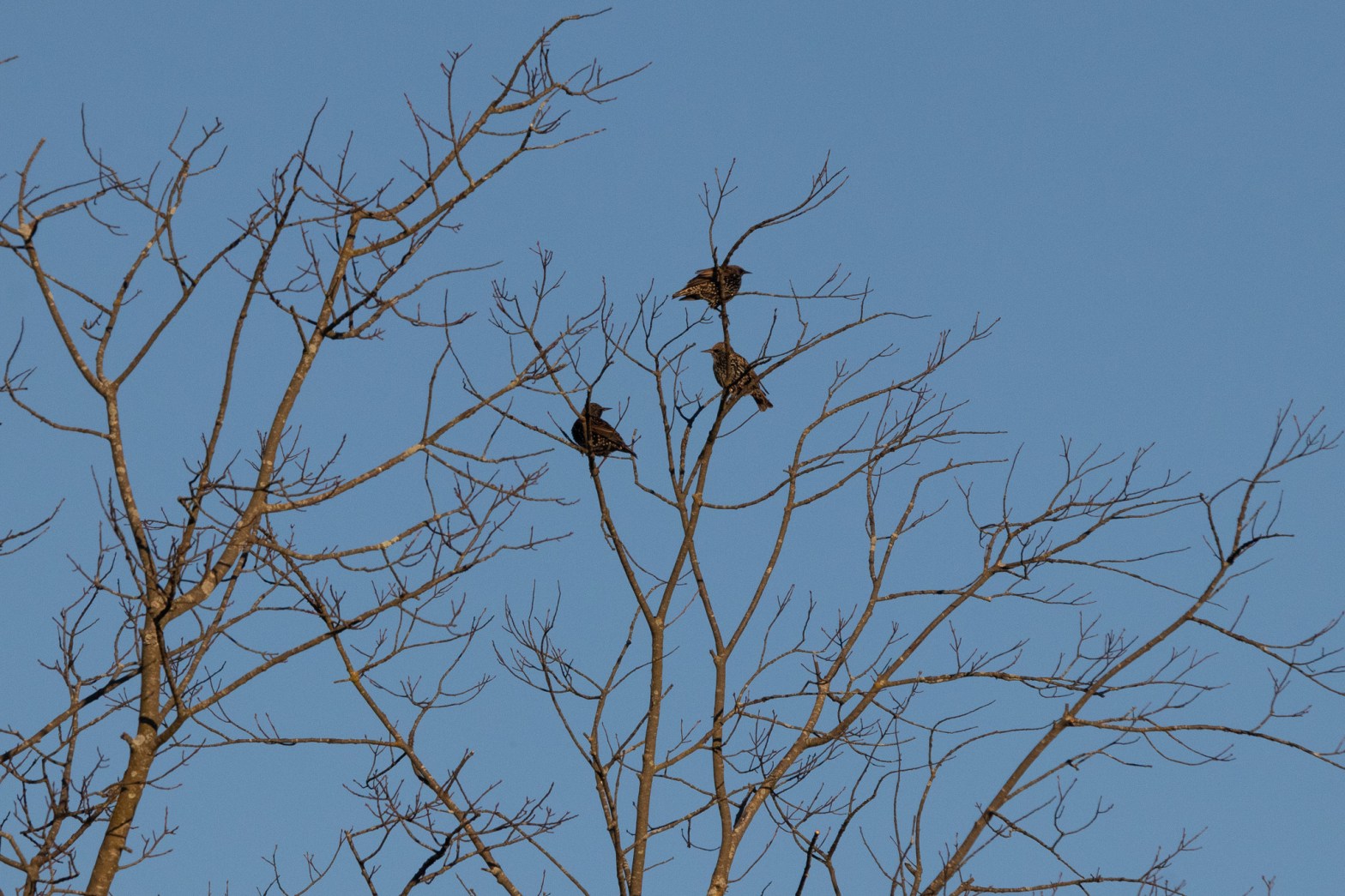
The instant find took a bit of drama out of the trip, but we were perfectly fine with that. We also noticed the gathering of European starlings in and around the big tree, and then Laura spotted something new. High up in the trunk of the tree was a round hole where starlings were nesting, with the parents flying in and out.
A starling in the nesting cavity, above the Reed Bryan Farm parking lot.
I’ve parked in that lot scores of times and seen hundreds of starlings in that tree, but I’d never noticed a nesting cavity. Score one for the eagle-eyed Laura, who was just warming up.
We walked downhill from the parking lot on a path bisecting two large fields. At the bottom of the hill is a footbridge over a small creek, and after crossing it you must turn left or right. We stopped at the intersection, looking around, hemming and hawing on which way to go.
A maple tree towers over the intersection, and at some point I spotted a yellow-breasted bird that flew into its branches about the time our Merlin sound apps lit up with “great-crested flycatcher.”
I can’t recall exactly how things played out, but it seemed there were two flycatchers coming in and out of the tree. Then Laura spotted a round opening in a dead spur of the trunk, about three-quarters of the way up the tree.
A nest!
Mom or Dad Flycatcher, perched on the edge of the nest.
The flycatchers were coming in and out to feed their young. They flew off in a couple of directions to our right and would be gone a few minutes before reappearing and popping into the cavity in the tree. We couldn’t see the little ones, but it was obvious that the parent birds were carrying food and stooping down from the edge of the nest to feed their brood. I took several hilariously terrible photos of the back half of the body and the tail of one of the parents, but I’m quite pleased with the photo at the top of this post. You can see the crest on the bird’s head as it emerges from the nest.
Would I have spotted the flycatcher nest on my own? Almost certainly not. Impatient sort that I am, I would have been wondering what the yellow-breasted bird I’d seen was as I moved on, hoping to catch a glimpse down the trail.
The same went for the starling nest. Most times, I glance up at the tree, do a rough count of the starlings, enter it in eBird and head off in search of birds uncommon and more colorful.
The lesson here is obvious. Four eyes are better than two, especially when the extra set is peering through a pair of high-end binoculars. Just as my friend Andy helped me find a scarlet tanager nest, Laura was the one who spotted the two nests today.
Even without the nests, strolling together, straining to hear a wood thrush and tapping each other on the arm to say, “Is that a …?” makes the outing more enjoyable.
A great-crested flycatcher flies out of its nest in a tall maple tree, heading out to find food for its little ones.
A surprise request came in to my mailbox several days ago. The real estate firm Redfin asked me to contribute some words of advice on how to attract birds to your yard.
I’d been considering a post on that very topic, so here’s what I submitted:
We’ve set up a triangle that attracts a colorful variety of birds to the yard at our suburban home. We started with a spring-loaded, squirrel-proof barrel feeder, the best choice if you can only do one feeder. We added a bird bath and then a double-hook pole with a finch feeder and a suet feeder. In the summer we swap a hummingbird feeder for the suet feeder, and in winter we put an ice melter in the bird bath.
The birds move from station to station as they please, and it pleases us to watch what shows up over the course of a year, cardinals and woodpeckers year-round and the occasional surprise visitor like the indigo bunting or rose-breasted grosbeak. Keep a bird book handy or get the Merlin bird ID app. You’ll be delighted with what you see!
A hummingbird buzzed our living room window last night, reminding me its time to put that feeder out. I’m actually going to put it on another shepherd’s hook we bought. I don’t dare shut down the suet feeder, as I’ll risk attack from the birds who chow down on it daily.
Topping this post is one of my all-time favorite photos, showing a house sparrow waiting as patiently as a sparrow can (which isn’t much!) for a red-bellied woodpecker to exit our Squirrel Buster feeder.
Here’s the Redfin blog post by Redin’s Ryan Castillo, to whom I’m grateful for the opportunity to contribute. His post includes a reference to my advice on squirrel-proof feeders.
As often as I walk the trails of the parks near home, I’ve spotted only a few bird nests. I was fortunate last week to come upon my friend Andy in the woods at the Mercer Meadows Pole Farm, who told me he knew where a pair of scarlet tanagers were nesting.
We walked over to the site and had a bit of trouble finding the nest, but eventually I spotted it about 10 feet off the trail in the middle of a horizontal branch about 15 feet up a tree.
Female tanager on nest June 15, 2023.
To our delight, the female was sitting on the nest, poking her beak above the leaves and giving us a partial view of her. After marveling at the sight, I turned to my side a few minutes later and gasped as I found the male foraging on the blacktop path only a few feet from us.
Andy and I fired off a few shots. As I recall, he got a great shot of the bird in the branches but I wasn’t as fortunate. Andy and I are enthusiastic bird photographers, and even we agreed that if we hadn’t gotten a single shot, seeing those two beautiful birds up close was worth every minute of our trekking that day.
Male scarlet tanager, June 15, 2023.
I went back to the Pole Farm on Monday, hoping to find the nest and the tanagers. I overshot the spot by probably 100 yards when I turned around to see Andy coming up the path, waving me back. I caught up to him right by the nest.
Neither parent was on it, and we scoured the trees for a sign of them. They may have been lurking, and a few other birds came in and out. After about 10 minutes, I heard one of them singing close by, and the Merlin sound app lit up. It wasn’t long before Mr. T landed on a branch just long enough for me to get what I thought was a good shot. The bird bounded about and I squeezed off several more frames. The best of the lot tops this post.
Male scarlet tanagers are striking in their vivid red and black plumage, and whenever I see one I have a sense of intense pleasure and privilege. The yellow females are beautiful, too, in their own way.
Alas, I learned from another birder this morning that the tanagers have abandoned the nest. Apparently their little ones didn’t make it, possibly victims of predators or maybe just plain bad luck.
I hope the couple have moved on to another site and get another chance at raising their young. With luck, maybe some day I’ll spot those offspring as adults, brightening the day with their vivid and thrilling colors.