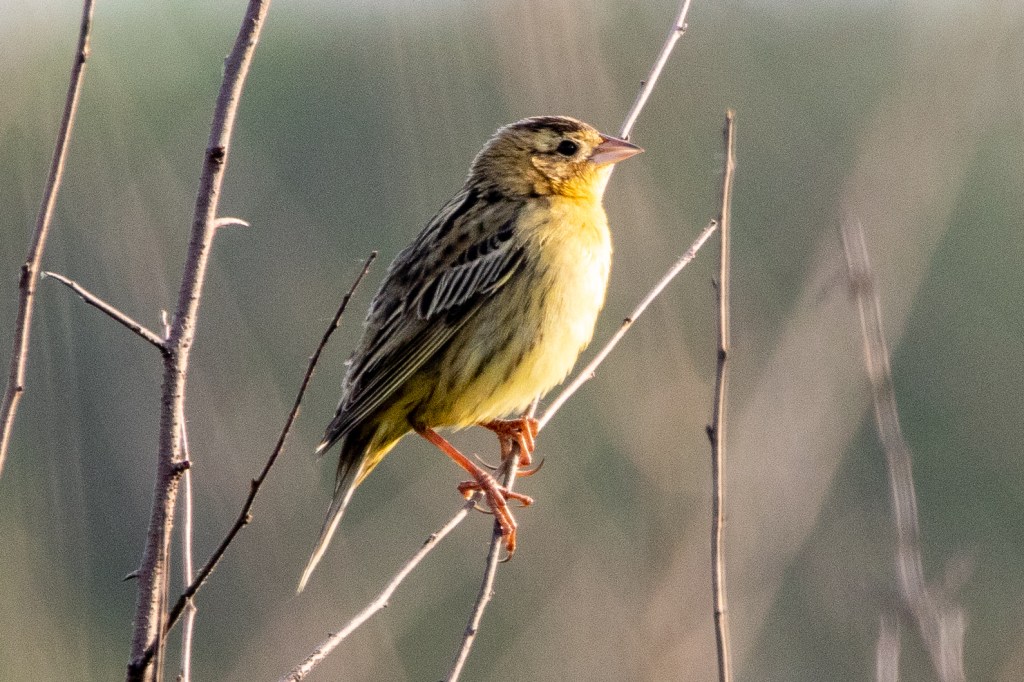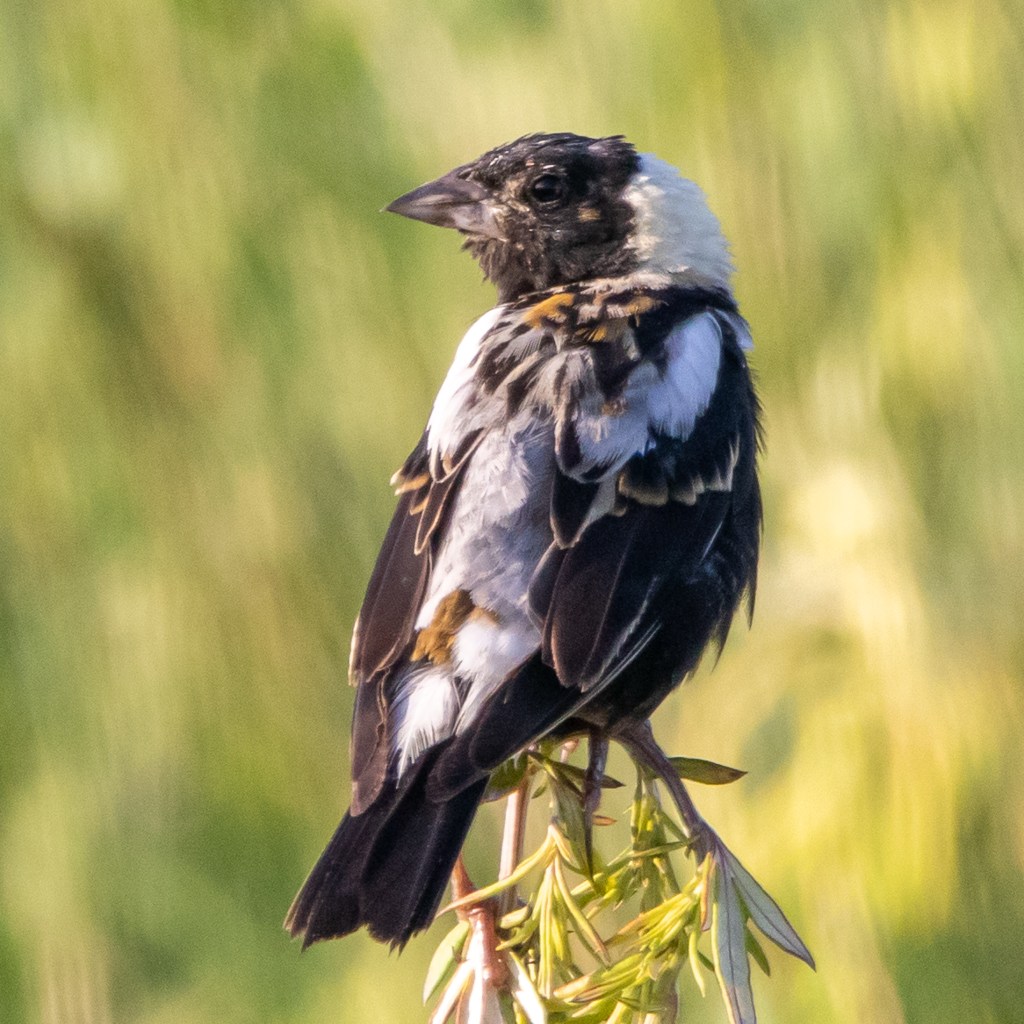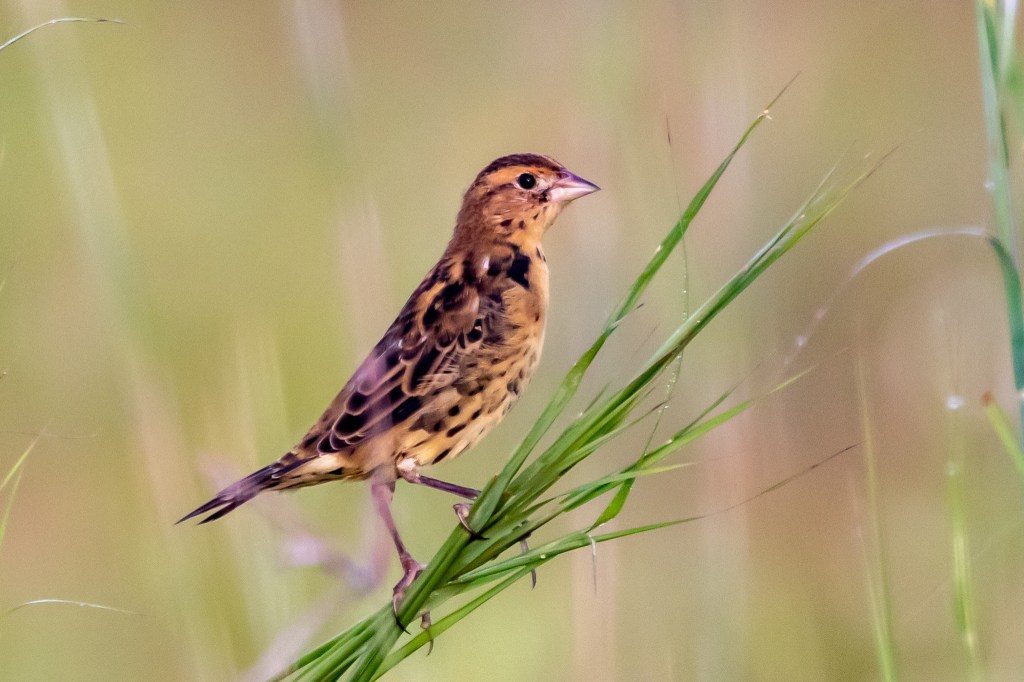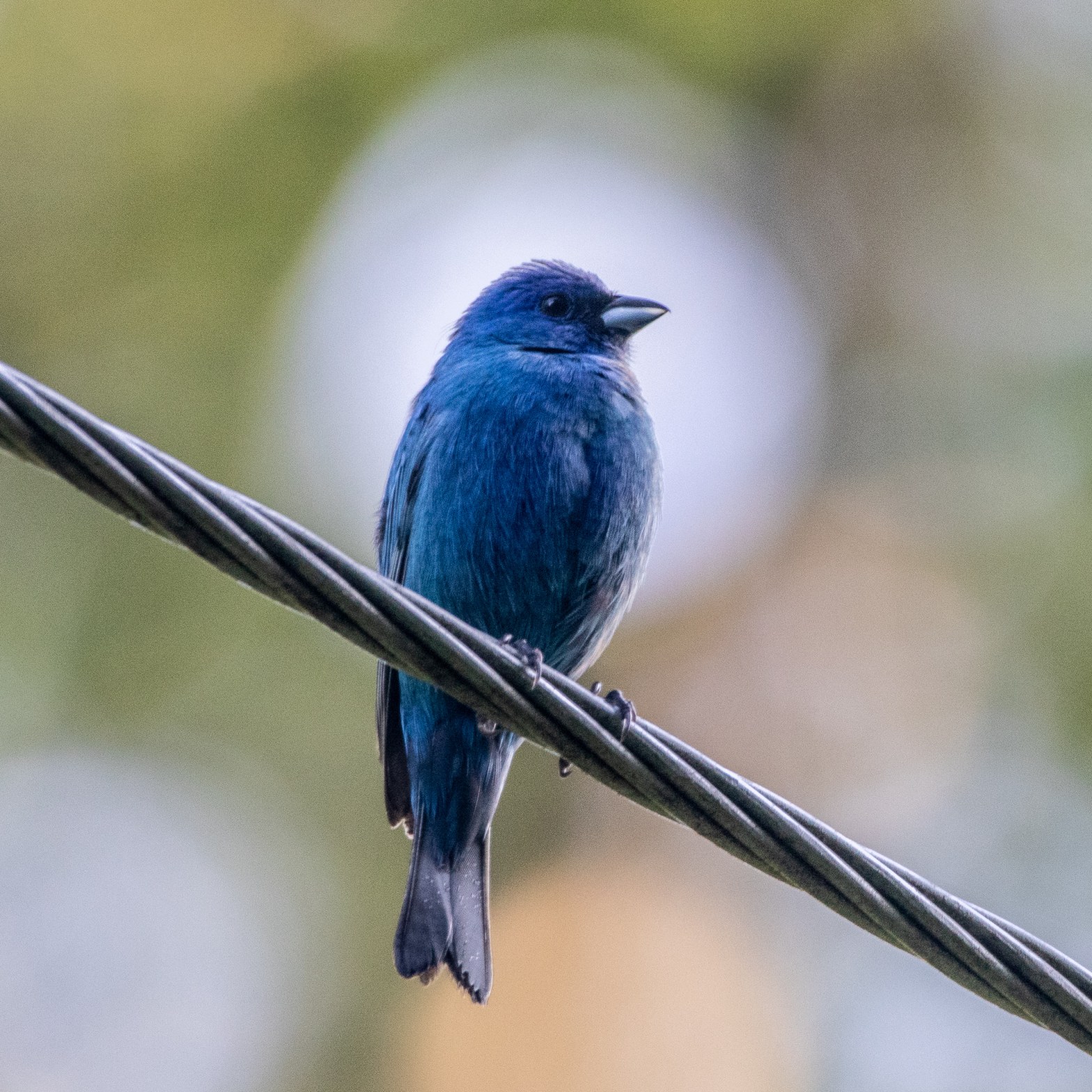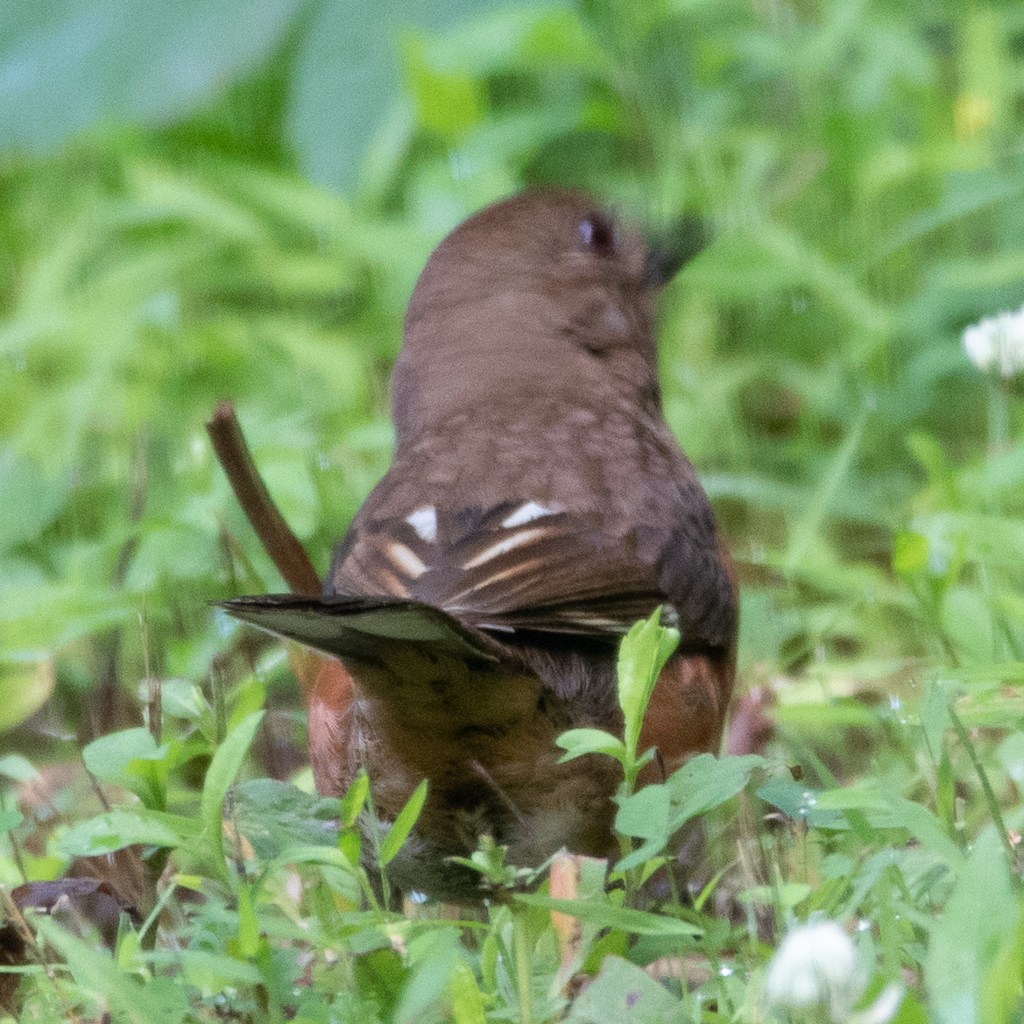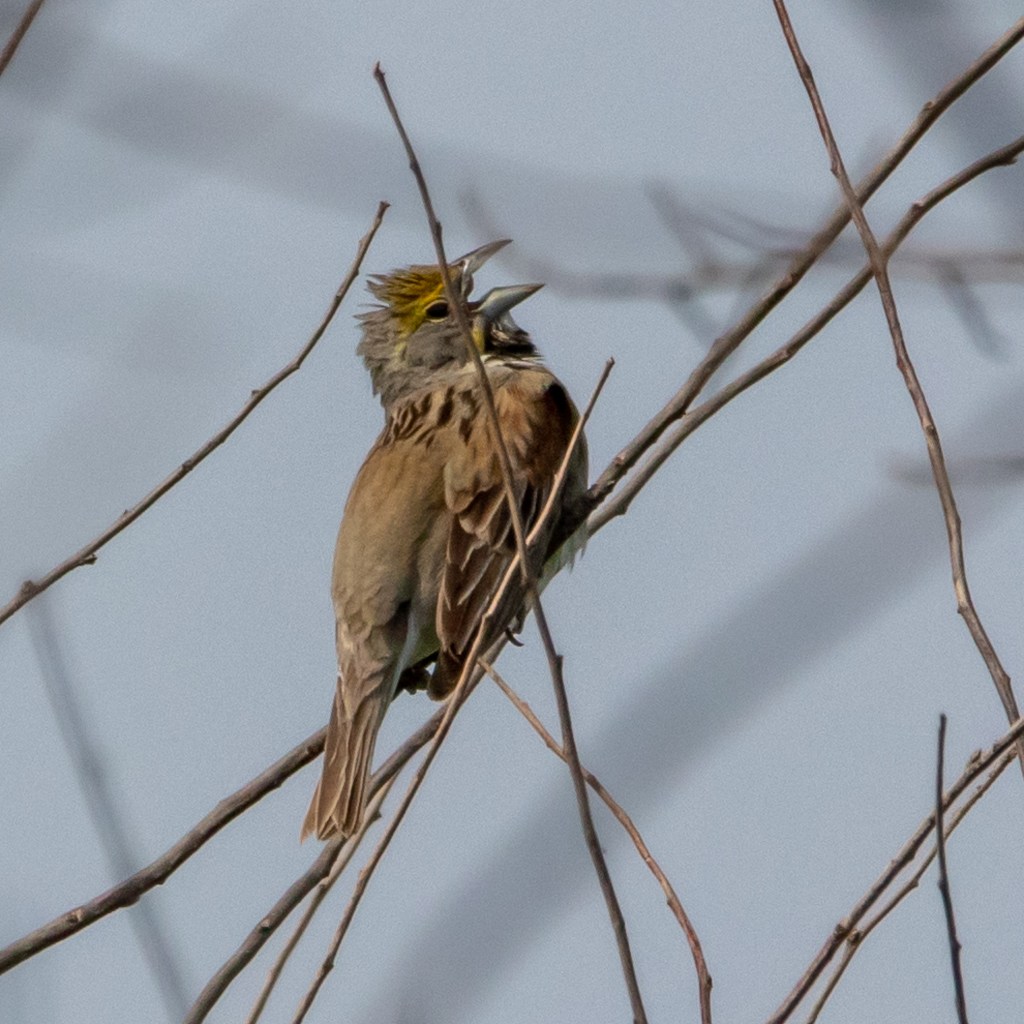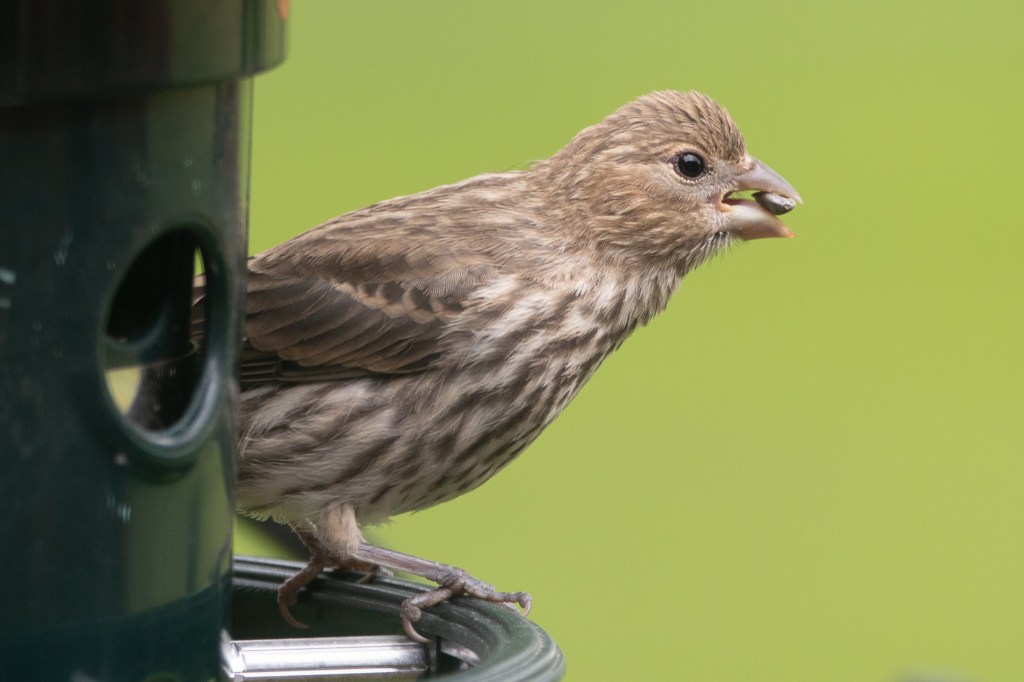
The Great Backyard Bird Count was on last weekend, and I did my part, logging all the familiar birds that visit regularly. But there was one trickster in the mix, and it took me a while to figure out that this particular bird breed had fooled me once again.
On Sunday morning, I logged in to the eBird app to record whatever flew into our yard and I spotted on the ground below the main tube feeder what appeared to be an oversized sparrow. The bird was a drab gray for the most part, and I reached for my binoculars to get a better look.
The mystery bird below the feeder.
The beak appeared average in size and didn’t give me any hints, but the head had a slight wash of brown. That should have steered me toward enlightenment, but I was oblivious to what would ultimately seem obvious.
Mystery bird perching by the feeder.
The bird was busy munching the seeds that dropped from the feeder, and I had time to fetch my camera and zoom in. The bird flew up to the feeder for a time, and I soon had a decent assortment of shots that I’d bring up on my laptop.
Even with the images on the screen, I was buffaloed over the ID. I moved the three clearest shots into my Apple photos app and pulled them up in the Merlin app.
You could have knocked me over with a feather: it was a brown-headed cowbird, most likely a juvenile male. It gave me a bit of solace that Merlin listed the bird as uncommon for this area at this time of year, although I had spotted at least one amid a horde of grackles a few weeks ago.
As I mentioned, this was not the first time I was stumped by a cowbird. At our prior residence about two miles away, I was bedeviled for a couple of weeks by the inability to ID a female cowbird visiting the feeder. I don’t know how many variations of “gray bird that looks like a large sparrow” I typed into Google or how much time I spent in a bird book trying to find the proper ID.
Eventually I figured it out.
In an odd way that long process of frustrated and eventually fulfilled curiosity heightened my interest in birding. Needing to know the answer to “what bird is that?” is my own version of Butch Cassidy looking into the distance at his pursuers and asking aloud, “Who are those guys?”
With 37 days of winter remaining yesterday, it didn’t strike me at first when I went out to fill the bird bath, but morning birdsong is back!
Robins and finches (not to mention a squawking blue jay) were making their presence heard in my yard. I didn’t really clue into the return of the morning melodies until I was waiting for my bus to work. From high up in a tree across the street emanated the sweet voice of a song sparrow. Not just chips and cheeps: a full-throated aria was soaring over the rumble of the cars and trucks traveling U.S. 206.
Morning birdsong is a sure sign that Spring is coming, even if it is more than a month until the vernal equinox.
We first paid serious attention to early morning bird songs two decades ago when we lived in Summit, which is about an hour’s drive north of where we live now. With at least one bedroom window open, we’d awaken to the symphony (or was it cacophony?) of the “Jersey birds.”
Living in the Princeton area, we hear more birds each morning as winter transitions into spring. The birds were plenty active again this morning. From the breakfast table, we looked out the window to see two red-tailed hawks sail through the yard in quick succession. The first targeted a squirrel, who tucked into a safe spot behind a tree trunk and, after the second hawk passed, scampered over to another tree and headed toward the safety of his drey.
We are not entirely without birdsong during the dead of winter. The Carolina wrens make sure of that, alerting us each morning with their piercing song that they are masters of the territory and that we are mere tenants.
I shot this photo of a song sparrow through a window after a recent snowfall. I imagine he’s looking forward to spring as much as I am.
Until I started taking a more serious interest in birding, to me a sparrow meant the ubiquitous house sparrow. A passer domesticus, rarely alone, was always at the feeders when I was a kid growing up in Ohio. Years later, I marveled at how the house sparrows thrived amid the skyscrapers of Midtown Manhattan, flitting about Rockefeller Center where I worked and making a life in every crack and cranny they could find.
As I began looking more closely at the birds fueling up on and below my home feeder, I noted slightly smaller sparrows with rusty caps that were obviously different than the routine house sparrows that I never gave more than a casual glance. Intrigued, I pulled out one of our bird books and was delighted to find I had identified these warm weather visitors as chipping sparrows.
A chipping sparrow perches on the feeder post in my yard, May 2021.
The chippers were my port of entry into the wider passerine world. In the winter, I noticed the striped helmets of what turned out to be white-throated sparrows pecking at the snow to harvest the seeds that other birds had sloppily cast down from the feeder by our back windows. I didn’t nail down the ID until taking a few photos and zooming in to see the yellow patch at the bills. I can’t explain it, but the white throats that visit the house don’t have much of that yellow coloration, while those in the woods two miles away at the Pole Farm display the yellow easily discernible with the naked eye.
White-throated sparrow at the Mercer Meadows Pole Farm.
My birder friend Laura taught me to identify song sparrows that seem marked by a magnetic force pulling in the streaks of their upper breasts into a dot-like mass in the center of their chests. Over this past summer, I started noticing their distinct, charming song that gives them their name.
This white-crowned sparrow paid a visit on May 1, 2020.
One rainy spring day a few years ago, I looked out the window with surprise to see a white-crowned sparrow standing at the edge of our patio. He was just passing through, not to be observed at home again, although I do see his relatives at the Pole Farm from time to time.
One memorable morning I spotted and identified several Savannah sparrows, with their distinctive yellow eye lines, gathered in the grasses near one of the observation decks at the Pole Farm. I have seen many since.
Another morning on a path I spotted a sparrow feeding on the ground and trained my binoculars to find a salmon-colored beak, one of the tell-tale signs of the field sparrow. It took another birder to point out to me later that I’d been hearing field sparrows all along. I had not yet learned their song, which is paced like the speeding-up sound of a Ping Pong ball dropping onto a table.
I don’t have a photo of a grasshopper sparrow, but one of the expert birders I happened upon pointed a few out in a field. I’ve also spotted a few swamp sparrows and I’m proud to report I was able one day to point out a Lincoln’s sparrow, with a pale buff wash on its streaky chest, to other birders.
American tree sparrow at the Pole Farm
I’ve also been delighted in recent months to get close to some American tree sparrows, with their rusty caps and bi-colored bills. They are exquisite.
I remain hopeful to spot a vesper sparrow. My Merlin app sound monitor noted one near where I was walking one day, but if I saw him, it didn’t register.
Until this moment while typing this post, I had not totaled the number of sparrow species I’ve spotted. I have to use two hands to count all 11! The vesper would make an even dozen, and there are rarer varieties who come along in these parts.
It’s a revelation to learn that after decades of having taken sparrows for granted, how much my enjoyment of the natural world has increased by sighting so many different varieties. Who knows what wonders await on my next walk in the woods or at what might show up in the yard tomorrow!
The male house sparrow, on whose kind I have spent untold dollars in bird seed for our backyard feeder.
Most of my morning birding walks are at dawn or even slightly ahead of it, typically a convergence of my believing the birds are most active when they wake up and my needing to get home and get ready for work.
Even on the weekends and especially on Saturdays, I stick to the same early morning schedule, in large part to get home so my wife and I get a chance to run errands together.
This past Saturday, I got a slightly later start, getting out to the Mercer Meadows Pole Farm at the luxuriously late hour of 7:30 a.m. I was there to rendezvous with my birder friend Laura, who although still crazy enough to venture out into 15-degree weather, sensibly suggested that a slight delay after dawn might be in order.
We had fair luck tramping along the paths in the first hour, and one of the highlights was spotting a pair of hermit thrushes in some woods as we moved from the traditional Pole Farm side of the park to the Reed Bryan Farm.
A pair of hermit thrushes take shelter from the cold in the woods at the Mercer Meadows Pole Farm, Saturday, Jan. 15, 2022. After I took off a glove to snap several frames, Laura rescued my icicle fingers by giving me a hand heater.
But it was at 8:30 — a time when I’m typically either fast-walking back to my car or driving home — when things really got interesting. We emerged from the woods and followed the trail past the Reed Bryan observation platform and approached a big clump of trees. Laura was the first to notice the movement and the orange.
Bluebirds?
No.
Robins. Lots of robins. A big robin party! Their orange breasts gleamed brightly in the low-angle sunlight as they flew back and forth among several trees.
Something else, smaller, was in big patch of evergreens. It took us a while to get our binoculars on the quick little creature, and a yellow-rumped warbler revealed itself. We spent probably 10 minutes gawking at those trees, figuring we must have seen at least 30 robins.
A yellow-rumped warbler soaks up a bit of sun in the woods at the Reed Bryan Farm side of Mercer Meadows on Saturday, Jan. 15, 2022.
Pressing on down the trail, we stopped at the next major clump of trees and spotted more yellow-rumped warblers. We got close enough that I was able to get a couple of decent shots
I looked up down the trail to the right and spotted a hawk, near where I’d seen a red-shouldered hawk a few weeks earlier. As we approached, the bird flew off, revealing a red tail.
Also in the area were several bluebirds. We logged eight on eBird but there could well have been more.
Another breath-taking Eastern bluebird.
Laura and I (and her very good boy black Labrador retriever) were excited about our good luck in spotting so many birds, and we got even more excited when she heard the call of a pileated woodpecker. Not long after, she spotted one flying in the distance. I wasn’t able to catch up to that one, but the red-tailed hawk made a flyover and I was able to get my camera up quickly enough to snap one decent shot.
In two hours, we logged 71 birds in 15 species, plus one chickadee that in our cross-over area we enter as black-capped/Carolina. Most of that action came in the second hour. From now on, I may just sleep in or linger a little longer over my coffee before strapping on the bins and my Canon.
A red-tailed hawk flew over us. Note: I do little manipulation of my images other than bringing out the details and cropping; on this one, I did a bit of vignetting to draw more attention to the bird. On the rare occasion I do anything out of the usual like that, I will make note as I have done here.
As I headed into 2021, I was intent on improving my ability to recognize birds by their calls and songs. I’m happy to report that I improved that skill considerably, and I’ll continue my education there. I also realize that I am woefully weak on spotting and identifying waterbirds. In the new year, my top priority will be, ahem, to shore up my knowledge.
For most of my life, “duck” has meant the ubiquitous mallard, a common site in most ponds and lakes I’ve visited. “Goose” has meant the Canada goose. Those fat honkers invade seemingly every golf course I play and occasionally wander into our yard, only to be chased away by my wife blaring into the bullhorn she keeps by the back door.
In December, I made a couple of trips to Abbott Marshlands in Hamilton, New Jersey, hard by the capital city of Trenton. The marshlands include Spring Lake at John A. Roebling Park, so there are plenty of places for ducks and geese and coots and what-have-you to land. I’ll be heading back there regularly and plan to do a feature on the area at some point soon.
A Northern pintail plies its way through the reeds of Abbott Marsh near Trenton, New Jersey, Dec. 4, 2021.
My second-priority resolution for the new year is to get better at catching birds in motion. My best photos so far have generally captured birds perching on branches and grasses. I’m proud of those shots, but I also admire the work of fellow birders who capture birds — especially large raptors — winging their way through the air.
Finally, I’ll look to expand my range outside Mercer County and even outside the state.
Thanks for reading my posts, and have a wonderful new year!
Getting this shot today of an American tree sparrow taking flight from the tall grass at the Mercer Meadows Pole Farm is a fair start to meet Resolution No. 2 of catching birds in flight.
As with many things in my Cleveland upbringing, bald eagles were just another creature in decline during the 1960s and ’70s. As a teenager, I experienced a couple of ghastly fish kills while heading for a day at the beach on the shore of Lake Erie. Every time I’d look at the embarrassingly polluted Cuyahoga River, I knew I was more likely to see a fire erupt than see a fish.
Eagles, in other words, weren’t expected in the skies over sooty northeastern Ohio. I don’t believe I ever knowingly saw a bald eagle until the early 90s, and I had to go to Alaska to find them. On a business trip to Juneau, a colleague drove me to the edge of town, Mendenhall Glacier. There, soaring above the ice sheet, were an astonishing 27 bald eagles by my count.
I had only a pocket camera with me, and I don’t recall putting any eagle photos in my album. But I remember the day well.
Bald eagles, our national bird, have been making an encouraging comeback. I’m happy to report evidence of that. I saw one flying in the distance south of our first home after we moved back to New Jersey eight or nine years ago.
In the nearly six years we’ve lived in our current home, I’ve seen several eagles flying by, including one sailing over our next-door neighbors’ home while I was on a Zoom call from my COVID-year home office.
One morning as I was filling the bird bath, my neighbor asked if by chance the large bird he had seen on the golf course behind our homes could have been a bald eagle. “Could have been,” I said, and at that moment an eagle flew straight over my house and my head, and flew off into the distance toward Princeton.
I’ve not had the good fortune to have my camera at the ready when those close encounters came, here at home or out at the Mercer Meadows Pole Farm where I spend a lot of my free time and have had a couple of flyovers.
Two bald eagles atop a cell tower, January 2021.
The first photo I managed to get was of a pair of bald eagles perched atop a cellphone tower along Business Route 1, just south of where it feeds traffic back into regular U.S. 1 in Lawrence Township. My wife spotted one of them and insisted we turn around (no small thing in New Jersey, the jughandle state!). It was worth the effort, even if my modest telephoto lens could only get a few distant shots.
Some weeks later at the end of March, I was fortunate to capture an eagle in flight at Colonial Lake, a bit south of the cell tower where I’d spotted the previous birds.
A bald eagle soars above Colonial Lake in Lawrence Township on March 31, 2021.
My best shot, so to speak, came last weekend, when I trudged through Abbott Marshlands, a conservation area that hugs the Delaware River near Trenton. I’d been out on the trails for about 90 minutes with only a few distant frames of ducks in my camera and I was nearly back to the parking lot when I spotted a big bird flapping its wings over the marsh. Figuring it was a bald eagle, I silently said “To heck with the binoculars” and raised my camera.
Here’s the best frame of the bald eagle from near the parking lot at Abbott Marshlands.
The bird was too quick for me to get a decent airborne shot. It landed high in a tree across the marsh. I got some fair distant shots but nothing special. I waited for 10 minutes or so, hoping for a closer look, before deciding to head home.
The park is on a turnoff from where Sewell Avenue dead-ends at a bluff overlooking the marsh. As I drove up out of the park, I stopped my car as I entered Sewell and got out.
My luck held: the eagle was still perched in the same spot, and now I had a closer view.
Here’s the best shot I got of the eagle, oddly enough from the end of Sewell Avenue and not in the Abbott Marshalands just below me.
I’m still in the hunt for better eagle photos, and I should point out that the eagles mentioned in this post so far were all mature birds with the dramatic white heads atop black bodies. I have spotted a few immature bald eagles near Mercer Lake at Mercer County Park, a great gathering spot for bald eagles during the winter. With my new longer lens, I’ll be heading back out there once the colder weather comes.
I’m thrilled that bald eagles are no longer considered endangered or threatened, but I still note that their habitat is forever under assault by the relentless encroachment of human development. May they continue to thrive here in my little corner of the Garden State, up and down the Delaware River Valley, and from sea to shining sea.
Hope for the future: An immature bald eagle soars over Mercer Lake.
The only thing that can top the thrill of spotting a new bird for your life list is knowing that you have a nice image of that bird saved on your camera.
I was on the way back to my car about 8:30 this morning along one of my regular routes at the Mercer Meadows Pole Farm when I spotted a small bird on the ground just ahead of me. The bird quickly popped into a small tree beside the path, and I walked gingerly ahead to get the sun behind my back. When I turned around, I spotted it — a sparrow for sure — in the middle of the tree.
This was my first shot of the American tree sparrow, which nicely shows of its bi-colored beak.
My usual procedure is bring up the binoculars first to get the best chance at identifying the bird, then hope it sticks around long enough for me to get a photo or two. This time, however, I raised my camera right away and aimed. The bird was nestled in branches, giving my camera’s auto-focus fits but I was virtually certain I was seeing an American tree sparrow.
I snapped one photo, then another, reasonably confident at least one of them would be clear and sharp. I then switched over to manual focus and fumbled for a few seconds before switching back to auto, when the bird flew away.
I brought up that last photo on the screen on the back of my camera, and there it was, fully confirmed: an American tree sparrow, with its rufous cap and unusual bi-colored beak.
I had been for a walk Thanksgiving morning on the Reed Bryan farm side of Mercer Meadows, where another birder kindly pointed out a section of brush where American tree sparrows were cavorting along with some song sparrows. I’m certain I observed at least one of the tree sparrows (my first knowing sighting), but on my camera I only captured the song sparrows.
Today’s tree sparrow sighting was extra special, because I was a bit doubtful about the one Thursday. But there was no doubt about today’s tree sparrow.
This was the second shot, which is all I would get. My attempt to switch to manual focus only frustrated me. But I’m very happy with both frames I did get.
Since my daughter and her family moved to Michigan, during the handful of drives I’ve taken up Interstate 75 to visit I spotted with curiosity the signs for the Detroit River International Wildlife Refuge. Each time I drove past, I made a mental note to arrange to stop the next chance I’d get.
I got that chance a few weeks back on a trip that would also take me to Indiana. The refuge is just south of the city of Detroit, at the “wrist” of the “mitten” that is lower Michigan. I stopped at the refuge on a crisp fall day, the first break on the long drive back to New Jersey.
I arrived at late morning and discovered that the large visitor center was closed because of COVID restrictions. No matter; I was more interested in being outside and grabbed a trail map.
A ring-billed gull soars above the Detroit River.
From the parking lot, I walked toward the fishing pier that juts into the river, which actually looks more like a large lake, as the refuge shoulders a wide spot on the river. Seagulls soared overhead, and I was only able to spot a few ducks and Canada geese floating in the distance near Humbug Island a short distance across the water.
Walking back toward the visitor center, I entered a wooded area with flat, easy trails. I can’t recall seeing any birds, although a buck with an impressive rack trekked cautiously through the brush nearby, evading my camera.
A great egret searches for fish in the Monguagon Delta.
I eventually reached the edge of the Monguagon Delta, where I was treated to the site of a couple of great egrets stalking out fish. Conscious of the ticking clock, I headed back toward the car to resume my drive home.
View of the Monguagon Delta, just off the Detroit River.
I only stayed at the refuge for 50 minutes, not nearly enough time to explore all its trails. I hope to get back at an earlier hour some day, when there should be more avian activity.
Although I was disappointed I didn’t see a greater number and variety of birds, I am impressed that Detroit has such a great preserve so close by, not unlike the Heinz wildlife refuge hard by Philadelphia. It’s great to know that on the edges of sprawling urban areas that have already claimed too much natural habitat from our animal neighbors, these refuges are thriving and waiting to be explored further.
My next challenge: to find a similar spot close to New York City. I have a few ideas….
Entrance to the refuge in Trenton, Michigan, accessible by a short drive off Interstate 75.
The “Jersey Birder” title of this site notwithstanding, I do venture out of the Garden State on occasion and sneak in a bit of birding as time allows. Last week, I drove to Michigan for some family matters that involved a jaunt to the northeast quadrant of Indiana.
I had done some online scouting from home but had little luck figuring out a hot spot near where I’d be staying until I actually got to Indiana. There, a Google search brought up the Indiana Birding Trail website, which has an interactive map that led me to the Limberlost Swamp Conservation Area only a few miles from where I was staying.
The name “Limberlost” immediately clicked in memory. From childhood, I knew about “A Girl of the Limberlost” by Gene Stratton-Porter. Although I’d never read the book, I may have seen a movie adaptation on TV, and Porter’s work was discussed during a class I took in graduate school.
The Limberlost Swamp was the setting for Porter’s “Girl of the Limberlost” and other novels, based in large measure on her experiences growing up and spending much of her life exploring the swamp. In the motel, I read up on Porter and found on Project Gutenberg the text of her first novel, “The Song of the Cardinal,” which is centered in the Limberlost Swamp.
A section of trail in the Loblolly Marsh Nature Preserve.
At that point, there was no question I would head to the Limberlost. I struck out the next morning to the nearest entry point, the Loblolly Marsh Nature Preserve. I arrived about 9:20 a.m. That was a bit late to observe peak morning bird activity, but how hard can it be to find a cardinal?
Harder than I expected.
Although I passed a marsh that had scores of Canada geese, most birds were shy that morning. Other than several Canada geese on the wing, in my roughly 1.5-mile round-trip stroll I recorded only two blue jays and a tufted titmouse, and I got one out-of-focus shot of it before it flew off. A sparrow dashed by but tucked into tall grasses before I could identify the variety.
I decided to move on and head to the town of Geneva and the Gene Stratton-Porter Historic Site, which proved to be an unexpected joy. The site includes the “cabin” home where Stratton-Porter, her husband and daughter lived for many years. I was even more fortunate to chance upon Jeanne the guide, who gave a few other visitors and me a delightful tour of the property and a thorough and fascinating account of Stratton-Porter, a remarkable author, naturalist and photographer whose life wrapped around the turn of the 20th century.
The Stratton-Porter cabin, its parlor with a desk that belonged to Stratton-Porter’s contemporary Indiana author Booth Tarkington, and another room, with the dining room at rear.
There’s plenty of information about her online, but I must mention that Stratton-Porter is an inspiration for all of us birders who take photographs. Stratton-Porter taught herself photography, including demanding darkroom work, a necessity when the publisher of her nature works asked for illustrations. Stratton-Porter was appalled that most bird photography of the time was pictures of dead birds posed before the camera. She wouldn’t stand for that, and she spent hour upon hour camped out in the swamp, getting close enough to take photos of birds in their natural settings. That’s an even greater accomplishment considering the difficulty of the glass plates and other clunky, heavy camera gear of the day, which she lugged into the foreboding swamp by horse-drawn carriage.
But what of my quest to find a cardinal?
Canada geese swim away from me in a marshy area of the Loblolly Nature Preserve near Geneva, Indiana, Nov. 5, 2021.
As I was leaving the Loblolly marsh, I stopped along the road to take the photo shown here of the Canada geese. I turned around to head north-northeast toward Geneva, and as I pulled up to a stop sign at the edge of the preserve, a streak of red gleaming in the sunshine shot left to right in front of me.
I’d found my cardinal.
Someday, I intend to return to the Limberlost and hope to hear his song of “good cheer.”
As my birding activity ramped up over the past two years, I became increasingly aware of the shortcomings of my camera equipment. I’d been using a refurbished Canon 75-300 mm lens, and it has served me well shooting out the windows at our backyard feeders and shooting in the field at birds at close range.
But as I watched other birders with cubit-length zooms lined up to capture images from long distances, I was increasingly consumed by lens envy.
A work colleague had purchased a Sigma 150-600 mm Contemporary zoom a couple of years back, and I set my sights on getting one of my own. We’re fortunate to still have a camera shop in my neighborhood, and several months ago I stopped by to see if a Canon mount for the big Sigma was in stock. It was, and I said I’d be saving up and would return.
A few weekends ago, I was with a cluster of birders at the Pole Farm and we were checking out a merlin on a treetop. The best I could muster was a wide, distant shot that wouldn’t be worth printing. I decided then that it was time to head back to the camera shop, credit card in hand.
The shop had one of the Sigmas, and as it was in the same spot as when I’d been in earlier. I suspect it was the same lens. The dealer quoted me a price that matched that offered by the big New York photo houses, and I said “I’ll take it.”
The lens is great. I’m not going to turn this post into a review, so I will only note that the Sigma has stabilization features that help me get sharp images while holding the camera and lens in my hands. After a few weeks, I’m still learning how best to use it.
The best image I’ve taken so far is that of the white-throated sparrow that I’ve included with this post. For that one, I had the lens mounted atop my monopod. The bird parked on the branch long enough for me to get off a handful of frames, and I’m thrilled with the result.
White-throated sparrow at the Mercer Meadows Pole Farm, Oct. 22, 2021.
Depending on conditions, I may or may not take the monopod (it has three collapsible tripod-like feet) into the field. As chance would have it, shooting hand-held I was able to get some nice images of a merlin perched even higher atop a tree than the one I shot previously with my shorter zoom.
I’ve been taking my upgraded kit into the field frequently, and that’s a good part of the reason why I have not posted in several weeks. More to come!
A merlin perches atop a tree at the Pole Farm, Oct. 22, 2021.