Tips on making your yard a bird sanctuary

A surprise request came in to my mailbox several days ago. The real estate firm Redfin asked me to contribute some words of advice on how to attract birds to your yard.

I’d been considering a post on that very topic, so here’s what I submitted:

We’ve set up a triangle that attracts a colorful variety of birds to the yard at our suburban home. We started with a spring-loaded, squirrel-proof barrel feeder, the best choice if you can only do one feeder. We added a bird bath and then a double-hook pole with a finch feeder and a suet feeder. In the summer we swap a hummingbird feeder for the suet feeder, and in winter we put an ice melter in the bird bath. 

The birds move from station to station as they please, and it pleases us to watch what shows up over the course of a year, cardinals and woodpeckers year-round and the occasional surprise visitor like the indigo bunting or rose-breasted grosbeak. Keep a bird book handy or get the Merlin bird ID app. You’ll be delighted with what you see!

A hummingbird buzzed our living room window last night, reminding me its time to put that feeder out. I’m actually going to put it on another shepherd’s hook we bought. I don’t dare shut down the suet feeder, as I’ll risk attack from the birds who chow down on it daily.

Topping this post is one of my all-time favorite photos, showing a house sparrow waiting as patiently as a sparrow can (which isn’t much!) for a red-bellied woodpecker to exit our Squirrel Buster feeder.

Here’s the Redfin blog post by Redin’s Ryan Castillo, to whom I’m grateful for the opportunity to contribute. His post includes a reference to my advice on squirrel-proof feeders.

Scarlet tanagers on the nest

As often as I walk the trails of the parks near home, I’ve spotted only a few bird nests. I was fortunate last week to come upon my friend Andy in the woods at the Mercer Meadows Pole Farm, who told me he knew where a pair of scarlet tanagers were nesting.

We walked over to the site and had a bit of trouble finding the nest, but eventually I spotted it about 10 feet off the trail in the middle of a horizontal branch about 15 feet up a tree.

Female tanager on nest June 15, 2023.

To our delight, the female was sitting on the nest, poking her beak above the leaves and giving us a partial view of her. After marveling at the sight, I turned to my side a few minutes later and gasped as I found the male foraging on the blacktop path only a few feet from us.

Andy and I fired off a few shots. As I recall, he got a great shot of the bird in the branches but I wasn’t as fortunate. Andy and I are enthusiastic bird photographers, and even we agreed that if we hadn’t gotten a single shot, seeing those two beautiful birds up close was worth every minute of our trekking that day.

Male scarlet tanager, June 15, 2023.

I went back to the Pole Farm on Monday, hoping to find the nest and the tanagers. I overshot the spot by probably 100 yards when I turned around to see Andy coming up the path, waving me back. I caught up to him right by the nest.

Neither parent was on it, and we scoured the trees for a sign of them. They may have been lurking, and a few other birds came in and out. After about 10 minutes, I heard one of them singing close by, and the Merlin sound app lit up. It wasn’t long before Mr. T landed on a branch just long enough for me to get what I thought was a good shot. The bird bounded about and I squeezed off several more frames. The best of the lot tops this post.

Male scarlet tanagers are striking in their vivid red and black plumage, and whenever I see one I have a sense of intense pleasure and privilege. The yellow females are beautiful, too, in their own way.

Alas, I learned from another birder this morning that the tanagers have abandoned the nest. Apparently their little ones didn’t make it, possibly victims of predators or maybe just plain bad luck.

I hope the couple have moved on to another site and get another chance at raising their young. With luck, maybe some day I’ll spot those offspring as adults, brightening the day with their vivid and thrilling colors.

Male scarlet tanager, June 19, 2023.

When catbirds attack, duck and run

We birders — most of us, anyway — are happy to share tips on where and how to spot the various birds that come calling in our little corners of the planet. Today’s tip from me is unusual. I’m offering advice on how to avoid a bird, not how to find one.

Last week I was walking the main leg of the red trail at the Charles H. Rogers Preserve in Princeton when a gray catbird to my left started chattering excitedly.

Catbirds are common in my sector of New Jersey. They are frequent visitors to our home (there’s one in the back yard as I type) and to the woods I walk in Mercer and surrounding counties much of the year. Catbirds seemingly pay me no heed, and it’s not unusual for me to see a dozen or more over the course of an hour, often only a few feet away.

I don’t know what was agitating this particular bird, but it seemed to follow me down the path, flying from one tree to another. All of a sudden, the bird darted into the trail from behind me at about a 45-degree angle and buzzed my head. I kept walking, a little faster, and it swooped around and came at me again. I ducked and kicked my stride into overdrive to head down the trail.

After 50 yards or so I stopped at a point where the trail veers to the left at a water company pump house. The catbird was no longer hectoring me and was nowhere in sight. I breathed a sigh of relief.

I didn’t have enough time to take the trail the long way around to get back to my car, as it was a work day and duty called. So I summoned up a bit of bird-resistant courage and started walking resolutely back the way I came, keeping my head down and staying on the far side of the path.

I walked well past where the catbird had attacked and finally slowed to my normal pace, and I started wondering what had set the bird off. My first guess was that I had wandered close to its nest, but if that had been the case, it should have pestered me as I made my way back.

It also could have been coincidence that I appeared at a time it was agitated at another bird or other threat, and I wandered into the crossfire. I’ll never know the reason.

So I will close with this advice: if you hear birds getting agitated as you approach, keep a wary eye out. Should one of the birds come zooming at your head, duck and high-tail it out of the danger zone as quickly as you can.

In nature photography, how much post-processing is too much?

Saturday morning arrived cool and very, very overcast gray in my part of the mid-Atlantic region. Those conditions can occasionally make for great photos, but often they leave me with dull, muddy images.

The photo above of a great blue heron stalking in Colonial Lake just off Business U.S. 1 in Lawrence Township is what my camera captured about 7:15 a.m. Other than cropping in about 15 percent of the frame in Adobe Lightroom, what you see is virtually identical to what I saw when I snapped the shutter: a gray heron against a dark surface of water.

Compare that to what came up when I hit the “auto” button in LightRoom.

Big difference! The bird is a bit brighter but what surprised me was how the surface of the lake has a green sheen. Unless I’ve suddenly gone colorblind, this “corrected” photo gives a false impression.

Since I switched to shooting RAW from jpeg a couple of years ago, I’ve used LightRoom to edit my photos. Under most conditions, I use LightRoom’s sliders to enhance my photos to some degree in an attempt to get an accurate depiction of what I saw in real life.

While I studied art photography in college and graduate school and have a deep appreciation for it, I also trained in photojournalism. While never a news photographer full-time, as a reporter and editor I’ve taken many news photos, usually when I happened onto the scene or took my camera to an event because a “real” photographer wasn’t available.

While I’ve managed to take a few abstract or otherwise arty shots, my style is journalistic. In shooting birds and other wildlife, I try to get the lighting and color right to portray the subject truthfully.

As I scroll Instagram, I repeatedly see ads for apps that will excise exes and cut out other “distractions” from photos. I won’t and don’t do that, although I do crop to remove distracting branches or other elements that draw the eye away from the subject. I’ve also learned to clean up digital noise that shows when I crop in on a distant subject. The noise isn’t part of nature.

Where does one draw the line?

That’s up to each photographer, informed by the purpose of the image. With my photos, I want you to see the bird as it really is, or at least get as close to that ideal as I can.

Tapping the animal network to bring out a bird

Spring migration has been a bit of a disappointment for me this year, as I haven’t seen as many warblers as I did last year. I’ve heard them, or more accurately the Merlin sound app has heard them clustered around me, but I’ve had relatively little luck spotting them.

As of the start of this week, I had yet to see a scarlet tanager, not a warbler but a migrant who shows up in these parts in fair numbers year to year. So when I set out on a morning walk the other day at the Pole Farm, I was hoping it would be the day I’d finally spot one.

To change my luck, I decided to walk one of my regular routes counter-clockwise, which I rarely do. I was about 45 minutes into my trek when I turned the corner that set me on a path through a short stretch of woods that would lead me toward my car in the parking lot.

I looked ahead on the trail, and an Eastern cottontail was snacking on the path. The rabbit seem unconcerned about my approach, and as I stepped closer I said aloud: “Hello there, bunny. Where are my birds? Where are the warblers?”

The rabbit then dashed into the bush, but I hoped he’d send a message to the birds that I was eager to catch a break.

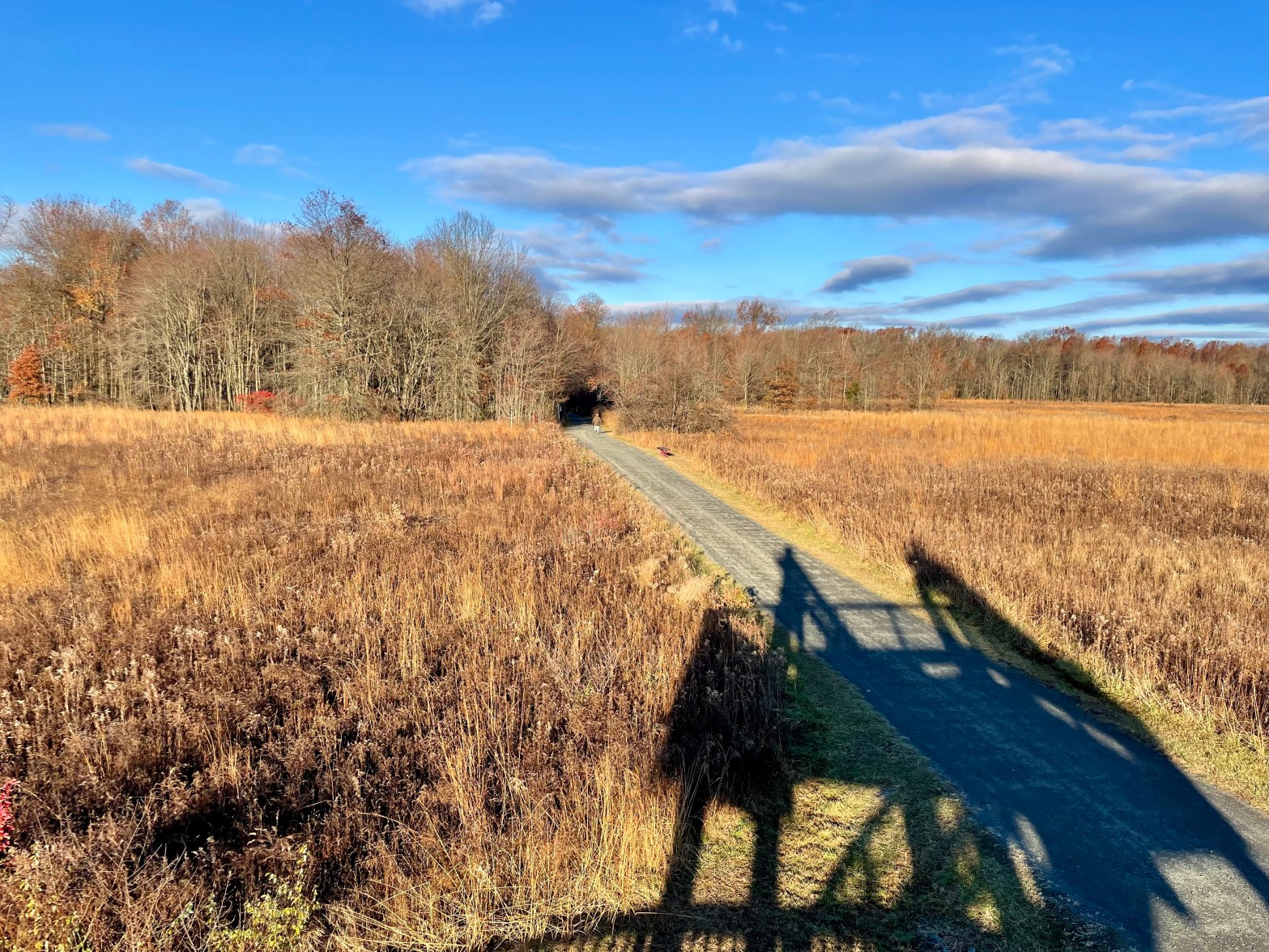
One hundred yards or so later, I emerged from the woods into the main meadow where the observation deck is. As I cleared the trees on my left, I looked back and up into the trees.

Way up high was a dash of red — could it be a tanager? It might be a cardinal but — no! — it’s a scarlet tanager on a treetop branch swaying in the breeze. The bird was in profile, and the black wing contrasted clearly against the rest of its plumage, a deep, lush red.

Scarlet tanager on a branch high up in a tree.
The top photo shows the tanager in broader context; this one, cropped heavily, was the best I could get.

I brought my camera up and squeezed off several frames before the bird flew off, and a quick peek in playback gave me hope that I’d have at least one good shot.

I smiled at the thought that the rabbit might have somehow been responsible for the sighting — I’ll take help however I can get it! — and headed down the trail toward the car and home.

The shots were not as sharp as I’d hoped, and I concede that I should have expected that result. The bird was high up and far from where I was standing. My camera and my lens have their limits.

But the photo results are secondary. I finally saw my first scarlet tanager of the year, and I hope to see more.

How big was my ‘Big Day’ in 2023?

My 2023 Spring “Big Day” was a lot of fun as I logged 51 species in e-Bird, doing my part to contribute to the crowd-sourced science that makes these annual counts so important in preserving our avian friends.

Unlike last year when I traveled to Cape May County during the World Series of Birding, I stayed close to home this year, never venturing out of Mercer County. But variety abounded, from my own backyard and the Mercer Meadows Pole Farm to the Millstone River Impoundment and the Charles Rogers Preserve in Princeton and the Dyson Tract along the Delaware and Raritan Canal.

The day started at the impoundment, where, thanks to a tip from a fisherman that the bird was headed in my direction, I got the post-topping shot of a great blue heron preparing to land.

One of two green herons spotted at the D&R Canal Dyson Tract.

Next up I made two stops with my birding buddy Laura, first to the Dyson Tract along the canal to see the prothonotary warbler, a lifer for her and a second sighting for me. We also spotted two green herons in the marsh, our first sightings for the year, nearly a year after we had our first sighting of one together last year.

From there we drove to the Pole Farm — my home court, if you will — and in the parking lot ran into Laura’s friend Joe. The three of us meandered up the central fields to the woods and back down the paved Lawrence Hopewell Trail. We were disappointed that the “warbler wall” at the old AT&T Building One site was quiet other than for catbirds. Laura stalked a blackpoll warbler in the evergreens there, and we heard it repeatedly but never saw it.

We recorded it but could not justify doing the same for the Wilson’s warbler that popped up a few times nearby on the Merlin sound app. A bird for another day, if not another year!

A couple of surprises awaited us as we made our way back to the parking lot. First up was the buzzy call of the willow flycatcher, one I’d been hoping to hear since they flew away last summer. We heard the call several times and settled on reporting two of them. I am eager to go back and spot one.

The final surprise came as we reached the car in the parking lot. Something big flew past us and landed on a bare, spikey tree. It then flew into the large tree to the right of the trail out of the lot, and by then Joe had nailed the ID: another green heron.

Late in the afternoon, I made one more foray into the woods, at the Charles Rogers Preserve, tucked behind graduate student apartments on the outskirts of the Princeton University campus. Not much was happening there, although I did spot a female wood duck flying across the marsh from the observation deck at the parking lot.

Twenty-four hours later, I reflect on the day and note that as much as I enjoy my solitary walks, birding is better with a friend, and even better when you make a new one.

Big days in May: chasing the rare prothonotary warbler

When I first started paying attention to the Spring migration a couple of years ago, I saw sporadic, excited reports of prothonotary warblers being spotted here in New Jersey. What a weird name for a bird, I thought, and I’ll be darned if I’m going to chase all over kingdom come to find one.

A little more than a week ago, reports started coming in that a prothonotary warbler was singing its little yellow heart out along the Delaware & Raritan Canal about five miles from my home. The bird was hanging out in what’s known as the Dyson Tract, a swampy marsh studded with dead trees not far from U.S. Route 1 and close to a major shopping area. The spot is at the convergence of Lawrence Township, Princeton and West Windsor.

On Monday morning, I drove to the spot and parked in a small lot across the canal from the canal keeper’s house. It’s one of the last remnants of the old town of Port Mercer that died out in the mid-1800s as railroads muscled out canals for freight traffic.

I made the short walk along the towpath to look into the swamp where the bird was reported, and Merlin lit up with the bird singing. I couldn’t distinguish its song and, with no one else around to guide me, I took a walk farther into the tract. I was fortunate to hear a yellow-billed cuckoo, my first of the year, and I was happy with that. I emerged from the short trail and headed back along the towpath toward my car around 8 a.m. Three birders, soon to be joined by a fourth, were looking into the swamp. They’d seen the warbler popping up occasionally. I stayed with them for maybe 10 minutes before duty called me to the car, home and, ultimately, the office.

I returned on Wednesday morning, and another birder came by to tell me she had just seen the warbler. She even had a couple of nice photos of it in her camera. Alas, even though the prothonotary kept popping up on Merlin, I could find not a glimpse.

Back I went Friday morning, about 7 a.m., determined to wait the bird out. It was out there, Merlin insisted repeatedly, and I saw a few flashes of yellow far back in the swamp. I was fairly confident (or overly optimistic) that I’d at least seen it airborne. But I wasn’t satisfied.

To change my luck, I wandered farther into the tract, then turned around to take one more shot at the warbler.

After a few minutes, I spotted a small yellow bird, high up in a tree that wasn’t fully leafed out. Excitedly, I pointed my camera toward the bird and blasted off a few shots. Prothonotary warbler? No. A yellow warbler. Nice, but hardly rare and not what I was seeking.

I like to keep moving when I go birding, but I forced myself to stay put, keeping an eye on my iPhone clock as it ticked toward 8 a.m.

And then it happened.

Up in the same tree where I’d seen the yellow warbler, the prothonotary warbler appeared. No question. Bright yellow head and breast, dark wings. The bird was perched up high, and when it turned its head in profile, the sun lit it beautifully.

I clicked a few frames with my camera, then pulled up my binoculars to get a better look. The bird flew off shortly thereafter, and I let out a whoop and pumped my fist in triumph.

A lifer, long anticipated, and a beauty.

My photos were serviceable, not as crisp as I’d like but the bird was a good way off, and I had no complaints.

Today, Saturday, I went back to the Dyson Tract with my friend Laura, who was hoping to add the prothonotary to her life list. Merlin heard the bird repeatedly but we couldn’t see it for quite a while.

The prothonotary warbler singing on Saturday, farther back in the swamp than it had been the previous day.

All of a sudden, Laura spotted it singing at the top of a dead tree in roughly the middle of the swamp. It took me a few seconds before I could spot it, but when I did, there was no mistaking that yellow plumage, distant as it was. I got a few shots off with my camera, even one with the bird’s beak open in song.

Laura has better binoculars than I do, and I was able to get an even clearer view with them.

Our “Big Day” was underway, and we’d leave the Dyson Tract in a happy mood as we headed over to the Mercer Meadows Pole Farm for even more adventure. More on that to come!

Can hearing aids make you a better birder?

I had just stepped out of the car at the Reed Bryan Farm parking lot at Mercer Meadows, anticipating the usual gaggle of European starlings that congregate in the large tree near the barn beside the lot. I hadn’t even opened the back-seat door to fetch my camera and binoculars when I heard the loudest, clearest call ever of an Eastern meadowlark.

It had to be close, almost certainly overhead in that big tree. Even as I strained to spot the lark, my thoughts were preoccupied with a question: were the hearing aids I got the day before making an immediate difference in my birding?

The process that eventually brought me to an audiologist for a hearing test earlier this month was long in developing. I’d had a hearing test in a mobile lab several years ago. I had only the slightest hearing loss then, almost certainly attributable to cranking up my stereo at home and several amps-at-11 gigs in a garage band.

Now that I’m eligible for senior citizen discounts, I started thinking I should get my hearing checked again. I gradually realized that I’ve increasingly had trouble hearing across the table at crowded, noisy restaurants, and my wife and I often find ourselves shouting “What?” from room to room at home.

But what pushed me to deciding to get tested was birding.

This pastime/obsession of mine started primarily as a visual exercise: see bird, ID bird. But the more I learned about birds, the more I came to appreciate their songs and calls and to take pleasure in hearing the variety and differences.

Although I’ve trained myself to listen more attentively while on bird walks, I’ve known that I’m missing out on a lot of the activity, particularly the higher-pitched calls. I use the wonderful Merlin app virtually every day, and even allowing for the occasional false positive, I can see there’s a gap between what my iPhone and my ears pick up.

As blue-gray gnatcatchers have returned to New Jersey during spring migration, I’ve seen Merlin light up with them many times. I know I’ve heard them in the past, but this year I hadn’t heard them at all, even as a friend pointed one out in the woods the other day.

All of this is to say that I convinced myself a couple of months back that for the benefit of birding alone, I should get my hearing checked.

After checking my benefits through work, I made an appointment at the Penta hearing office in Princeton and the audiologist gave me a thorough test. The result was not a surprise: although my hearing for normal ranges is OK, my high frequency reception needs a boost and I need help filtering out background noise.

That diagnosis brought a recommendation that I invest in a state-of-the-art pair of Starkey brand hearing aids, which I picked up Monday afternoon. I’m still adjusting to having them in my ears. I have noticed and sometimes been startled by what I’m hearing and hearing more clearly.

The clack of the keyboard as I type this post. The plop of my bare feet on the wood floors in the house. The squish of the carpet as I enter our suite of offices at work.

I even heard the clatter of a guitar pick as it bounced on the floor below my feet the first night, and this morning I heard our deep freeze humming in our pantry for the first time.

On the trails at Mercer Meadows yesterday, it was hard to judge just how much of a difference the hearing aids made. I am reasonably certain I was hearing distant calls that I probably wouldn’t have heard the day before, and that I was alerted to nearby rustling in branches that I wouldn’t otherwise have noticed.

As for the meadowlark, I finally spotted it on a branch near the top of the tree, but it flew off (of course!) just as I raised my camera. However, as I returned to the parking lot about an hour later, from fairly far off I could hear the lark’s call again and spotted one (I’m betting it was the same bird) in the same spot as before.

I was able to walk up the trail, come around the corner of the barn and snap a few shots, the best of which perches on top of this post.

I will make mental notes in the coming weeks of how these newfangled computer-chip hearing aids affect my birding, but I’m already convinced they will be a big help.

I knew I had some hearing loss and I acknowledge the inevitable effects of aging, but if anyone asks me what led me to get hearing aids, I will reply truthfully: It was for the birds.

The warblers are coming. Time to look up!

Spring migration has begun, and the warblers have started arriving here in central New Jersey. Within the past few days, I’ve seen palm warblers, a yellow warbler and common yellowthroats, all welcome returnees to my neck of the woods.

As these birds and more arrive, I need to remind myself as I wander through the woods to look up to the tippy-top branches of the tallest trees. That’s where many warblers congregate, if only for fleeting moments.

At the Mercer Meadows Pole Farm on Thursday, I spotted movement well above me and was delighted to watch four palm warblers flitting about on the upper half of a tall tree at an intersection of two paths near the old AT&T Building One oval.

I get a lot of photos like this one, a from-the-bottom view of a.palm warbler.

During migration, I must not only train my eyes but also crane my neck to spot arriving species. As a result, I take many “bird butt” photos and other shots showing the undersides of our feathered friends.

If I’m patient and lucky (not necessarily in equal proportion), I’ll get a fairly good shot that pleases me, like the one of the palm warbler topping this post.

My little buddies, the common yellowthroats, are lower-altitude birds. I typically spot them at eye level, give or take a few feet, in the bushes or out in the grassy meadows.

As I typically find it with birds that come and go from season to season, I’ll hear them for a day or two before I spot them. That’s the case again this spring with the yellowthroats, ovenbirds and Eastern towhees that have come back the past several days. I’m due to hear a wood thrush any day.

Spring is a great time to see old friends like the first-of-the-year catbird I saw this morning, and to anticipate new friends in species I’ve yet to spot. Y’all pay attention, Kentucky warblers and Louisiana waterthrushes!

My first-of-the-year catbird, which I spotted in a tree moments before I heard its telltale kitty cry of “mew.”

Bueller? Bueller? Birds at the parking lot

As if to prove there’s no rhyme or reason to birding, consider the parking lot birds that appear just as you’re about to leave the birding location or, even rarer in my experience, those who show up just as you arrive.

That latter scenario played out Thursday morning when I pulled into the Cold Soil Road parking lot for the Mercer Meadows Pole Farm, got out of the car, turned around and — bam! — a killdeer was about 10 feet from me.

Even more amazing, the bird didn’t take off immediately. I had enough time to grab my camera out of the back seat, flip the camera to “on,” raise it, aim and fire a couple of quick shots.

I had seen a killdeer once before at the Pole Farm a year or two back, and Merlin had occasionally lit up with their calls in the past few weeks. I couldn’t distinguish those calls, nor could I spot one of the birds nearby, no matter how hard I tried.

But my luck — and it was pure luck — changed Thursday morning.

Two days earlier, the magic bird appeared at the end of my journey. As I walked back to my car through the Pole Farm’s central path, I wondered if I’d be able to log a house sparrow. In my first visits a few years ago, I logged more than a few, and I have since doubted that those sightings were accurate. More likely they were song sparrows.

House sparrows are unusual at the Pole Farm, at least once you get beyond the parking lot. But again, logic be damned, I found one Tuesday. Or maybe it found me.

I was in my car, having closed out my e-Bird report and was ready to shift into gear and pull out of the lot. I looked up. Dead ahead on the wooden rail bumper that frames one side of the lot sat a male house sparrow.

Mr. House flew off a few seconds later, and I re-opened e-Bird and added the sighting.

Ferris Bueller had it right.

“Life moves pretty fast. If you don’t stop and look around once in a while, you could miss it.”