As the dreary days of winter drag on, I’m ever on alert for early signs of spring. Maybe the imminent arrival of Groundhog Day is stoking my curiosity, but I know for sure that certain bird behavior hints that hope springs vernal!
As I stepped out of the house yesterday morning, I heard a cardinal singing somewhere down our street. Although cardinals are a near daily sight in our yard, it had been a long while since I’d heard one singing.
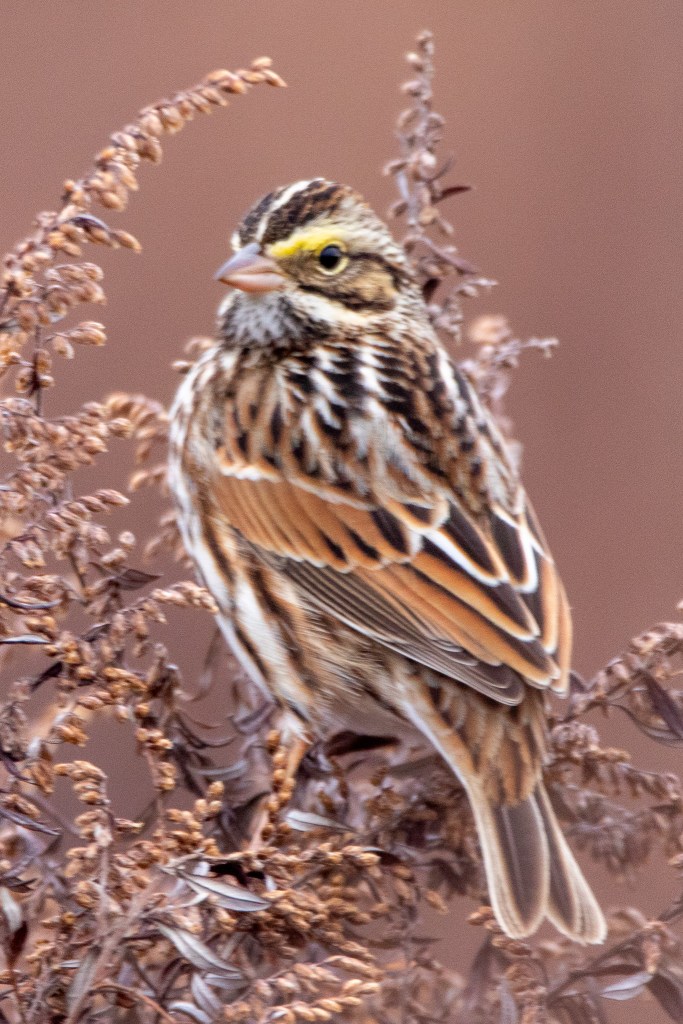
When I got out to the Mercer Meadows Pole Farm, I spotted sparrows on the ground and in the trees as usual, but I noticed a few savannah sparrows perched on tall grasses and spindly tree branches, as in the top photo. To me, that perching is an early hint of spring.
An even surer sign came toward the end of my walk when, having caught up with my friend Andy on the trail, we spotted a pair of Eastern bluebirds poking in and out of a bird box. While bluebirds stick around most of the year, it’s rare to spot them flitting about a bird box in the dead of winter.
The seeming nesting activity we saw yesterday gives me hope that the songbirds will soon again be singing lustily to ring in spring.
A pair of Eastern. bluebirds check out a nesting box. Any idea what that greenish blob on the roof is?
In my few short years of being a serious birder, owl sightings have been few. I’ve seen short-eared owls flying around sunset a few times and I’ve snatched partial glimpses at long-eared owls tucked deep into the trees.
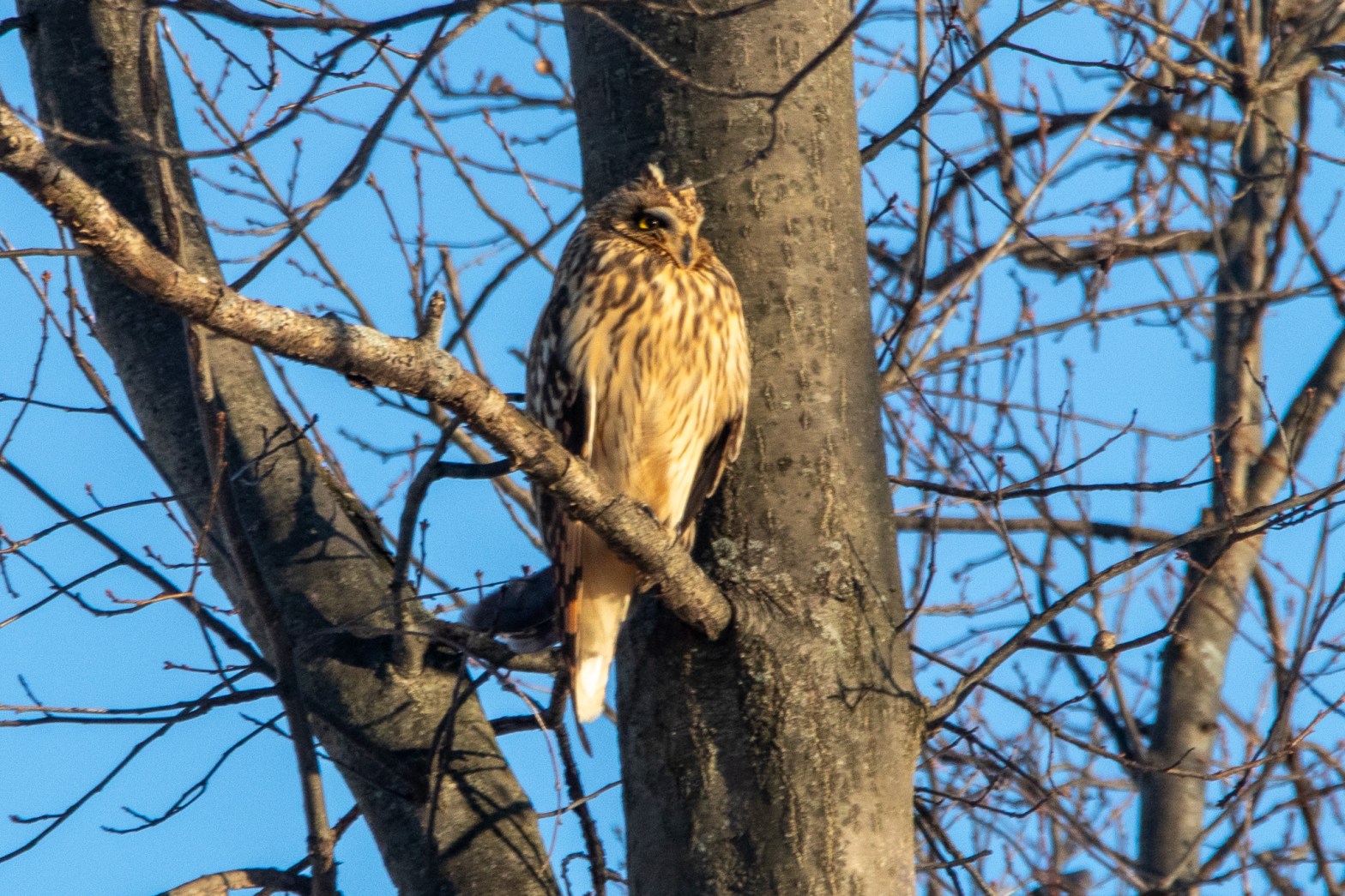
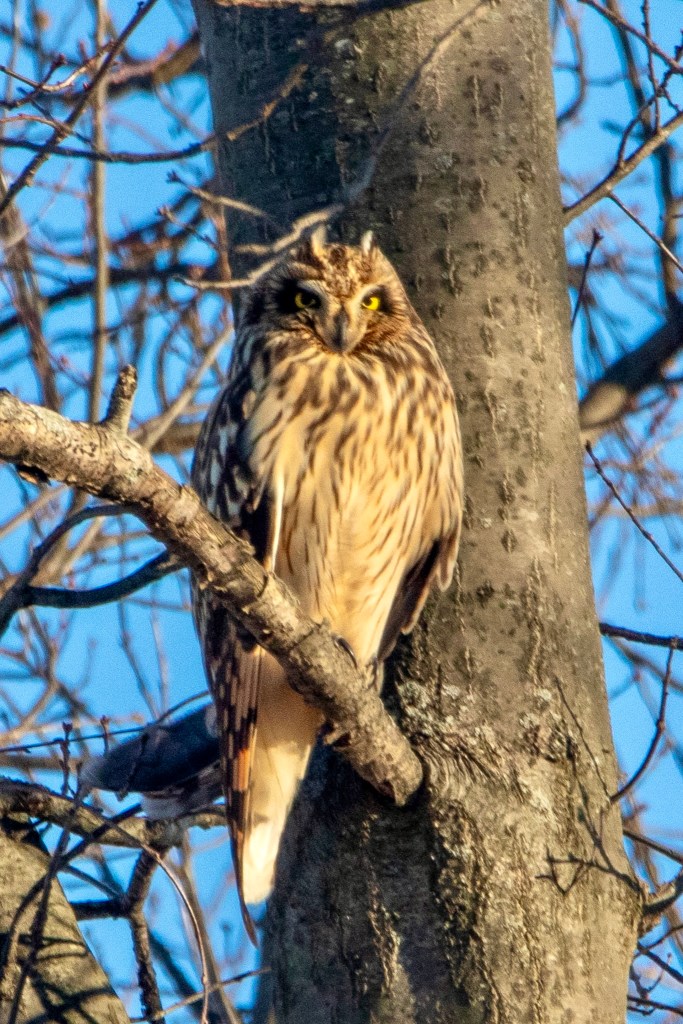
But last Saturday morning I received an unexpected treat at the Mercer Meadows Pole Farm. A short-eared owl was perched up in the lone, big tree in the center of one of the main fields, and the bird could be clearly seen even without binoculars.
You can just make out the form of the owl on the left side of the tree.
The bird, I learned later, stayed up in the tree for several hours, preferring that sunny perch to something low down on the snowy ground. I blasted off several dozen shots on a few camera settings, and I shot from a couple of locations to minimize the chances of small branches obscuring the owl.
Although I didn’t get a straight-on shot showing both or the bird’s beautiful orange eyes in full, I’m satisfied and grateful for the looks I got.
Best of the lot, and almost a full view of both eyes.
It’s mid-January, and as in much of the country, we are more often than not waking to leaden gray skies in my part of New Jersey. But Saturday dawned gloriously sunny, and I headed out with my camera anticipating excellent shooting conditions.
I stopped first at Audubon’s Plainsboro Preserve, hoping there’d be a variety of ducks on the lake that’s the centerpiece of the park. There were plenty of Canada geese, but not a duck was in sight.
I turned back toward home and stopped in Princeton at the Millstone River Impoundment, where the Delaware and Raritan canal intersects with Carnegie Lake. Bird and photo prospects were better.
Shortly after getting out of my car, I spotted two bald eagles circling over Carnegie Lake. A third eagle showed up a bit later, and I managed a few fair shots of it.
With an airliner flying the background, a bald eagle soars over Carnegie Lake.
What I initially thought was a handful of common mergansers on the lake turned out to be several dozen. As I stood on the shore hoping for eagle fly-bys, merganers started heading my way.
I blasted off several shots over a span of about 10 minutes. The best of the lot, of a female zipping past me, tops this post. I’m pleased with it, one of the sharpest I’ve taken of a bird in flight. A shot of three males is at bottom.
I leave it to your imagination as to whether the female was chasing or eluding the males.
The Mercer County Parks staff has put up fences at the Pole Farm to remind people to stay on the trails and not to wander off into the woods where long-eared owls have been roosting. I applaud the move.
I was walking up the central trail in shoe-sucking mud this morning when up at the tree line I spotted what appeared to be black boxes. As I approached, I realized what I was seeing were steel barrier fences on each side of the path, a longer group to my left and a smaller group to my right. I also could see a new trail camera, probably motion triggered, back in the evergreens where long-eared owls had been spotted in previous weeks.
Are those owls still there? Maybe. If the rangers are out patrolling for trail scofflaws, as an electronic sign alerts you as you at the juncture of a couple of the park’s main trails, that must mean that enough knuckleheads have tramped off trail and likely have spooked the owls.
I have only seen glimpses of those owls, and each time it was through binoculars from a respectful distance with other birders and photographers. After the fist couple of times I encountered others at the spot, I noticed that the grasses in front of the tree line had been trampled, presumably by owl prowlers who think the rules don’t apply to them.
This is not the first time park personnel have intervened to protect owls. A couple of years back, the staff put up steel barriers to block sections of trees at the old AT&T Building One oval, not far from where the new fences were put in place. People back then were wandering among those evergreens, from what I’ve heard, going right up to the owls to ogle and photograph them.
That boorish behavior has no place at the Pole Farm or anywhere else. We are in effect guests of the wildlife we observe in nature and we need to mind our manners.
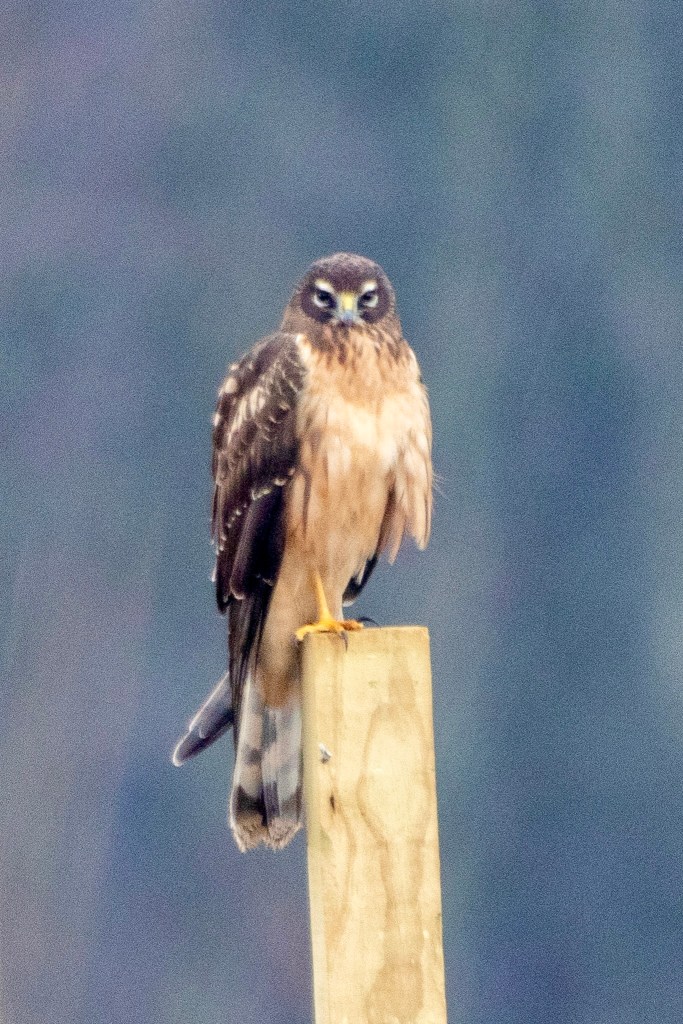
With another wet, wind-driven storm bearing down on the East Coast, I thought I’d better get out for a bit of birding yesterday morning, as I likely wouldn’t have a chance today. I made only a short visit to the Mercer Meadows Pole Farm, where once again I spotted a female Northern harrier perched atop a bird box near the edge of one of the main trails.
Henrietta, scoping out the meadow
I’ve dubbed this bird Henrietta. I’ve snapped her portrait several times over the past few weeks. Yesterday, after I’d taken a few photos of her and was ready to move on, she surprised me by taking off and flying almost directly overhead.
I rushed to pull my camera up and focus, but my Canon wouldn’t fire. I got an error message and a recommendation to restart, which I did quickly. By then Henrietta was flying east and out of range, and I was disappointed to have missed a chance for a close-in photo of her in flight.
The birding gods took pity on me, however, and sent a Carolina wren to perch in a tree I approached on my way back to the parking lot. I hear Carolina wrens near home most mornings, and I hear them singing virtually every time I visit the Pole Farm. But I could not recall getting a photo of one at Mercer Meadows, at least not in a long time.
This bird was unusually cooperative, perching on a branch and hopping over to another close by, giving me a couple of opportunities to take its picture. So it gets the billboard treatment atop this post.
I drafted this post early yesterday evening, just as the storm came howling in. Our power dipped six or seven times, knocking our WiFi offline. That’s why I’m posting today.
Thank you, little wren, for bringing good cheer. And Henrietta, I’ll see you after the skies calm down.
On this last day of holiday break, I could not resist the siren song of the red-flanked bluetail, a Eurasian native that has, curiously, been hanging out in a residential neighborhood in South Jersey since early December. It’s the first bird of its kind to be reported in the Eastern states.
My friend Laura texted me this morning to ask if I wanted to go birding. The answer, unhesitatingly, was “yes.”
Laura asked if we should take a shot at finding the red-flanked bluetail about 40 miles from our homes. Why not? How many chances in life will we get to find a bird in New Jersey that is visiting from its normal range between Japan and Finland?
Laura drove us down to Whiting, New Jersey, where we joined a scrum of a dozen other birders standing, squatting and sitting in the side yard of a duplex in a residential development in Ocean County.
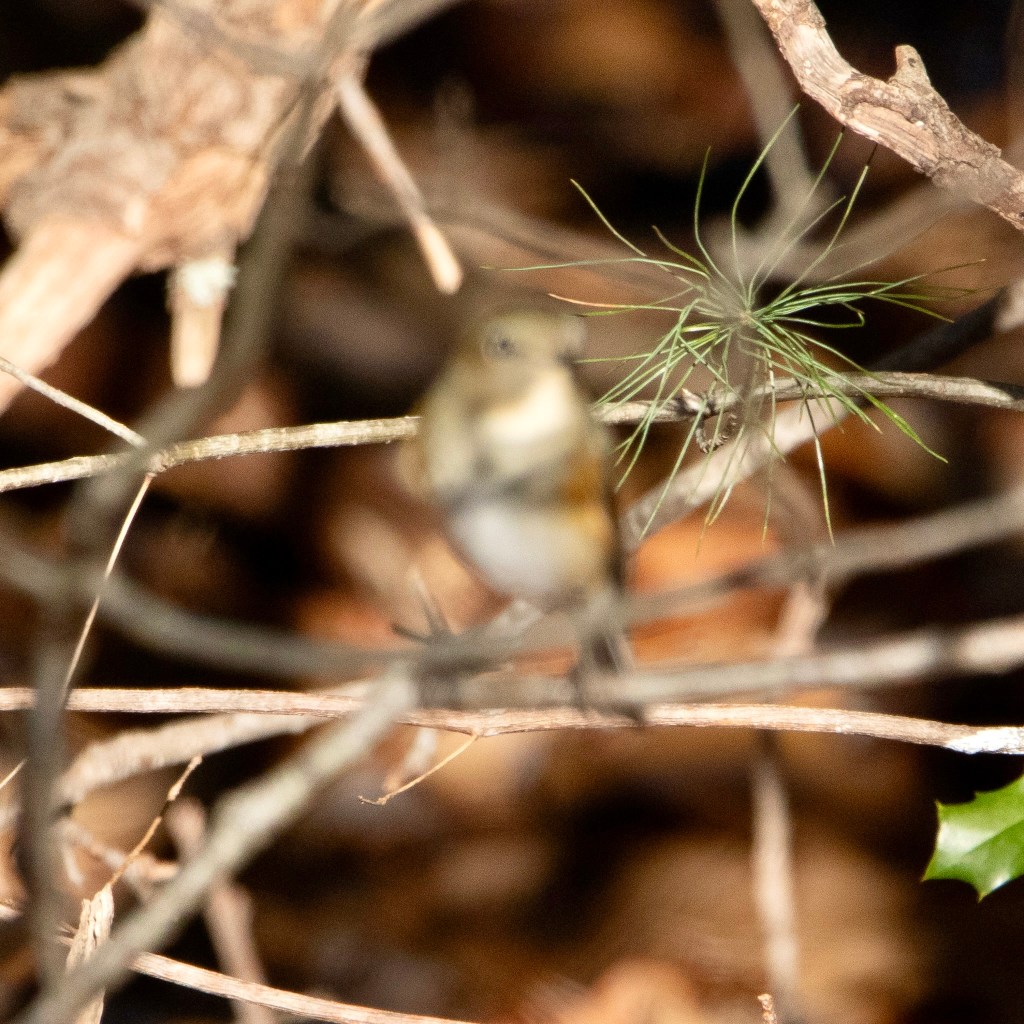
We waited about 15 minutes before the bird popped out of the holly and onto a low branch at the edge of the backyard. I squeezed off a few hectic frames, and I submit the better of two fuzzy images herein.
The bird returned to the holly and emerged a short time later to land briefly on the ground. I whiffed on that photo opp, but I was later able to spot the bird through a scope trained on her by a kind fellow birder.
Why the wayward bluetail chose this particular yard about 30 miles inland from the Atlantic coast is a mystery. The bird must have sensed that the residents of the house were bird-friendly. They have several bird feeders and a seed bell hanging from a small tree beside the house, which you can see in the photo topping this post.
Their instructions, posted on their patio, were clear: don’t go past the feeders. The stakeout crowd respected that limit, keeping about 20 feet away from the holly tree in which the bird has been living.
Laura spotted the bluetail through her binoculars and patiently talked me through finding her deep in the holly.
After half an hour or so, Laura and I headed back north, hoping to find another rarity: a black-headed gull that has been palling around with the geese at the Mercer Corporate Park in Allentown, New Jersey.
The lakes there were hosting hundreds of Canada geese plus hooded mergansers and American wigeons. No sign of the rare gull — like the bluetail miles from its normal range — but we did not complain.
We’d seen the bluetail, possibly the only chance we’ll ever have to see one. We were happy.
Happy New Year, everyone! I started the year with a good walk at the Mercer Meadows Pole Farm (above), excited to begin another year of birding adventures.
The first birds I heard were, predictably, European starlings screeching from the trees across from the entrance to the park. Then a chatty American crow started squawking from another tree just beyond the park’s border.
Turning my gaze and attention to the trail ahead, I was soon greeted by a Northern harrier squeaking from atop a post to my right. She was my first official photo capture for 2024, and she gave several fly-by passes for a few minutes. There was little sunlight slanting through the clouds, so the light was not ideal for a crisp in-flight shot. But I am grateful to have gotten this next photo.
A Northern harrier flies above me Jan. 1, 2024.
Eastern bluebirds came out in force once I reached the tree line on the central path, and there were even more as I looped back to the parking lot on the paved Lawrence-Hopewell Trail portion of the park. It’s always good to see them (and other regulars at the park, like the downy woodpecker and savannah sparrow).
Eastern bluebirdDowny woodpeckerSavannah sparrow
By the end of this year, my goal is to be able to say I’ve gone birding in all 21 counties in New Jersey. I’ve done 10 to date, so I have 11 to go, eight of them in the upper third of the state. I’ll be migrating north several times, as well as making a few forays to the south.
Trips west to visit family are in the offing, so I hope to chalk up a few more counties (and lifers) that way. Whether you’re birding at home, abroad or somewhere in between, may 2024 bring you good luck and joy.
As 2023 fades into history, I am reflecting on what this odd, odd-numbered year has meant to me. Most of all, I am grateful for the friends I’ve encountered in my birding excursions.
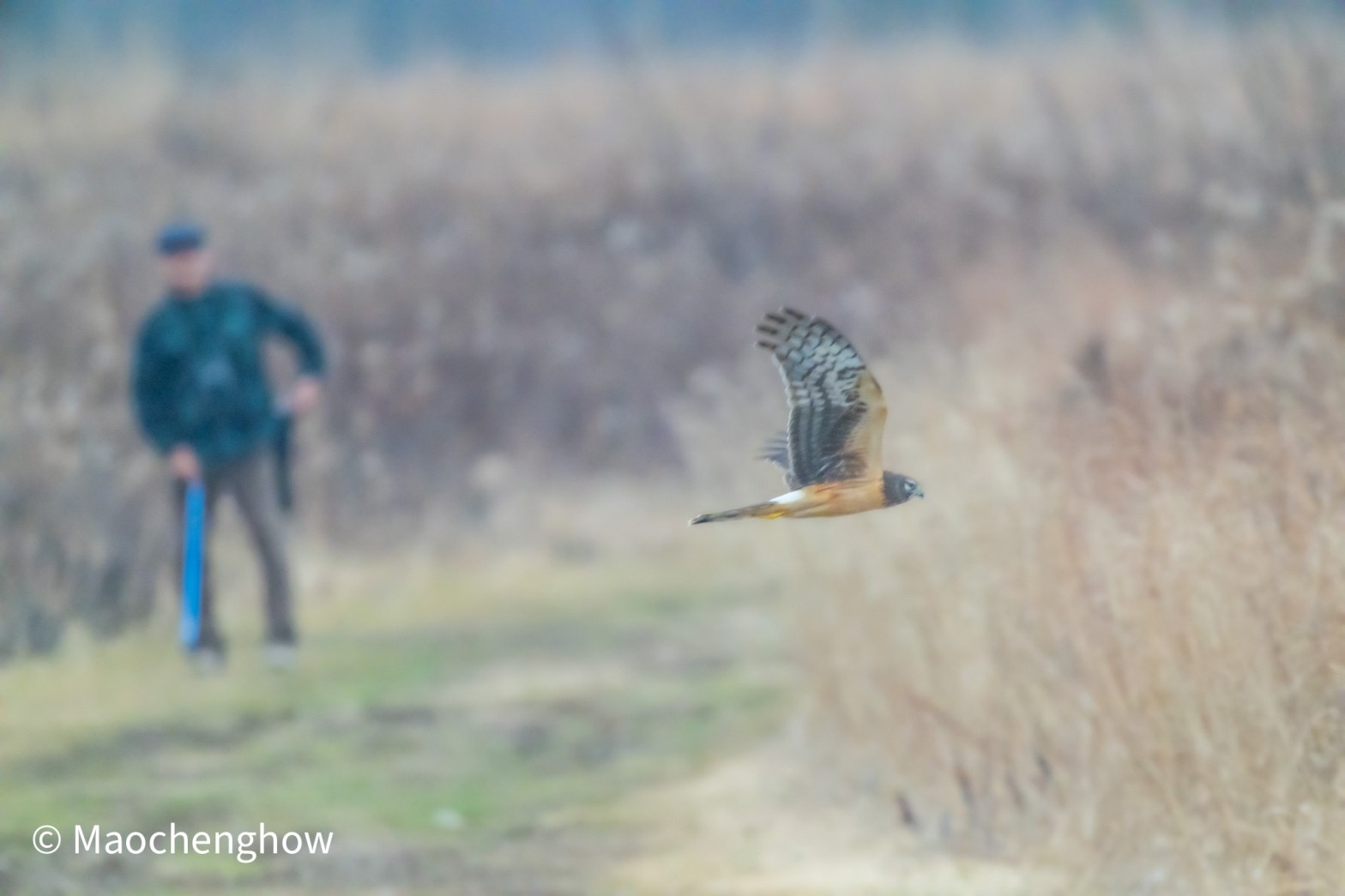
They include my steady friends, Jim and Andy, regulars at the Mercer Meadows Pole Farm, who share their joy in spotting birds and getting their photographs, overcoming the vagaries of weather and sunlight winter, spring, summer and fall. Andy supplied the photo topping the post, a Northern harrier sweeping across the trail as I, slightly blurry at back left, trudge along with my cane.
The pseudononymous Old Sam Peabody and Blonde-Crested Warbler are always a pleasure to see, no matter where we happen to converge.
Other friends include the Mikes (two with dogs) and Ginger and Nancy, whom I see periodically and with whom we trade hopeful notes on where to spot this or that species that catches our fancy.
And they include Jeanne and her friend whose name I did not get, visitors from Long Island stopping by the Pole Farm today in hopes of spotting the elusive owls that pay us a call seasonally, although not daily, at least not every time we’re we’re stalking the trails.
They include new friends, like Julia, a visitor from Canada, an “accidental” birder whose visit was a highlight of my year. I’ve made new online friends, too, via WordPress and social media, whom I hope to meet in real life in due time.
I cannot omit the Lauras, one Princeton University colleague who is my best birding buddy and another Laura, also a Princeton colleague, with whom I’ve walked a few trails this year. Nor can I leave out faithful email correspondent Sheila, whose missives never leave me short on joy.
Due to an illness that grounded me for more than two months, my yearly totals of species spotted did not quite match that of 2022. But I still had an enriching year, part of it spent in the easy chair at home, looking out the back windows at our feeders.
Despite the setbacks, I added 14 birds to my life list, many of them from highly satisfying chases with Laura as we tracked down a rare Harris’s sparrow and a not-so-rare but nemesis cackling goose.
To my friends, old and new, I thank you for making my birding adventures so pleasurable, and I wish you all the best, in birding and in life, in the coming year.
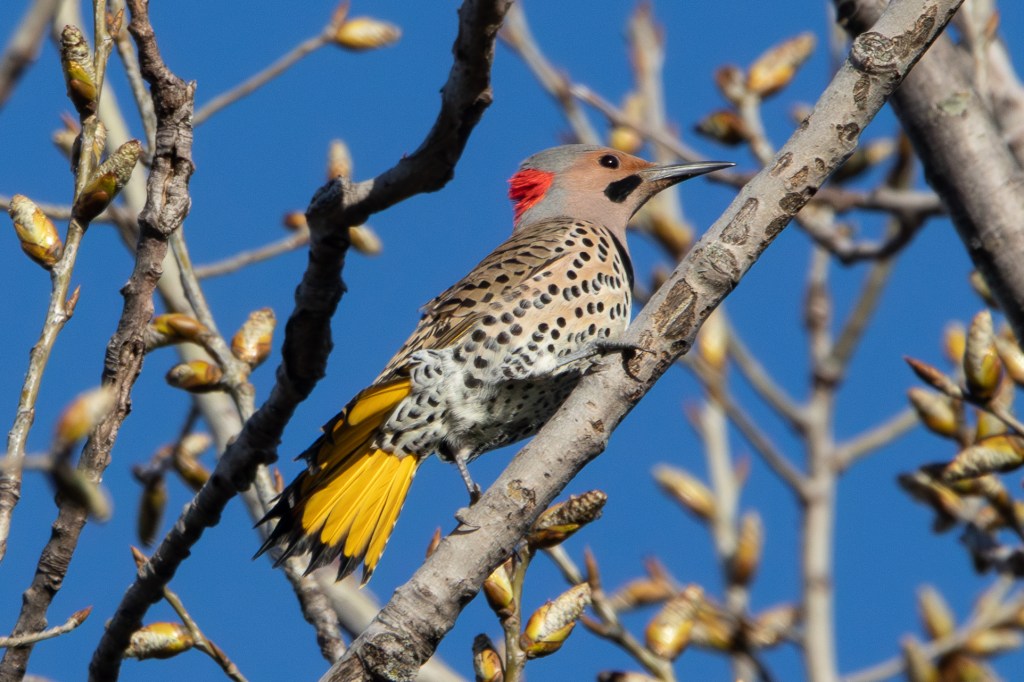
Northern flicker, April 2, one or my favorite images of 2023.
Back to the Pole Farm I went this afternoon, hoping to see more short-eared owls and Northern harriers flash about as the sun set. The cloud cover was heavy and the light low, not ideal for photography. Nonetheless, the Cold Soil Road parking lot was packed again (a sure sign of owl fever) as I pulled in just before 4 p.m. I had to improvise a spot on the edge of the lot.
First to appear were the Northern harriers, including two “gray ghost” males, giving me the best looks at them in a long while, even as they were flying back by the observation deck. Eventually, around 4:30 p.m., a couple of shorties emerged, darting among the harriers high in the sky, well out of the range of my camera. But I got some good views through my binoculars.
Several photographers bailed as the light dimmed, but a couple of us stayed planted. We were rewarded with views of owls and harriers that flew closer to us.
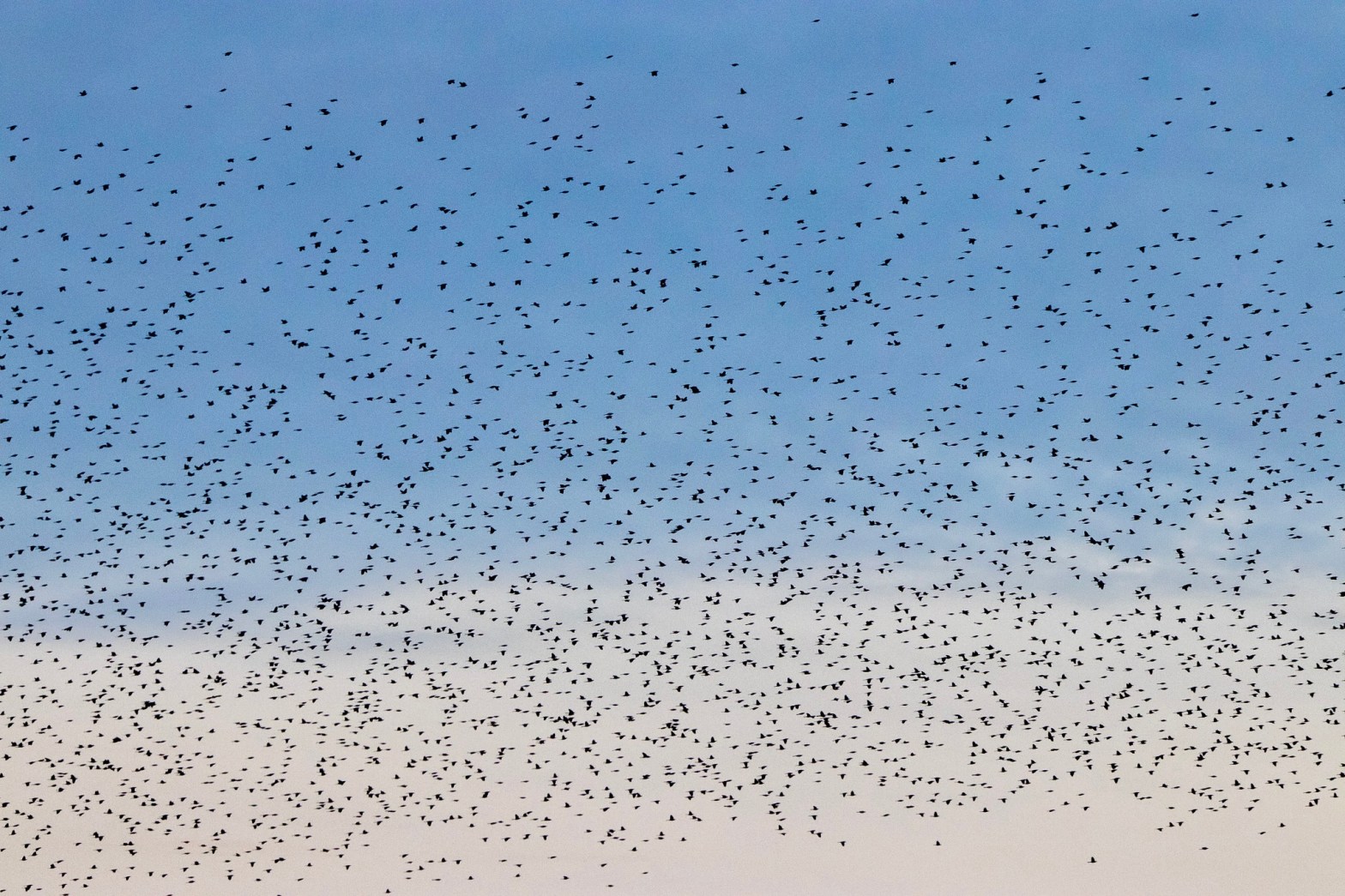
I don’t have any photos of them worth sharing, so I decided instead to top this post with a shot of the center of an impressive murmuration of hundreds of birds that flew in the distance, roughly following Keefe Road. It’s impossible to get proper IDs, but starlings, grackles and red-winged blackbirds were likely in the mix. I’d seen at least two other big flocks at the park in the last week, but this one was the largest.
While we birders spend most of our time trained on single specimens, it’s also a thrill to zoom out and get the wide view of hundreds of birds in a flock flying en masse.
On this Winter Solstice, I felt an obligation to do some birding at my favorite spot, the Mercer Meadows Pole Farm. It’s prime season for short-eared owls there, and I hoped I’d get a chance to see a few of them flying around sunset.
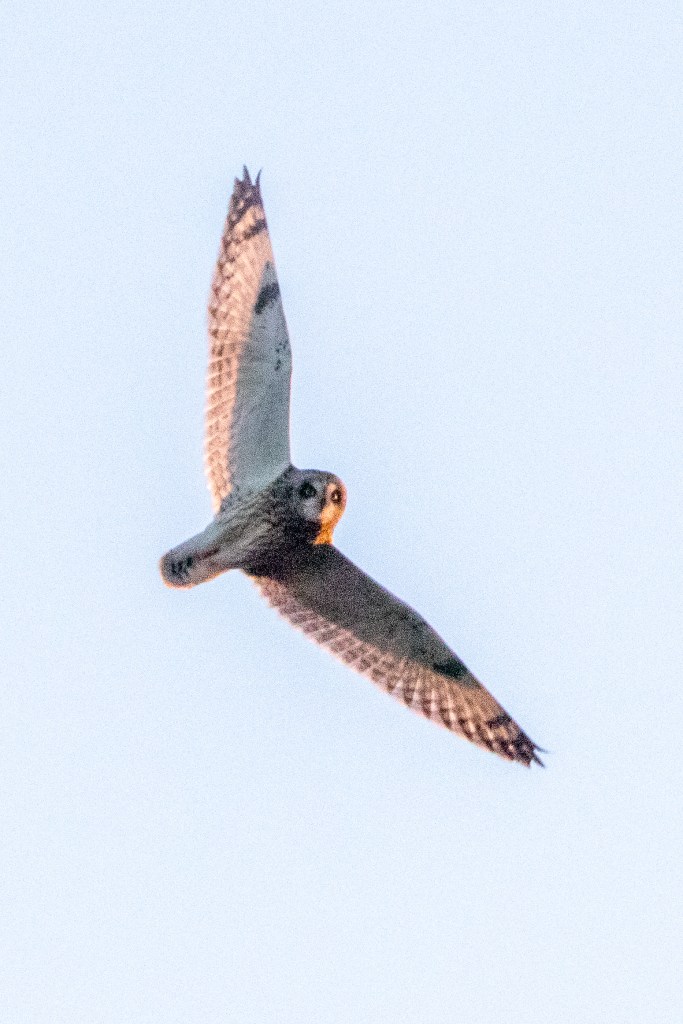
The birding gods were kind. On this, the shortest day of the year, three short-eared owls came out of the fields and put on an entertaining aerial display around 4:20 p.m., about 15 minutes ahead of sunset.
A crowd of photographers was already staking out positions along the central trail as I pulled into the Cold Soil Road parking lot shortly after 4. Every slot was taken, and I had to invent a spot near the maintenance barn.
As I walked up the trial, a Northern harrier landed on a bird box off the center trail, generating a lot of camera clicks from a cluster of photographers. Farther up the trail was an even larger gang of photographers, as seen in the photo atop this post.
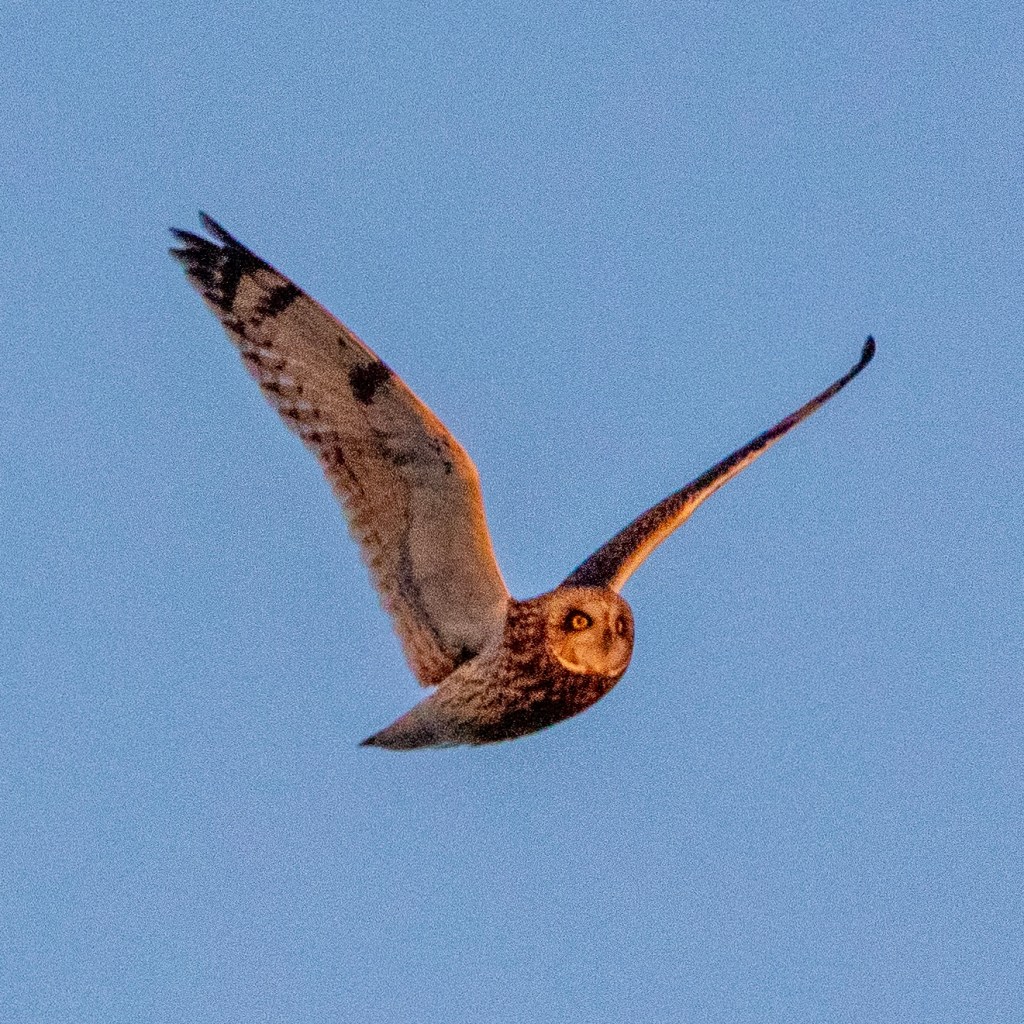
A short-eared owl flies overhead, with the about-to-set sun illuminating its face.
I soon spotted my friend Andy, one of the Pole Farm regulars and a terrific photographer who’s become a good friend. He and I stayed with the smaller group of shooters halfway up the trail, and it was a lucky choice. A short while later, ace birder Fairfax came up the path and was the first to spot a “shortie” flying at the far edge of the field to the north.
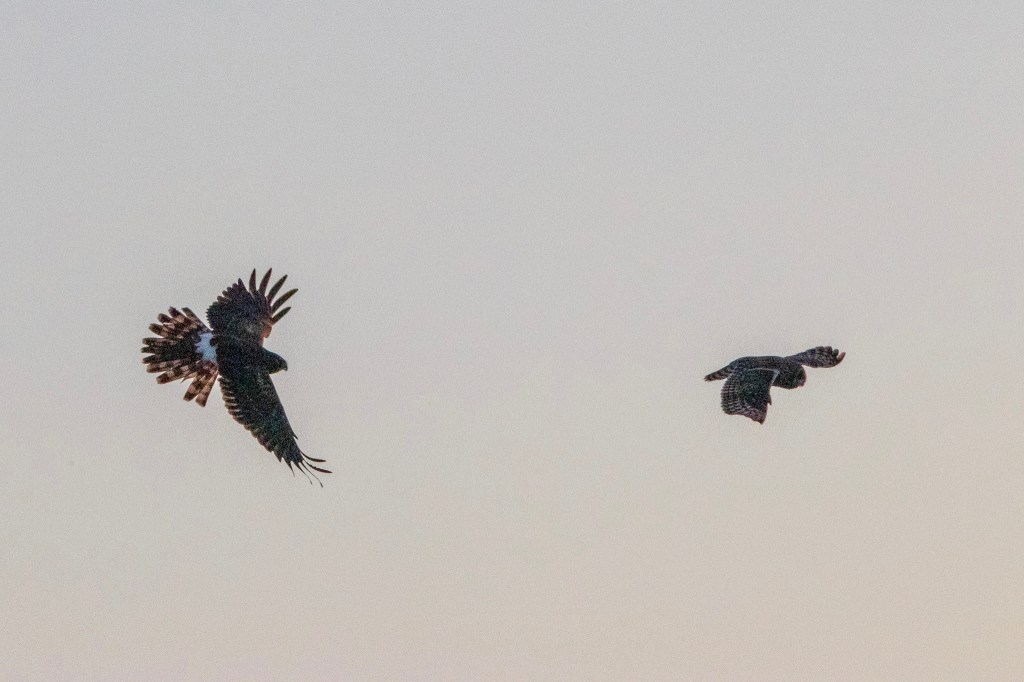
I can’t remember the sequence of things, but suddenly two shorties came flying at us, and we pulled our cameras up to catch the action. The owls passed over to the field to the west and started circling. A Northern harrier appeared and began harassing the owls, who were then joined by a third owl.
Northern harrier (left) pursues a short-eared owl
The harrier buggered off at some point, leaving the three owls to thrash about. One of the other photographers reported that one of the owls had a vole in its claws, which explained why the owls were doing what appeared to be aerial combat.
By this time, the sun was slipping below the tree line, and photo possibilities dwindled. Andy was frustrated that he didn’t seem to have any decent shots, although he got a good one of that first harrier taking off. I had only glanced at a few of my early frames and figured I might have one or two fair shots.










 The Jersey Birder