Blue jays are ruling the roost

2024 is turning out to be a banner year for blue jays, at least as I’m seeing and hearing them on my outings in Mercer County, New Jersey.

Each time I look out the back windows at home, it seems two or three blue jays are flying up to our feeders or streaking by the windows.

At the Mercer Meadows Pole farm in recent weeks, the jays usually top my tallies, even as gray catbirds vie for numerical supremacy on any given day. Yesterday, I listed 14 blue jays in my e-Bird count, and I followed today with 10. Those probably are undercounts, I think each time I push “submit” on a checklist.

I went into to Princeton yesterday afternoon to the Millstone River Impoundment, and the first bird I heard as I stepped out of the car was a blue jay. I recorded six on what was a quiet 45-minute visit. I saw more blue jays than eight other species, although there were 10 Canada geese out on the water. Their numbers are building, too.

For as many blue jays as I see and hear, I have relatively few photos of them. That’s partially attributable to an attitude that the birds are so common, I don’t got out of my way to shoot them.

More likely, though, is that they tend to perch briefly near the tops of the tallest trees and often are obscured by leaves. The leaves are starting to fall, so I’ll likely get better looks in the coming weeks.

I’ve topped this post with a blue jay photo from May, when one of them stopped in nice light atop a snapped-off tree. I didn’t hesitate to snap off a shot! 🦅

Northern harriers return to the Pole Farm

I headed out to the Mercer Meadows Pole Farm this morning, figuring I had a good chance of spotting some warblers. Even though I stretched my walk by about a mile longer than usual, I didn’t see or hear any fall migrants.

But on the way back to my car, I spotted a Northern harrier rising up over the big field to my right. To my delight, the bird flew closer and closer to me, arcing right to left.

I was able to fire several shots before it veered off to its right and headed toward the outer boundary of the park. The sun was out but was largely tucked behind the clouds when the harrier granted me the photo opp.

The photo topping the post is unusual for me in that it captures the upper body of the bird as it banks its turn. Most of my harrier shots are looking to their underside as they fly high above me. The more typical (and sharper) shot is below.

Over the next several months, I expect to see many harriers, often several on a single day. I’ll be lucky to get another extended fly-by like the one I got today. However the harriers present themselves, I’m always happy and grateful to see them. 🦅

Northern harrier flies by against a blue sky.
The harrier flies by me.

A fine morning at Hamilton Veterans Park

For the past several days, I’d been seeing e-Bird reports of snowy egrets and a little blue heron hanging around Veterans Park in Hamilton. When I woke up this morning, I figured it was high time I checked them out.

Sure enough, the little blue heron was staying close to a larger snowy egret, as shown in the photo topping this post. The birds were maybe 50 feet from the edge of the park’s lake, the water level of which seemed low. I was able to take a few steps off the hard-packed dirt trail that parallels the shore, picking my way from fallen branch to fallen branch to avoid sinking into the mud.

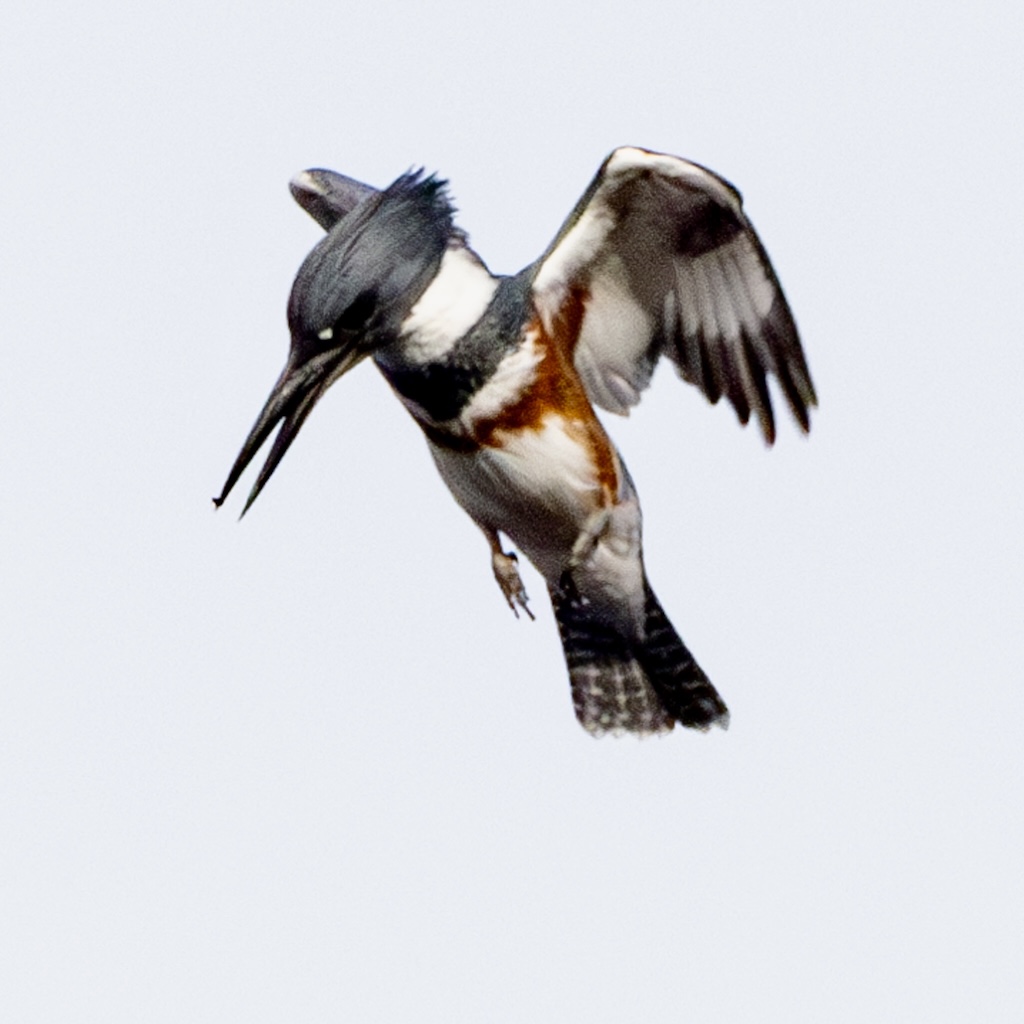
I only saw one snowy egret, and I could see a few great egrets fishing across the lake. Great blue herons were close by, and I watched two bald eagles cross the lake and land in a tall tree. They tucked into the leaves, not leaving me a decent photo opportunity. I also observed two belted kingfishers chasing each other over the water, a fun sight but one too fast and far off to shoot.

At one point, I heard an unusual call and turned on the Merlin app. It said it was hearing a greater yellowlegs, and a quick scan into the distance didn’t turn up anything. The bird continued calling for a minute or two, and I soon turned my attention and camera to a few spotted sandpipers stalking along the mud flats.

Spotted sandpiper walking in a mud flat.
Spotted sandpiper making its way along the shore.

About the time I decided to turn back to my car, I notice a somewhat taller bird stepping along the shore. I took a few shots, thinking it was another sandpiper and didn’t think much about it. With 108 frames on my camera card, I was eager to get home and see my little blue heron and egret shots.

To my pleasant surprise, that last bird I shot turned out to be a greater yellowlegs, almost certainly the one that Merlin had heard calling previously.

All in all, it was a fine morning to catch a few birds I don’t often get to see, let alone have relatively close access for photos. The day also reminds me that Veterans Park is worthy of a place on my Hot Spots section, which I haven’t given enough attention. 🦅

Greater yellowlegs walking in shallow water.
A greater yellowlegs treks through the shallow end of the lake.

Old friends return: a Northern harrier, Savannah sparrows and a West Virginian

It’s that time of year when some of the birds who left us in late spring and the summer start making their way back. At the Mercer Meadows Pole Farm this morning, I was delighted to see a Northern harrier for the first time since the lot cleared out a few months ago.

Northern harrier flying by.

She rose up from the low-lying layer of fog over one of the central fields, and when I pulled up my binoculars I was able to see clearly her signature white rump. A minute or two later, presumably the same bird appeared flying off to my left and I got a couple of grab shots.

I would later spot the harrier as I made my way back to the car along the paved Lawrence-Hopewell Trail. Again, I wasn’t sure if it was the same bird, but I know in a few weeks I’ll see multiple harriers hunting the Pole Farm fields.

Also today, Merlin started lighting up with Savannah sparrows, which I still can’t distinguish on my own. I took a few photos of them without realizing what they were, as the usual tell-tale yellow striping on their heads was not pronounced. But when I got the photos up on screen, the IDs were confirmed. One of the shots tops this post.

As for the West Virginian, that was not a bird but a birder, a dear friend from college days who came through town on her way to New England. Sheila and I had not seen each other since we graduated (and since Jimmy Carter was president).

We spent a full day birding at the Pole Farm, across the Delaware River at the Bowman’s Hill Wildflower Preserve, and at the Trenton marsh at John A. Roebling Park.

We saw a fair number of birds at the Pole Farm, but pickings were slim at the other locations. No matter, we dredged up some wonderful memories and shared, in person, finally, our love of the outdoors and our feathered friends.

I wish the harrier and the Savannahs had shown themselves when we visited the Pole Farm last week, but that makes for another reason for Sheila (who I know will read this post!) to migrate here at any time of year. And I owe her a trip to the Mountain State. I hear they have birds there, too.

A Labor Day lifer

It’s the Labor Day holiday in the United States, and I headed out onto the trails of the Mercer Meadows Pole Farm hoping that I’d get a glimpse of the early-arriving migrating warblers that had eluded me.

I did spot black-and-white and prairie warblers while hanging out near the old AT&T Building One oval with expert birder Jim Parris. But that wasn’t the highlight of this relatively cool morning with the sun only partially out. As Jim and I were scouting a nearby patch of trees in what I call “the warbler wall,” Jim spotted a yellow-bellied flycatcher. It was a ways off, and I got a quick look through binoculars before it darted away. It popped out a short while later, again offering only a fleeting glance and no chance for a photo.

Yellow-bellied flycatcher perched on metal fence.
The yellow-bellied flycatcher cocks its head.

But lo and behold, the flycatcher reappeared maybe 30 feet to our right, perched on a deer exclosure fence. It’s a pretty bird, with its yellow-wash breast, bicolor bill and striking wingbars.

It was a lifer for me, number 221 (197 in New Jersey), and the memory will keep me smiling for a good time to come.

A hint of fall at the Pole Farm

We’re still a few weeks away from the autumnal equinox, but Mother Nature is dropping a few hints that Fall is coming. The annual fall migration of birds is underway, and I’ve yet to see any southbound warblers in my treks at the Mercer Meadows Pole Farm.

Eastern kingbird in tree, with one wing partially extended.
Eastern kingbird. Is that a wave of “hello?” Or maybe it’s “goodbye.”

But this morning, an obliging Northern cardinal perched on a tree, and behind him I could see a patch of foliage turning from green to red and gold. The bird set himself amid some small branches, and I had to shift my position a couple of times to put my focus point on him. He spent most of the time turning his back on me, but he turned to his side a couple of times to afford me one clear shot, which tops this post.

Cardinals are with us year-round, fortunately, but soon I’ll be saying goodbye to some of the itinerants who spend only the middle months of the year with us. I spotted a pair of Eastern kingbirds yesterday, and I saw one again this morning perched high up in a tree.

The number of field sparrows and common yellowthroats, both species whose songs delight my summer mornings, are getting scarce. I’ll be sad to see them go, but not too sad. I know they’ll be back next spring. In the meantime, the Northern harriers should be back soon.  🦅

Female common yellowthroat perched on a branch, with its beak open in what almost appears a smile.
Common yellowthroat on Aug. 26.

Summer doldrums for birding? Nah!

For the past week, I’ve endured a stretch of work and weather that has not been conducive to birding. The last couple of days have drenched the area with rain, some of which can be attributed to the remnants of Hurricane Debby. My binoculars and cameras have been parked indoors, and I’m itching to take them out again when the sun comes up tomorrow.

I did manage to get out to the Pole Farm on Tuesday morning, and I was pleased to get the shot topping this post of a song sparrow. At least I’m reasonably certain it’s a song sparrow, as I saw it in profile and could not clearly identify the trademark dark spot on its breast. I like the shot because the bird shows up clearly on the reddish branches against a lush green background. The photo looks good on the desktop screen of my laptop and on the big monitor I have on my desk at work.

The Pole Farm fields have been fertle for the Eastern cottontails this year, and I got an unusual look at one Tuesday along the Lawrence-Hopewell trail. I always thought the cotton tails were attached directly to the hindquarters, but this rabbit had unfurled its tail. I’ve taken many trips around the sun, and I’d never seen anything like that before.

Rabbit with tail extended.
Funny bunny: check out the tail, with the cotton part smushed against the pavement.

My turn as a birding guide

My office hosted a conference for colleagues from similar offices at other universities this week. As part of the festivities, I offered to lead a birding walk at the Mercer Meadows Pole Farm.

Tuesday dawned partly sunny and partly muggy, but conditions were good for the walk. As for the birds, this was one of those days when they were elusive.

In our leisurely hour-long stroll, we only identified nine species, an unusually low total, even for the middle of summer. Although there was a typical chorus of field sparrows, stunningly, we heard just one common yellowthroat. Normally in similar circumstances, I’d record 10 or 12.

We did get one unusual sighting, a common raven that squawked as it flew overhead. That’s only the third time I can recall spotting a raven at Mercer Meadows, the second on the Pole Farm side of the park.

I only had occasion to raise my camera a couple of times. A willow flycatcher came into view as we were heading back down the trail, and a gray catbird poked out of a tree. The catbird shots weren’t worth saving, although I had two fair frames of the flycatcher.

Two of my colleagues on the walk work at Cornell University, and we spoke glowingly about the Cornell-developed Merlin app. We demonstrated it on site.

Willow flycatcher perched in bare tree branches.
Willow flycatcher

The walk was the first time I led a group outing, and it was a pleasure to show off the Pole Farm. Even though we saw unusually few birds, I was happy to share my love of birding.

I didn’t probe deeply, but those who joined me were more “birding curious” than active birders. Several talked about birds spotted in their yards at home. I’m betting many of these new friends will be paying more attention to their avian visitors when they get home.

Demon grackles swarm my feeders

Common grackles are the motorcycle gangs of the bird world. They swoop into our yard, attacking the suet feeder and often by sunset gobbling up the two cakes I had put in fresh after sunrise.

It’s not unusual to see scores of them at home — a group strutting around the grass while others squabble over the suet and others pounce on the tub feeder perch. European starlings and red-winged blackbirds will sometimes arrive with the grackles. It’s never clear which species spotted the food to be had in my little half-acre, but word spreads quickly.

While females and juvenile male grackles are a drab brown, mature males have a stark beauty, best revealed when sunshine brings out the shimmering iridescence of their heads.

Above, two grackles grapple at my suet feeder. Below, a grackle shows off his colors at the Mercer Meadows Pole Farm.

A common grackle perched in a tree and lit by the sun.

Fortune finds me a feather

One year ago, I aborted a visit to the Reed Bryan Farm side of Mercer Meadows because I wasn’t feeling right. My balance was off. Later that day I fell at home and had difficulty walking after that. I ended up hospitalized for a bit, missed two and a half months of work and spent a couple of months walking with a cane.

I’m fully recovered, thank goodness. To celebrate one year of passage*, I headed out to Reed Bryan Farm this morning, hoping the birding gods might grant me a special gift — a lifer, maybe, or a great photo opportunity.

A female Northern flicker. Did she give me a special gift? I’d like to think so.

I found a typical assortment of birds, not counting three purple martins clustered in the same tree where I had spotted their kind once before, the only time I’ve seen them at either Reed Bryan or the neighboring Pole Farm. Photo opportunities were less than average, although I had caught a Northern flicker high up in a bare tree and hoped that might turn out alright.

As I looped back toward the parking lot, ahead of me on the trail I spotted a yellow and black feather, clearly something shed by a Northern flicker. I’m not one for omens or superstitions, but on this day, I figured I should treat the feather as that gift I was hoping for. I stopped for a selfie photo, and as I resumed walking I decided the feather was a prompt to realize that I truly was given a gift, the gift of good health.

When I got home and checked my photos, I could see that the flicker I had encountered was a female, with her yellow shafts clearly visible. I have no proof, of course, but I’d like to think she left that feather for me to find.

*I’ve since figured out that I was a day early for the anniversary of that aborted visit, which was Monday, July 17, 2023. Leap Year threw me. Regardless, it’s a special day for me as I conclude the year that has passed.