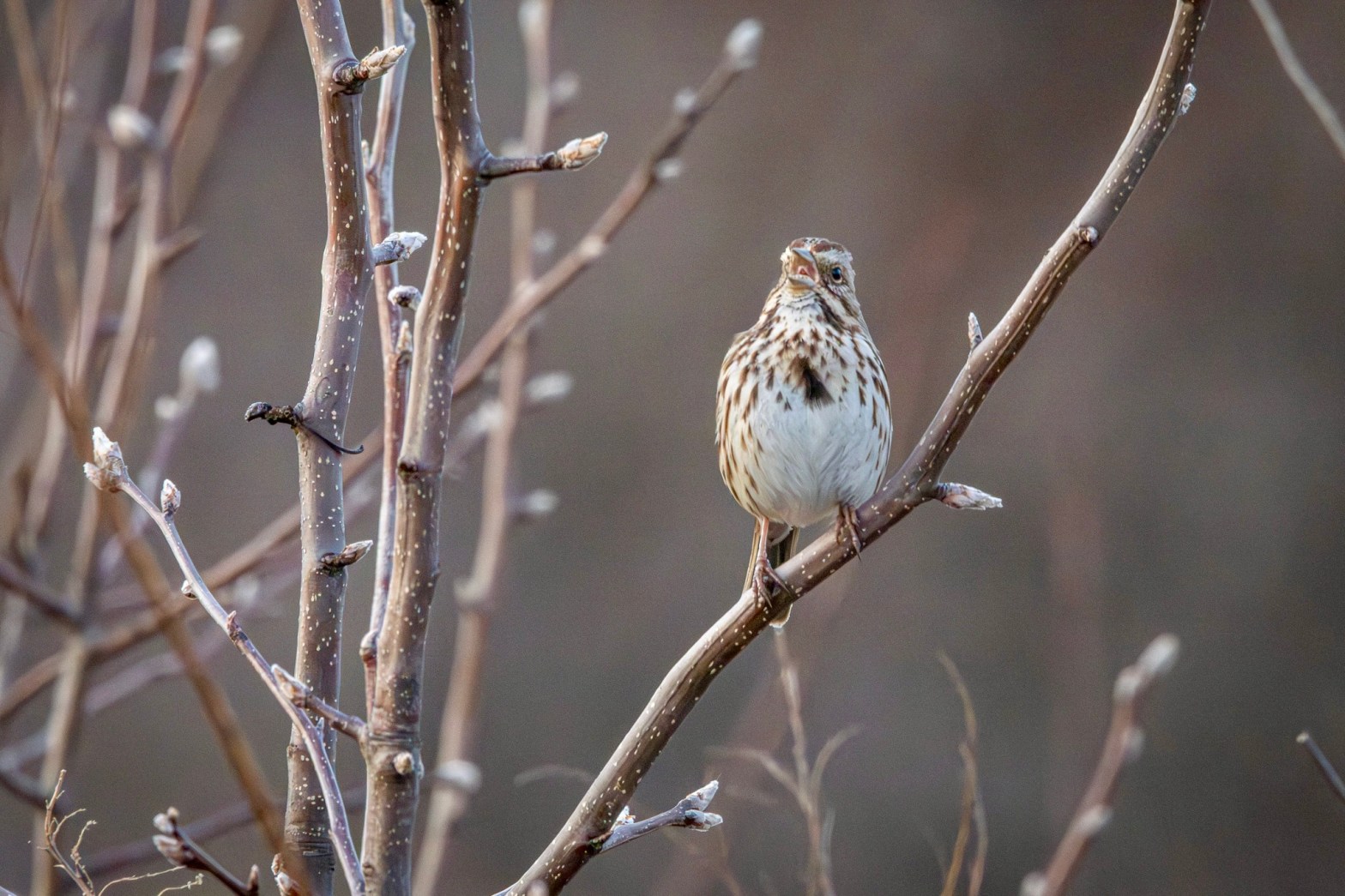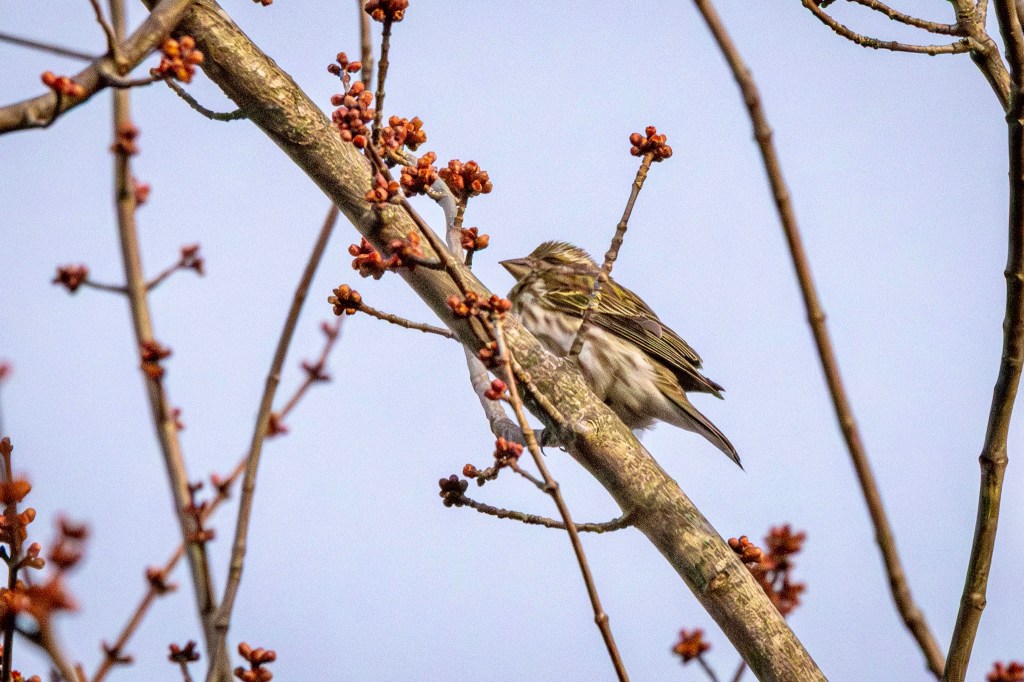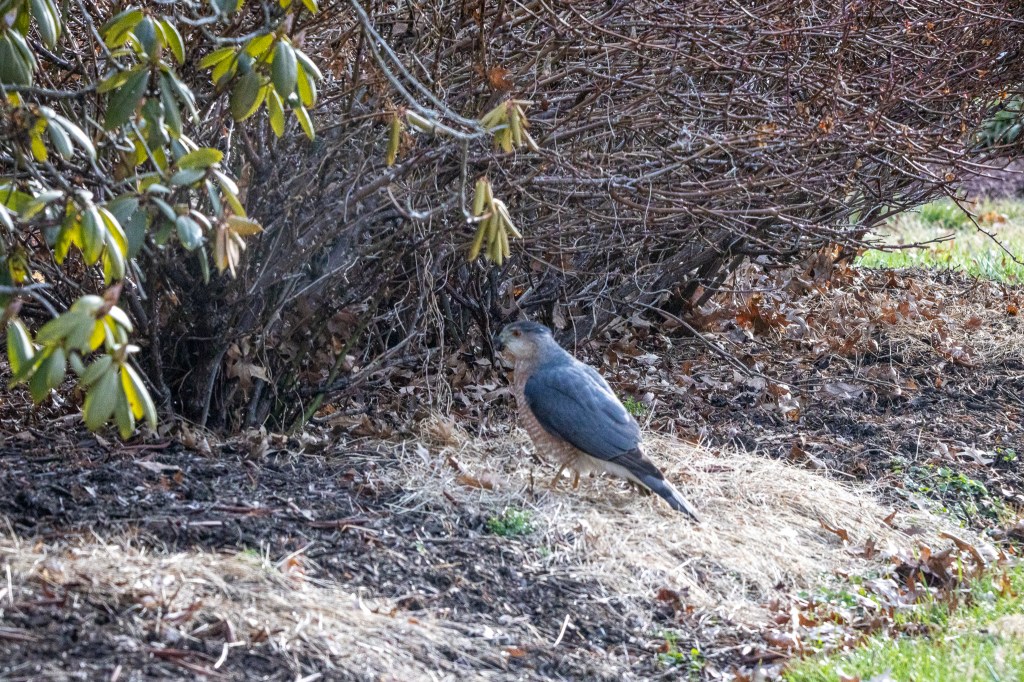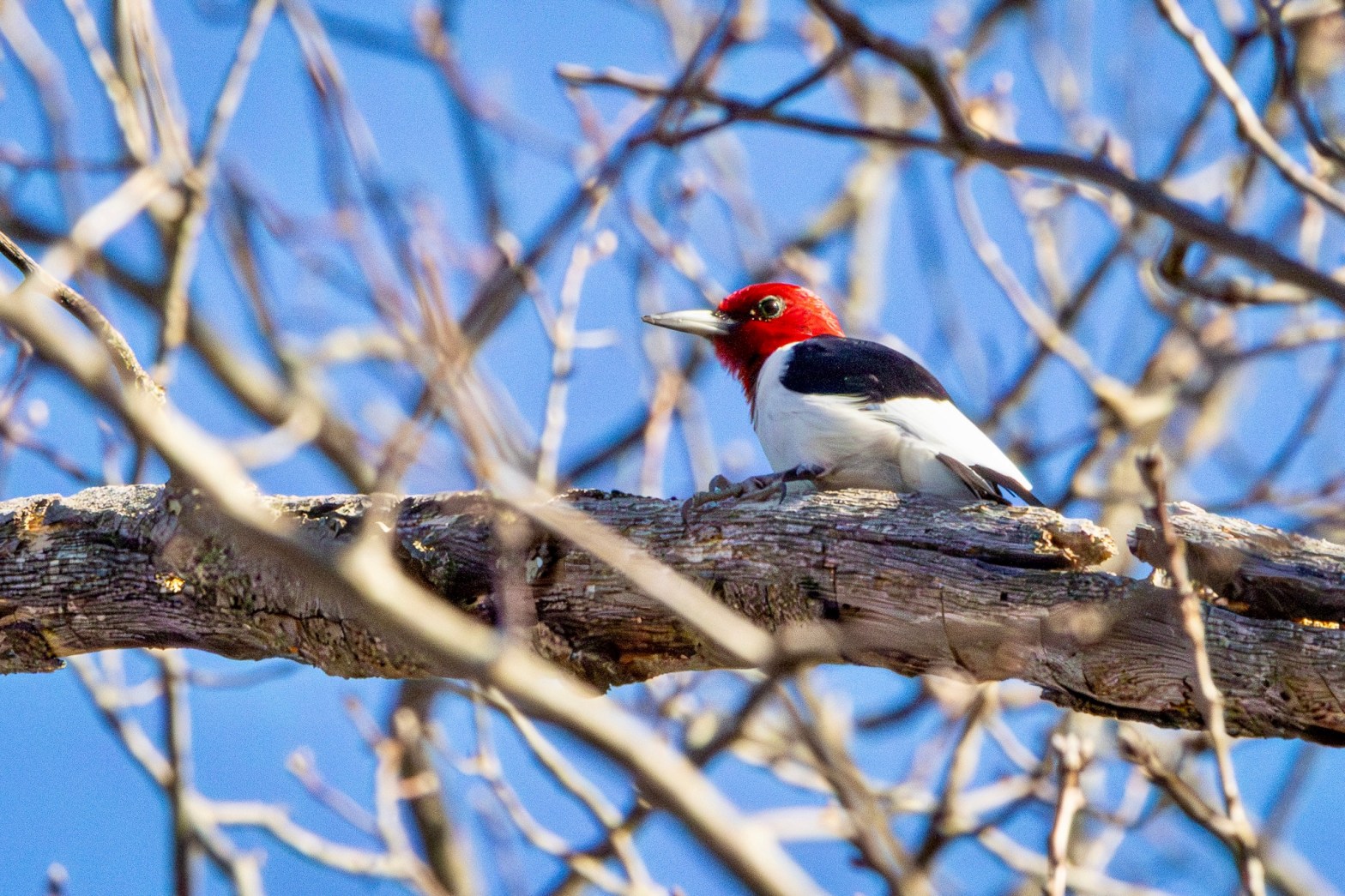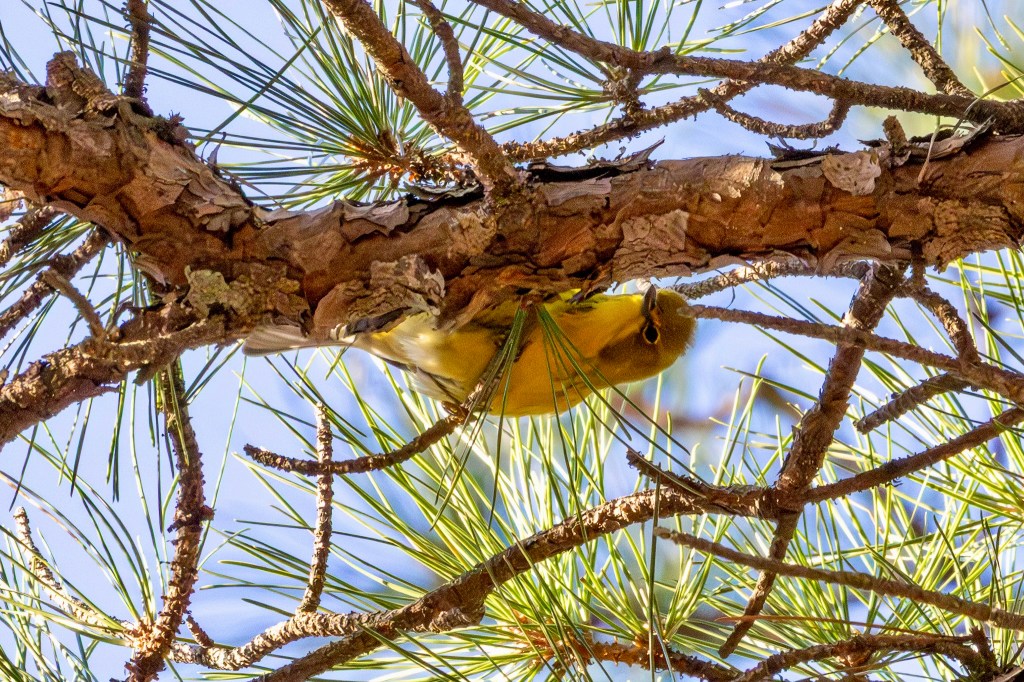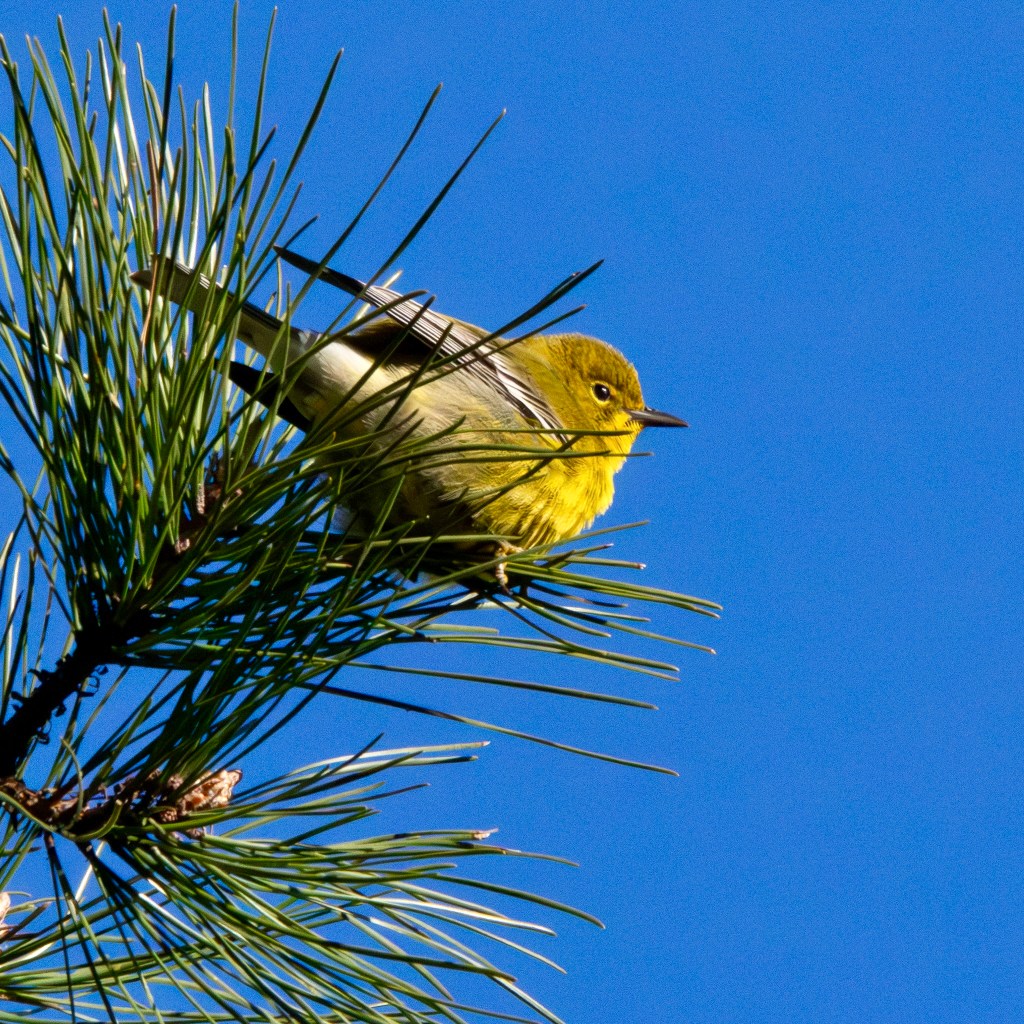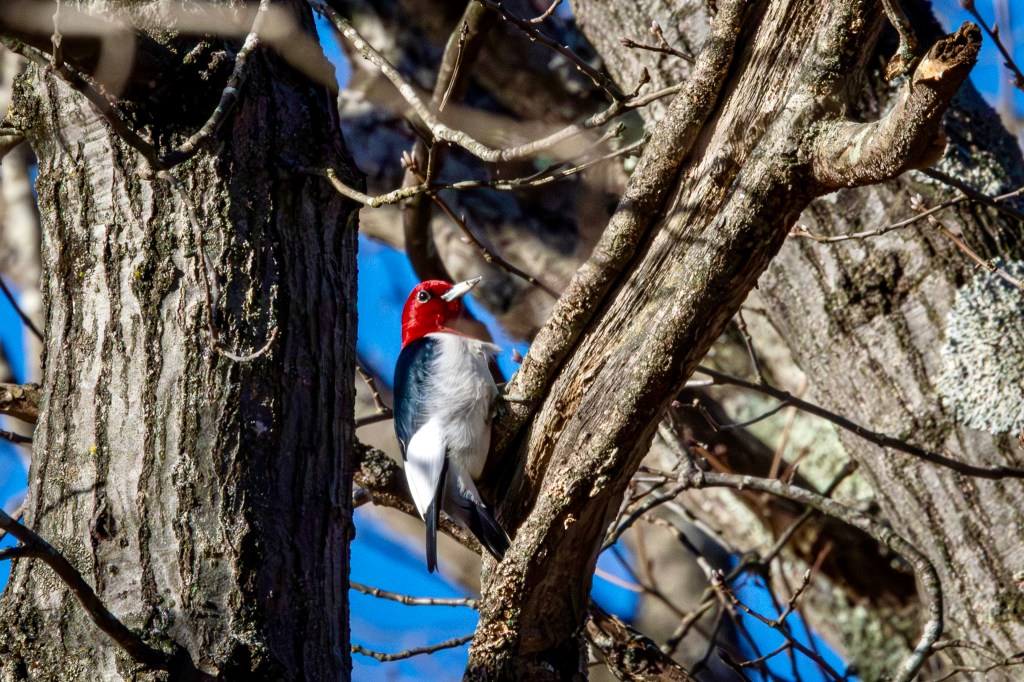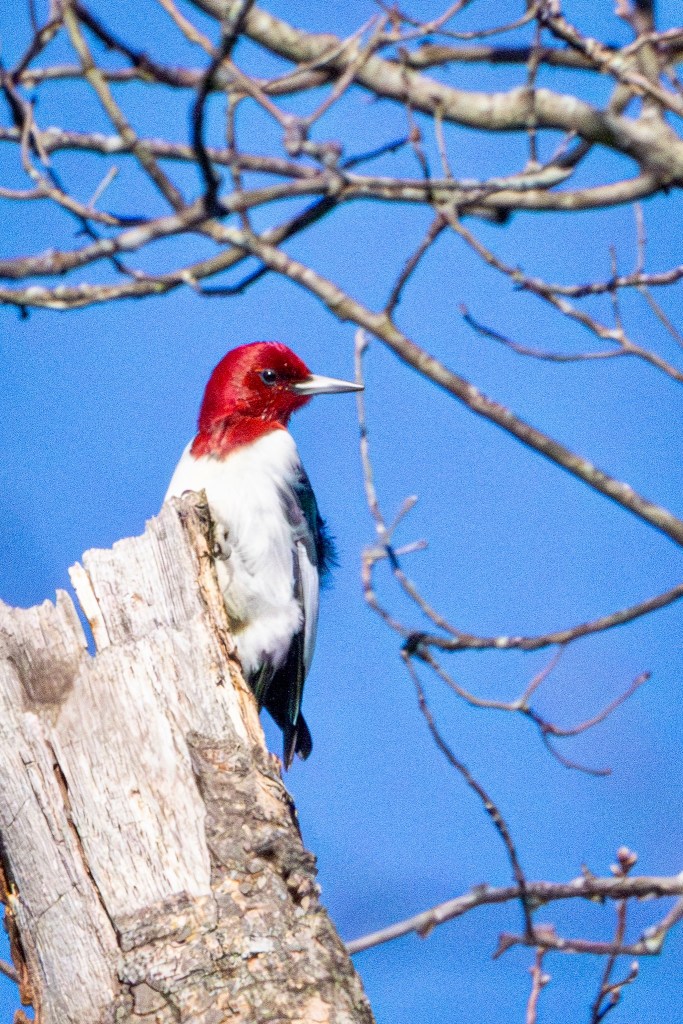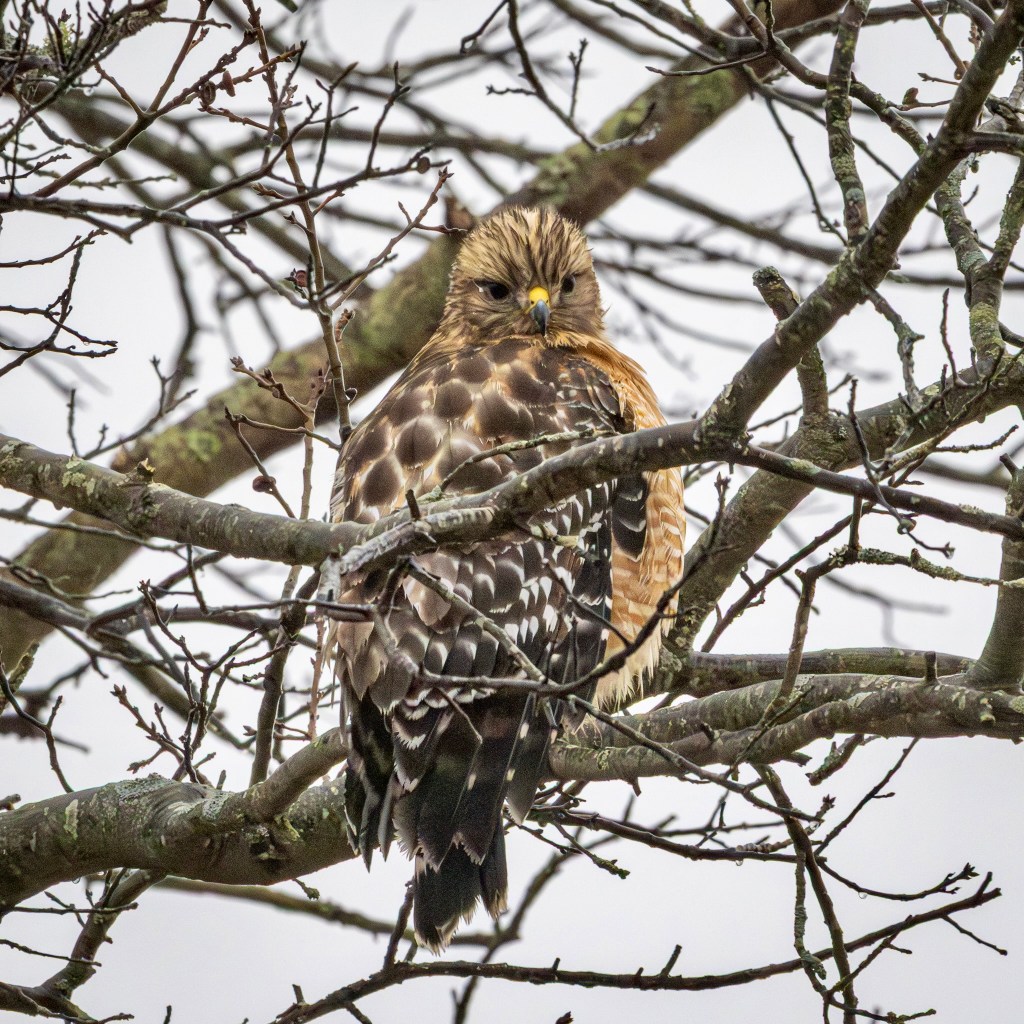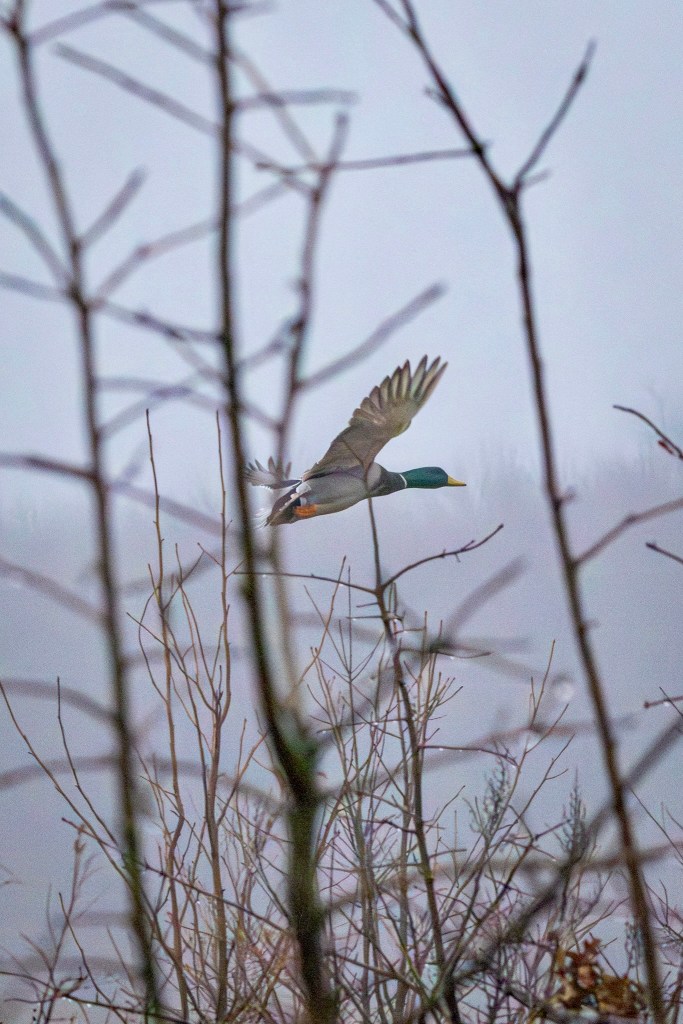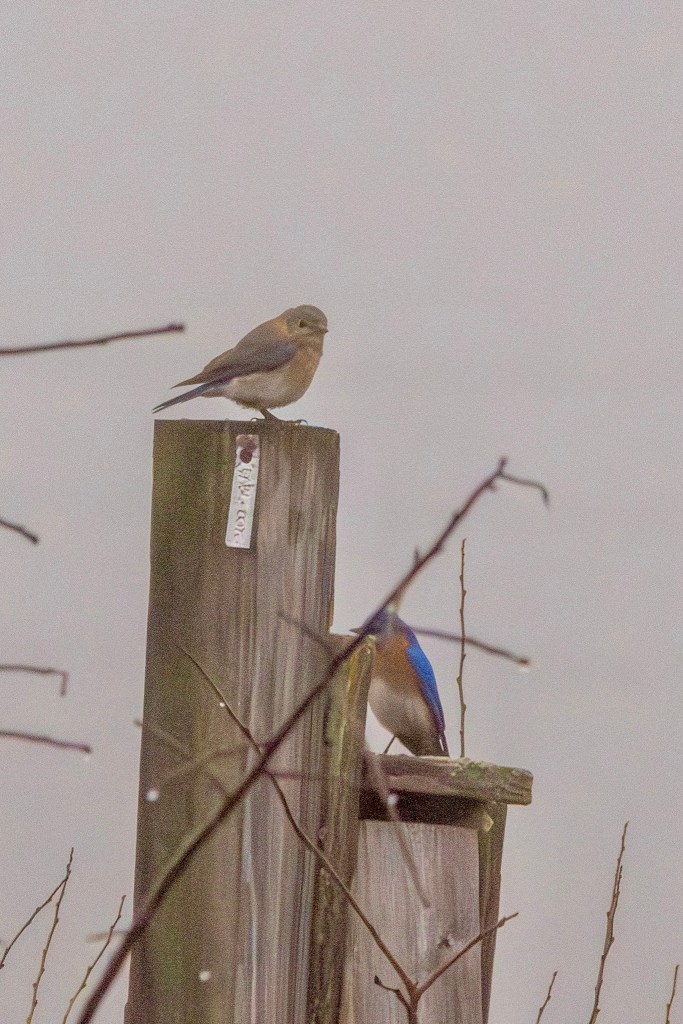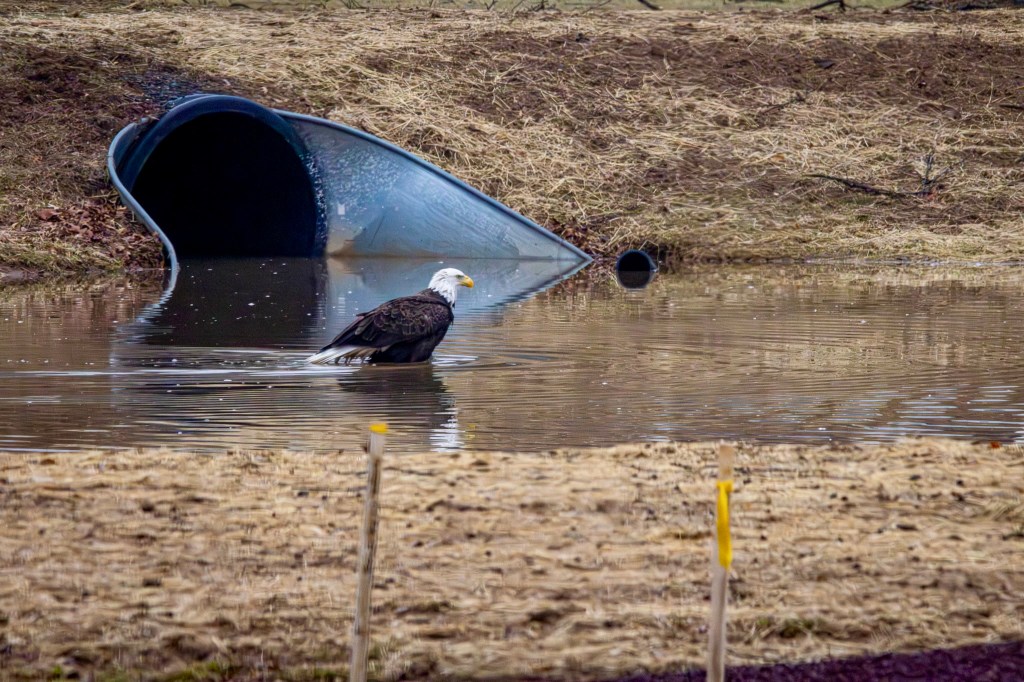
A rare Pole Farm visitor from the west: a Townsend’s warbler

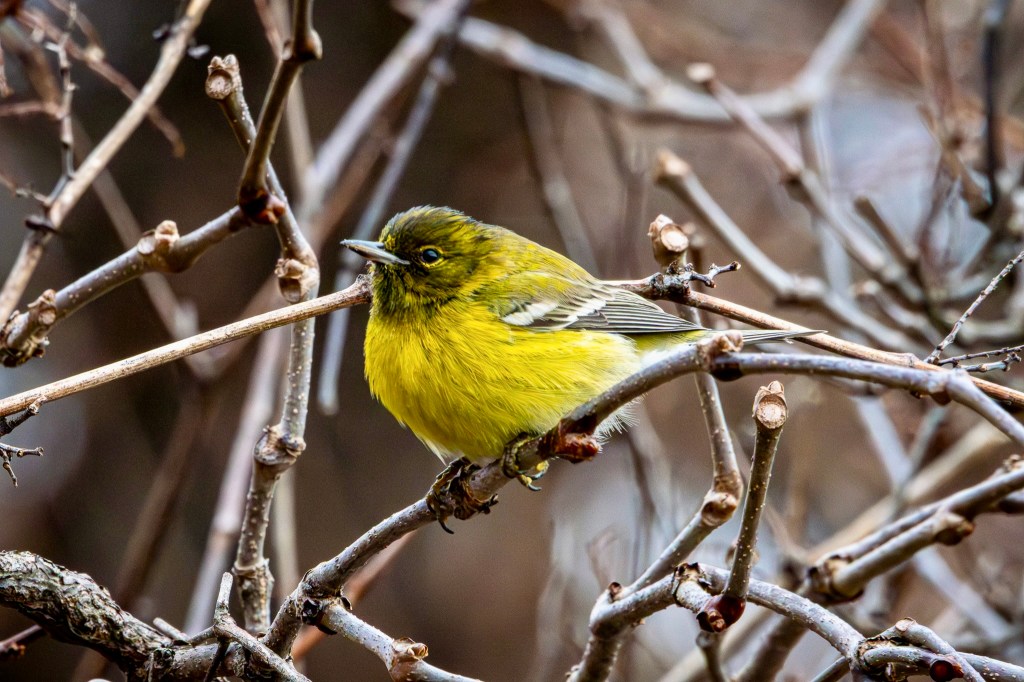
We had a bit of birding excitement this week when a Townsend’s warbler was spotted at the Mercer Meadows Pole Farm. Word got out Wednesday afternoon, and I hoped when I’d be able go to the park on Thursday that the bird would still be around.

I got to the park around 9 a.m. and, judging by the unusually high number of vehicles in the parking lot, guessed that the warbler was the reason.

With my new knee still settling in, I picked my way carefully up the snow-covered central path and soon spotted a few birders near the entrance to the woods. They reported that the Townsend’s warbler was indeed still in residence and that they were waiting for it to reappear in the nearby cedars.

I chatted with a few other birders a bit farther up the path, then came back to the group at the edge of the woods. After a bit, I decided it would be best to head back to the car. As I left, I told the group that my departure would increase the odds of the bird coming back.

I had gone maybe 50 yards down the path when I heard a commotion: the bird was back! Some newly arriving birders and I quick-stepped up the trail and spotted the bird flitting about the cedars.

I saw it pop up several times, but I wasn’t able to a photo. I took the unusual step of asking Google Gemini to create a banner image for this post.

I knew the Townsend’s warbler was rare for the Pole Farm, but until reading up on it on the All About Birds website, I didn’t realize how far from home it was. This is a West Coast bird in North America, so I can only imagine the journey it took to get here and how confused it likely is on its surroundings.

I don’t know if the bird stuck around today but I wish it safe passage home whenever conditions are favorable. 🦅

A rare chance to see birds in snow

With the snow falling this morning, I headed to the Mercer Meadows Pole Farm hoping to get some good shots. These years, we typically get only a few snowfalls, so when the white stuff comes down, I’m extra eager to get out with my camera.

The gate to the Cold Soil Road parking lot was locked when I arrived, so I drove over to the lot along Keefe Road and was welcomed by several dark-eyed juncos as I started my walk. A photo of one of them tops this post.

I enter the park from the Keefe lot only occasionally, and I had to trudge through about four inches of snow. Another inch or so would fall before the storm moved off.

I didn’t see any birds as I passed through a short stretch of woods. Tree branches were bending under the weight of the snow, a pleasing sight.

The path ahead of me, with a meadow to the left and woods on the right.

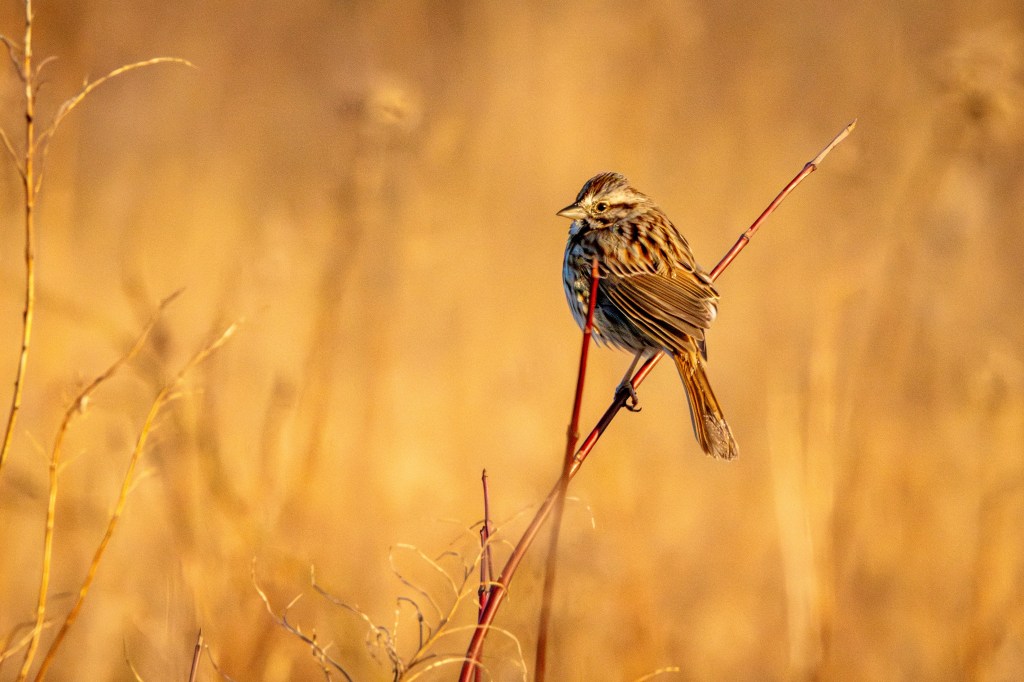
As I continued, I spotted a song sparrow perched atop some grasses near one of the wooden bridges along the trail. The bird posed for a good minute or so, giving me the clearest shots I’d get. With a heavy overcast sky, it was difficult to see through the viewfinder, and I felt as if I were shooting blind for a good part of my visit.

The song sparrow posing for me, with a couple of snowflakes shown falling between us.

Farther up the trail, I entered another clearing and watched three female Northern harriers fly overhead. The third came relatively close to the path, and I tried my best to track it and keep it in focus.

The third harrier, with snowflakes partially obscuring parts of its body and wings.

I was grateful to get a few fair shots of that last harrier, and it took me a bit to understand that I also managed to capture some of the snowflakes through which it was flying. My first thought was that it was digital noise, as I was shooting at ISO 3200.

From there, I walked back to the car, snapping photos of a few more juncos congregating near the parking lot. Although I saw relatively few species, I considered the trip a success. I hope to get back tomorrow, when the sun is expected to shine. 🦅

Nothing beats a bald eagle

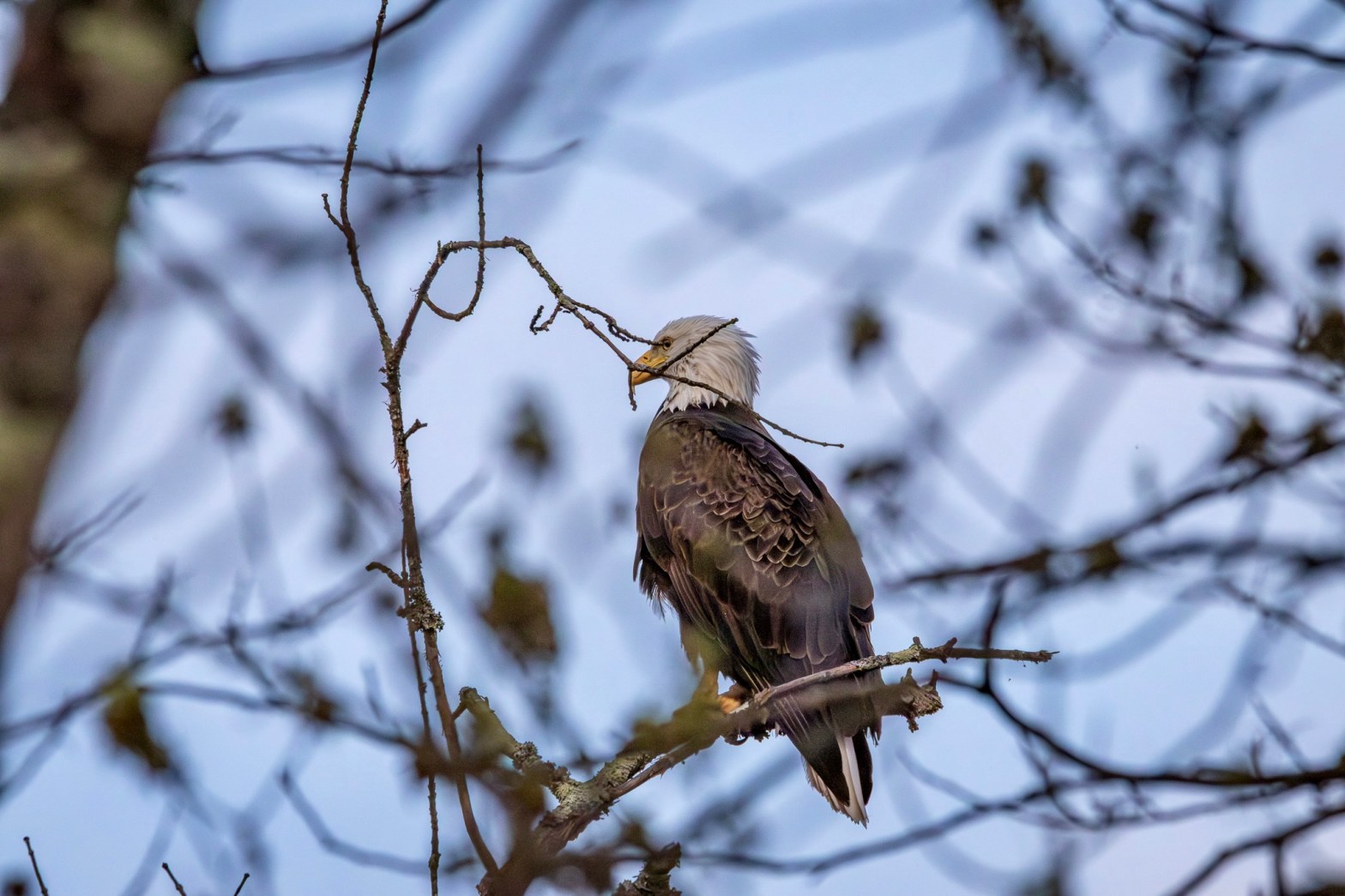
Symbol of America, the bald eagle is a magnificent bird. I had the privilege of seeing two of them this morning. I got one of them on camera in Princeton as I was driving away from the Millstone River Impoundment.

I was heading to U.S. 1 when I looked to my right and saw the eagle fly to the top of a tree just off the road. Surprised at my good fortune, I pulled off the road, put my flashers on and walked across the street to get a view unobstructed by telephone wires.

The eagle turned its head a couple of times and stayed long enough to give me time to frame my shots. I estimate the bird was about 25 feet above the ground, a rare opportunity to zoom in on the upper half of its body.

The headshot topping this post was cropped from one of the frames. I also got a couple of full-body shots, as below.

A bald eagle looks down from its perch atop a bare tree.
Bald eagle in the tree top.

After the bird flew away, I got back in the car and drove a few miles to the Dyson Tract along the Delaware and Raritan Canal. As I got out of my car, I spotted another eagle flying off, out of camera range but firm evidence of how fortunate we are that the eagles are still here to inspire us and for us to admire. 🦅

Close encounters of the bird kind

With birding as in life, you never know what lies around the corner. I had two great blue heron sightings today. This morning, from the main observation platform at the Charles Rogers Preserve in Princeton, I spotted a heron at the edge of the reeds on the back side of the pond in the center of the park.

I extended my zoom lens to 600 mm and took a few shots, which turned out better than my low expectations. It was the only bird I managed to get a clear shot of. There were plenty of white-throated sparrows and one or two hermit trushes singing, but they stayed in the shadows.

Great blue heron across the pond at the Rogers preserve.

The sun was still shining brightly this afternoon, and the temperature rose a few degrees above freezing. I decided to see what I could find at John A. Roebling Park, a.k.a. Trenton marsh.

The visit started well. Getting out of my car, I could see several mallards in the marsh. On closer inspection, I discovered that several Northern shovelers were swimming with the mallards. Even a green-winged teal was among them.

I wandered up the trail that skirts the marsh, heading toward the bridge that connects to the back island. When I came out of the trees, I was startled to see a great blue heron standing just to the left of the bridge, roughly a mere 25 feet ahead of me.

The big bird’s back was to me, but it turned its head a couple of times, offering profile shots. The one topping this post was my pick for best of the lot, and I also like this next one. It’s a bit moodier than the other portrait.

A great blue heron, seen from behind, looks to its right onto an inlet at Trenton marsh.
One of the first shots I got of the heron as it looked out onto the water.

I assume the bird heard my camera shutter, as it flew off after I squeezed off roughly a dozen frames. I’m glad it stuck around for those few seconds and gave me such a nice opportunity. 🦅

Cold-weather birding is back

It was a chilly 13 degrees Fahrenheit when I reached the Mercer Meadows Pole Farm yesterday morning. Even without a breeze, few birds were out half an hour after sunrise. But avian activity picked up as I reached the woods up the central trail.

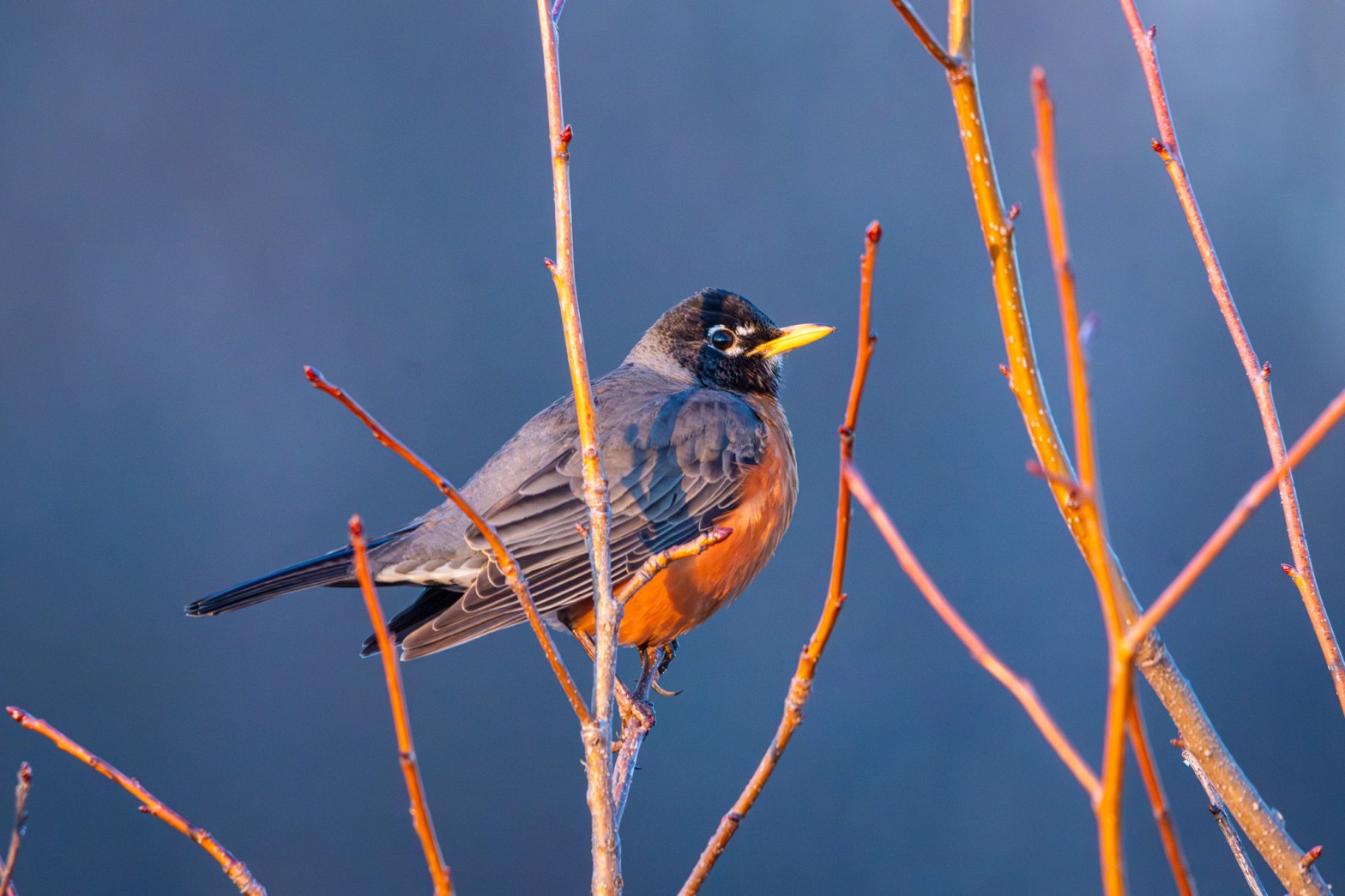
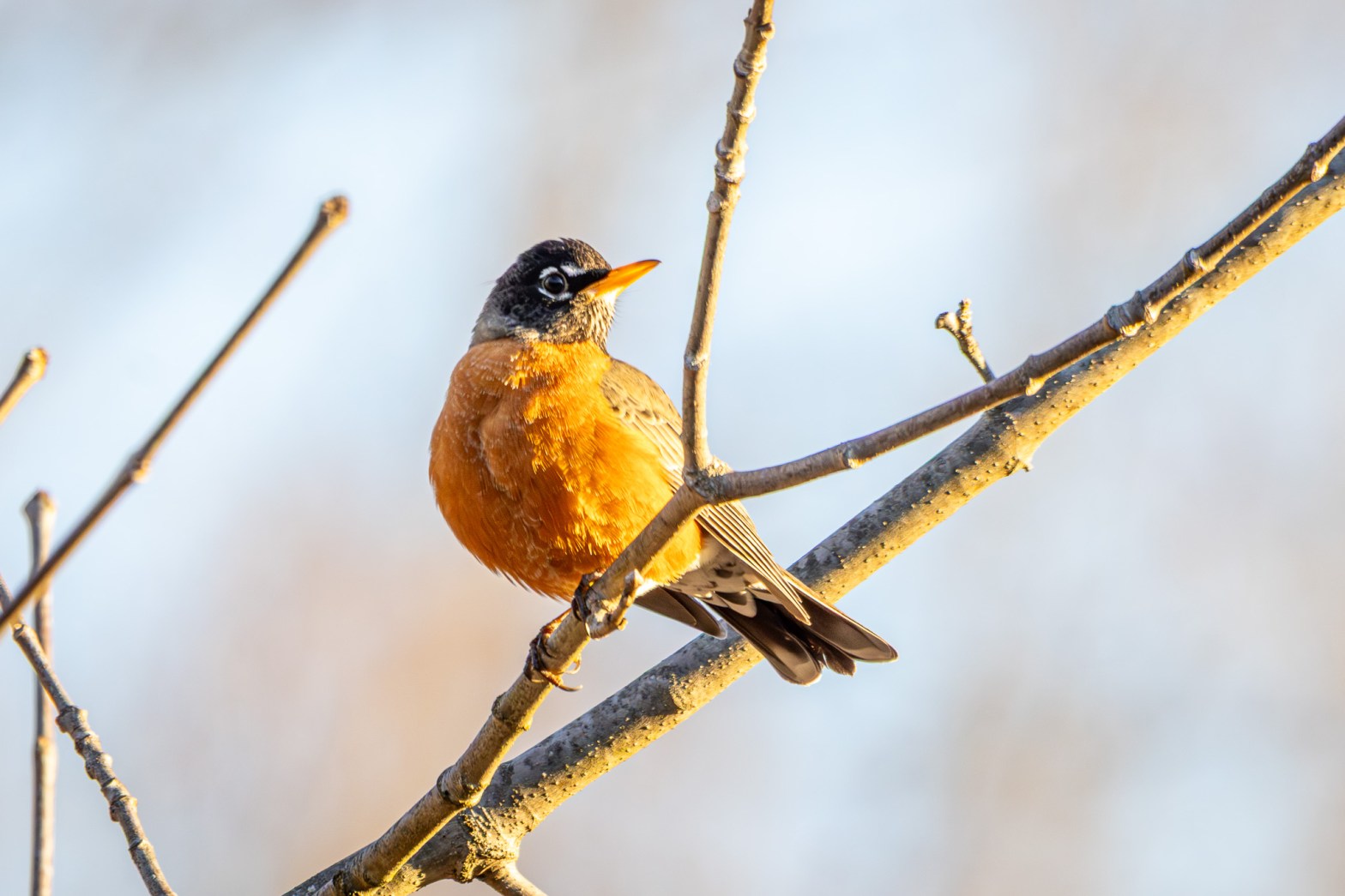
First to appear were several robins flitting about the trees.

American robin in profile, sitting in a tree, with its beak slightly raised.
American robin perching in a tree.

I went a few steps farther and heard furious pecking somewhere above. Initially, I could only see the bird’s back. The pecking was so aggressive and loud that I guessed it was a hairy woodpecker. But I finally maneuvered into a spot where I got a few shots including its head and beak, which settled the ID: downy woodpecker.

Beak open, a downy woodpecker clings to a tree branch, poised to strike the bark.
Downy woodpecker, caught for a moment during a vigorous pecking stretch.

Stepping ahead a few yards, I spotted another woodpecker, this one a female red-bellied (shown in photo topping this post). She was lit up nicely in the sun.

That sun not only made her look good, but it made a big difference to me. The cold air was bracing, and the bright sun plus the lack of wind made my mile-and-a-quarter stroll pleasant, with one exception.

Well, two exceptions: my hands. Even with good gloves, my fingers were cold, in part because I was taking them off to log my sightings in e-Bird and to adjust my binoculars and camera.

I had brought along some “Little Hotties” hand warmers. But they were duds, probably because I bought them a couple of winters back. I learned the (cold) hard way that they expire.

I have a rechargeable Zippo warmer, which I used exclusively last winter. I’ll be relying on it from here on out to keep my hands comfortable.

One of these days I’ll invest in a pair of gloves designed for outdoor photographers. If anyone has a recommendations, I’d be delighted to hear it. 🦅

Surprise! It’s a yellow-bellied sapsucker

Few birds were about this morning as I walked the trails at the Mercer Meadows Pole Farm, which made a surprise discovery all the more enjoyable. I’d seen a couple of wedges of Canada geese but little else as I reached the woods half a mile up the trail from the parking lot.

I had a flicker of hope that I might spot an owl tucked into the cedars at the old AT&T Building One site. Park rangers have cordoned that area off with metal barriers, a good sign that either long-eared owls have returned or will do so soon.

I walked around the fenced area and saw nary a bird, let alone an owl. I had not even raised my camera to take a photo, and I turned back toward my car. Just before I reached the edge of the woods, I spotted a bird fly into a tree to my left.

Downy woodpecker was my guess, but then I saw the bird’s long, pointy beak and exultantly decided, hairy woodpecker. The bird was working its way around the tree trunk, affording me fleeting looks at its backside. I moved back and forth to try to get a better look as the bird pecked away. It recoiled just enough for me to get a couple of shots of its head.

A cedar wawwing shown in profile, sitting on a tree branch.
One of the cedar wawwings, basking in the sun.

As I walked into the clear, I spotted two birds perched high up in a tree.. They were cedar waxwings, and I took a few shots through the branches, not expecting much.

But the sun was shining and lit the bird nicely, as I discovered when I got the frames on screen at home. I uploaded photos of one of the waxwings and the putative hairy woodpecker to e-Bird, and that’s when I got my surprise.

Merlin flagged the “woodpecker” images as wrongly placed — they showed a yellow-bellied sapsucker. Only twice before had I recorded a sapsucker at the Pole Farm.

E-bird’s photo recognition capabilities are new, at least in my experience. I’ve been corrected a couple of times in the last several weeks and delighted with that. I want to get my IDs right. It’s even better when the bird is one I don’t often see. 🦅

Yellow-bellied sapsucker clinging to the trunk of a tree, its beak poised to peck at the bark.
Another shot of the sapsucker. Note how closely its breast feathers resemble the tree bark.

What do I need to start birding?

If you’re interested in becoming a birder, you’re probably wondering what gear you might need. In this post, I’ll offer some advice based on my experience. I aim to keep expenses reasonable and minimal.

For starters, all you need to do is look out the window of your home to see what birds show up. Or take a walk in a neighborhood park and make a note — mental, on paper or on a cell phone — of what you see.

It helps to have a guide book to consult when you spot an unfamiliar bird. I rely on two of the most popular, the Sibley and Peterson field guides, as well as a few other specialty books I’ve accumulated. You can also describe the bird in a search engine or AI query, and chances are good you’ll get a an answer with photos.

Looking about and consulting a guide book is what I’d call Stage One birding. To advance to the next step, I recommend two items. First is the Merlin birding app from the Cornell ornithology lab. It’s free and amazing. You turn it on to listen for birds and are alerted with IDs on whatever it hears. You can also answer a few prompts for characteristics of a bird you see, and the app will suggest what it might be.

Note that the app’s sound recognition ability is not perfect. Using it over time, you’ll know when to be skeptical and when to accept its reports, which is most of the time.

Essential tool: Binoculars

Second is a pair of binoculars, and here’s where budget considerations start coming in to play. My best advice is to buy what you can afford but don’t go super cheap. Many websites offer advice on the best bins for birding, and the most helpful sites and blogs are those that present choices in tiers of prices and capabilities.

My Nikon Monarch bins. 8 x 42 field of view is the most common among birders.

I spent around $300 on Nikon Monarch M5 8 x 42 binoculars, a solid all-around choice. They offer excellent range and color definition, and they do well in a wide range of lighting conditions. There are more pricey models from Zeiss, Swarovski and other manufacturers, and there are lower-priced brands that give good value. You might even be able to pick up a used pair.

Birding organizations often have promotional days when you can examine and buy binoculars from multiple makers, often with a discount. That’s a great way to not only see the products but also to get guidance from experts on site.

Logging your sightings

Once you get the hang of identifying the birds you observe, you likely will want to start keeping a list. I started by using the Notes app on my iPhone to keep a list of the species I spotted around our home.

When I began heading out to the fields and woods, I started using the e-Bird app to track the birds I’d see. I’m an inveterate list maker, recording every car I’ve owned and every flight leg I’ve flown. The e-Bird app tracks how far you’ve traveled and even makes a map of your route. I’m also a map lover, and the web version of e-Bird displays your birding adventures on several levels, from a county to the world.

Map of the United States, with states shaded where I've recorded bird sightings.
Here’s my e-Bird map of my birding in the United States, as of early December 2025.

Need a scope?

Spotting scopes are a useful tool for catching birds at a distance, such as gulls floating offshore at a lake or waterbirds on a spit or island far off from where you’re standing on the beach. As with binoculars, scopes range in capabilities and price, and they need tripods.

I haven’t plunked down money for a scope (yet), in part because a birding friend has one that we use if we head to the New Jersey shore. Besides, many birders with scopes that you’ll encounter will happily invite you to take a look at whatever they’ve spotted. A friendly “hello, what are you seeing?” approach usually does the trick.

Overall, binoculars are much more useful in most birding situations than spotting scopes. For most people, binoculars should be the first purchase. With experience, you may reach a point where a spotting scope becomes a compelling need.

What about a camera?

I was an enthusiastic amateur photographer long before I became a birder. When I started birding, I bought binoculars right away and almost immediately began slinging my camera over my shoulder on my outings.

At the time, I had a Canon Rebel XTi, a fairly low-end DSLR onto which I mounted a Canon 75-300 mm zoom lens that I’d bought second hand. I got many nice shots of birds, a few of them up close and a lot of wider “birds in their surroundings” images.

Seeing other photographers with long lenses, I developed lens envy and started plotting how to get one with longer reach. A colleague at work bought a Sigma 150-600 mm Contemporary zoom lens and showed me some of his bird photos, and that became the object of my desire.

A year or so later, I was out at the Mercer Meadows Pole Farm with a few other birders pointing their long lenses at a raptor up in a tree. They were getting close-in photos while I snapped a few landscape-like shots with my smaller lens. That afternoon, I went to the camera store, plunked down my credit card and bought the Sigma. I’ve not looked back.

Many birders I know have the same lens, some with Nikons and others with Canons like mine. If I were a rich man, I’d likely buy a 500 mm Canon prime lens, but I’m happy to shoot with my Sigma. It gives me excellent images. It can’t compete with a prime lens in low light, but I’m not often birding in such conditions.

A zoom lens like my Sigma affords a good range of composition options. Sometimes you want to narrow in on the bird and other times you want to pull back to get more of the bird’s surroundings.

As with binoculars, my lens choice was at the sweet spot between capability and affordability.

I’ve upgraded my camera body twice in recent years. I ordered a Canon SL2 to succeed the XTi. When the SL2 conked out, I ordered a mirrorless Canon R7, with which I am very happy. It has excellent video capabilities, but I rarely give that a try. With the long Sigma zoom attached, I need a tripod — which I don’t have — to keep the camera steady.

One of my birding buddies who’s an excellent photographer uses not a DSLR but a Nikon super-zoom camera for both still photos and video. He gets good results in both formats and doesn’t use a tripod. That type of camera is an excellent option and a good value.

If you don’t have the money or interest in getting a high-end camera, you can still take good photos and video with a cell phone. Zoom capabilities are limited, but you can get scenic shots of birds at a nearby feeder, in bushes or in trees. That may satisfy you. If you get hooked on birding, you may get bitten by the camera-and-lens bug.

Jpeg or RAW?

For the first couple of years of serious birding, I shot jpeg photos, not wanting to fuss with the more elaborate controls of advanced photo editing software.

About the time I upgraded to the Canon SL2, I tried shooting in RAW mode and editing the images in Adobe Lightroom. Just by using Lightroom’s auto edit function alone, I immediately saw the advantages of shooting RAW. Lightroom allowed me to lighten shadows and otherwise salvage images that were blown out or dark and muddy.

I’m still learning Lightroom, which now offers AI tools to improve photos at the click of a box. I have a light touch with the editing functions, striving to get a realistic representation of what I saw in the field.

As noted at the top of this post, you can enjoy birding with or without gear. For some, exercise is the main motivator for getting outdoors, and spotting birds and other wildlife is a bonus, no photos required or desired.

For me, photography is essential to my enjoyment. It’s a creative outlet and a critical contributor in my ability to identify birds. Often in the field, I’ll encounter a bird I don’t recognize. Back home, I’ll usually be able to make the ID by looking at the photo.

All the above is my basic advice on getting started and advancing in birding. I’ve been fortunate to get many tips from fellow birders, most of whom are more than happy to share what they know. This post is my way of paying that back. 🦅

Thank goodness for backyard birds

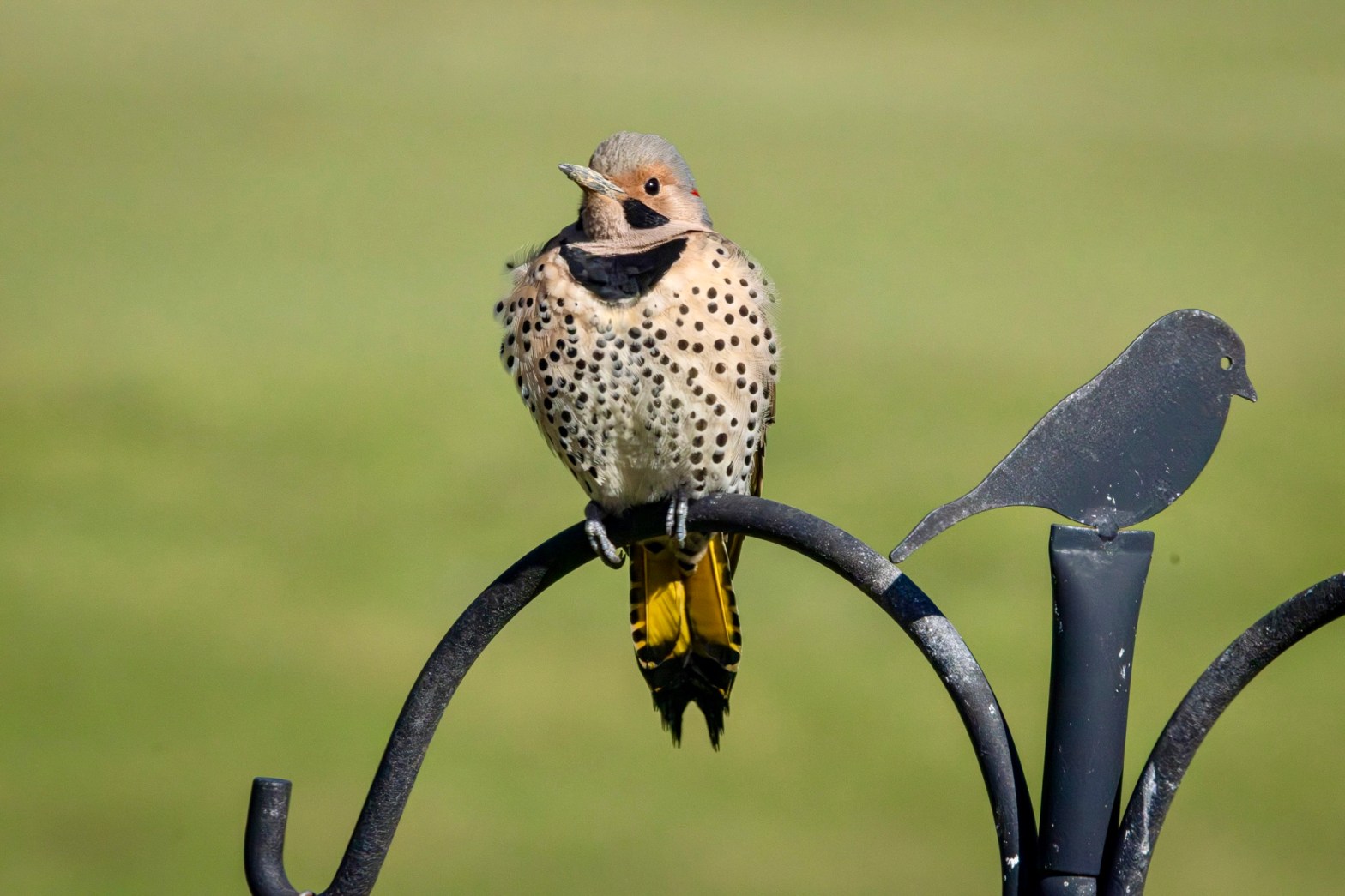
Cooped up at home for a couple of weeks after knee surgery, I’ve managed birding only by looking out the windows at home. I got a surprise yesterday when a Northern flicker parked on the suet feeder long enough for me to get my camera and take a few photos.

Flickers visit our yard with fair frequency, usually plucking in the grass or pecking the bark at the base of trees. What was surprising about this visit was that the bird clung to the feeder, something I can’t recall seeing previously.

As on most days, a host of house sparrows were pigging out at the suet feeder and the tube feeder. Through a window, I looked on the ground below the tube feeder and was pleased to see a white-throated sparrow grazing on the seeds that the house sparrows had slopped into the grass.

White-throated sparrow standing on the ground atop brown larch needles and green brown and green leaves.
The white-throated sparrow foraging for feed.

Blue jays, Carolina wrens, American crows, mourning doves and common grackles have stopped by the last few weeks. I’ve even spotted a couple of red-winged blackbirds and a single Eastern bluebird, both species of which come by only occasionally.

Thanks to thrice-a-week physical therapy sessions, I’m recovering quickly from the surgery and expect to get out into the fields again within the next week or two. Meantime, I’m grateful for the birds that come calling at home. It’s also great therapy. 🦅

Dee-dee-dee: How I love thee, chickadee

My heart belongs to the chickadee. Black-capped or Carolina, I have no preference. Whichever of those perky, petite birds comes into range, I am in thrall and in love.

[Note: This is a repost of the original post from Nov. 8, which I accidentally deleted.]

This morning at the Mercer Meadows Pole Farm, I took an uncharacteristically slow and short walk, needing to get back home in time to consult with our tree guy. The highlight of the morning, up and down the trail, was an abundance of chickadees zipping about the tree branches at the entrance to the Mercer Meadows Pole Farm woods.

On my way up the trail toward the old AT&T Building One site, I spotted several chickadees frolicking in the trees. Try as I might, I could not lock my camera on to one of the Carolinas zipping from branch to branch overhead.

The Building One oval had little activity, so I turned back to head to my car and home. But I had to stop again near the edge of the woods, as the chickadees were again out in force.

I managed to get just two in-focus frames of one of the birds, a black-capped as it turned out by virtue of its buffy sides, in a color scheme similar to what the Jersey Blues troops wore in the American Revolutionary War against Great Britain.

I make no apologies for my admiration of chickadees, who pack more personality into a small frame than just about any bird I know. In my part of New Jersey, we’re in a crossover zone where the black-cappeds and Carolinas share the same air and tree space.

At home, we had to take down a pair of dying maples and a black cherry tree a few years back. Our tree service contractor is going to replace them with an “Autumn blaze” maple and a redbud variety, which I hope will provide habitat for birds. If chickadees happen to be the species that settles in them, no one will be happier than I. 🦅

An annoyance of grackles descends

‘Tis the season for huge flocks of common grackles to fill the sky and, in recent days, descend into the front and back yards of our home. A quick Google search revealed that groups of the stolid black birds with iridescent purple heads can be called a flock or, more pointedly, a plague or an annoyance.

On a recent morning at the Mercer Meadows Pole Farm, I watched in awe as at least 200 grackles flew overhead in a long, sinuous column. I figured it wouldn’t be long before a swarm would find our property.

Twice in the last three days, I’ve looked out our back windows to find grackles covering our yard and attacking the suet feeder. Often, five or six of them will slam into one another as they fight for morsels from the cage.

Three grackles set upon a cage feeder containing suet cakes.
Three grackles set upon our suet feeder in 2024.

The birds will stay for a few minutes and then, spooked by who knows what, take off en masse and land in a neighbor’s yard or on the adjoining golf course.

The flocks are impressive, if a bit intimidating, like a black-jacketed motorcyle gang showing up at a block party.

The grackles chow down heartily on our suet, but I don’t begrudge them the treat. In our yard, whatever food I set out for our feathered friends is available to all as their diets demand, table manners not required. 🦅