Published in May 2021. Latest update: February 2024.
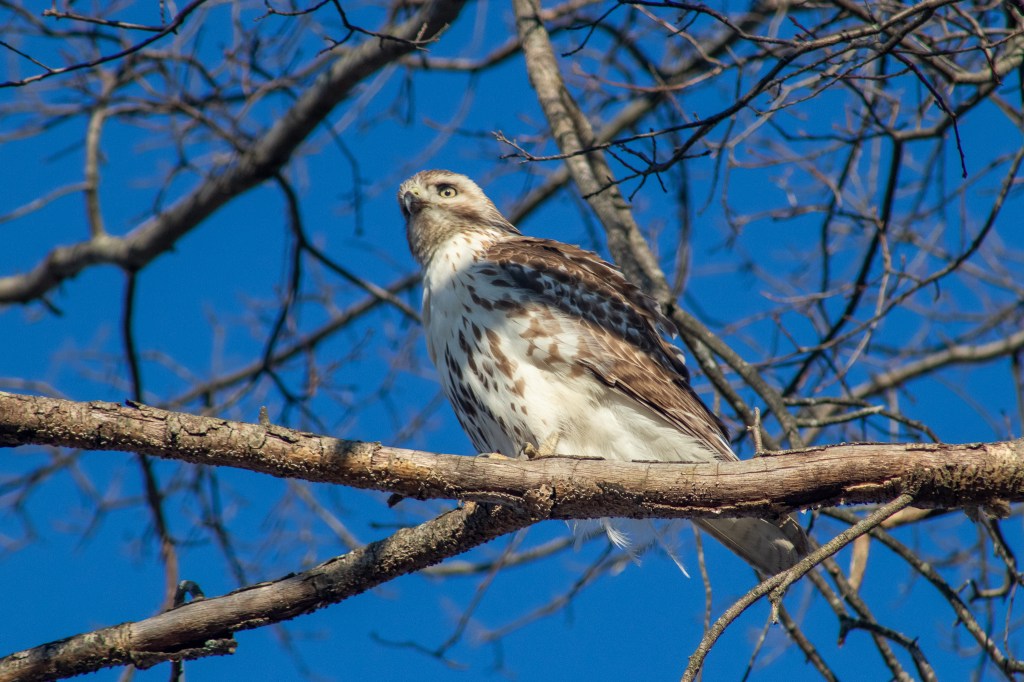
The “Pole Farm,” where for a good chunk of the 20th century AT&T maintained a network of radio antennas for international telephone calls, is a true birding hot spot.
Built around remnants of what at one time was a coordinated tangle of poles and wires that connected the world, today’s Pole Farm in Lawrence Township, New Jersey, is a magnet for all types of birds, changing season by season as they migrate up and down the Delaware River valley and the Atlantic coast flyway. As I wrote this post in spring 2021, birders had recorded 218 species since 1998 through the eBird program. As of late fall 2023, the total had climbed to 221.
Want to know the latest sightings at the Pole Farm? Visit eBird.
I’ve been visiting since spring 2019. I started going a couple of times a month on weekends, but during COVID I started going nearly every day. I mainly visit on mornings before work, as time and daylight allow. During the cold months, I often go out in the mornings and, on weekends, come back an hour or so before sunset.
One of the best aspects of the Pole Farm is that it provides a mix of habitats. Broad grassland fields attract tree swallows, indigo buntings, Eastern meadowlarks and several varieties of sparrows. Wooded areas attract Eastern towhees, woodpeckers, thrushes, brown thrashers and more. Red-winged blackbirds, Northern cardinals and catbirds are ubiquitous much of the year, and always remember to look up: you might spot a pair of bald eagles passing overhead or a group of cedar waxwings congregating in the treetops.
Warblers come around in the spring and in the fall, always a delight.
Harriers and owls

If there’s a signature bird at the Pole Farm, it’s the Northern harrier. The white-rumped raptors swarm over the fields in the fall, winter and into the early spring. If you want to see one, this is the place to go. You can also see them over at the Reed Bryan Farm. The Pole Farm and Reed Bryan, both part of Mercer Meadows, are connected. Many trails enable you to visit both without having to drive to the other side.
The same goes for short-eared owls, which once December hits start appearing just ahead of sunset and for a short-while after. They fly over the main fields up from the Cold Soil Road parking lot, and the best way to spot them is to look for groups of birders, most with long lenses and many with tripods, staking out a few positions.
N.B.: If you are searching for owls (or any other bird, really) please, please, please stay on the trails. Do not go bushwhacking to get close to the owls — it stresses them and drives them deeper into cover or away altogether.
Saw-whet, screech, barred and long-eared owls sometimes stop by, too, in the cold months.
My top priority is to view and photograph birds, but deer and other animals are present along with butterflies and other insects. Wildflowers bloom through much of the year. If I get skunked (and I did see a skunk once!) on photos of birds, there are nice fallback options.


Monarch butterfly
The park has a couple of observation platforms and blinds on which are posted signs showing some of the birds and other wildlife commonly found. They are good teaching tools for children, not to mention adults.
The trails, by the way, are easy to walk for kids and basically everyone except those with serious mobility issues. (I get along fairly well with a cane these days, a temporary situation.) The ground is mostly flat to gently sloping, and the trails are a good eight to 10 feet wide in most places. Sturdy boardwalks take you over Shipetaukin Creek and some marshy areas.
A wheelchair could roll along the paved Lawrence-Hopewell Trail that runs through the park. Other trails are gravel or dirt with tire-track ruts. If anyone wishes to try them in a wheelchair, I’d recommend that someone else scout the trails and make a judgment.
Be aware that bicyclists and runners use the trails regularly, and the occasional horse and rider might show up, the former leaving proof.
My only quibble about the Pole Farm is that the trails are not marked with blazes or markers beyond the crossroads signs that point you to various destinations. There are no maps at trailheads. Oh, and there’s no pond to attract ducks and other waterfowl, so you’ll typically only spot them if they’re flying overhead.
As noted above, the Pole Farm is part of the larger Mercer Meadows park, and its site offers a map of the park at large for download.
The history of the Pole Farm is a fascinating study in telecommunications technology, which was what first drew me in. But the birds and wildlife and wildflowers are what keep bringing me back.
Mercer Meadows Pole Farm is free to the public and open 365 days a year, sunrise to sunset. Dogs on leashes are welcome. The main parking lot is at the intersection of Cold Soil and Keefe Roads, and it’s crowded only when the owls are out. Roughly equidistant to Princeton and Trenton, the park is a great destination. If you’re visiting this part of New Jersey and have only one chance to go birding, do it here.
 The Jersey Birder