Lunch al fresco, with a birdsong soundtrack

With a pair of off-campus meetings bookending the lunch hour yesterday, I stopped at the Charles Rogers Nature Preserve in between appointments to have lunch with the birds.

I parked near the main observation platform overlooking a large pond that at this time of year is covered almost completely in rushes and reeds. As I stepped out of the car, I could hear a Baltimore oriole singing nearby.

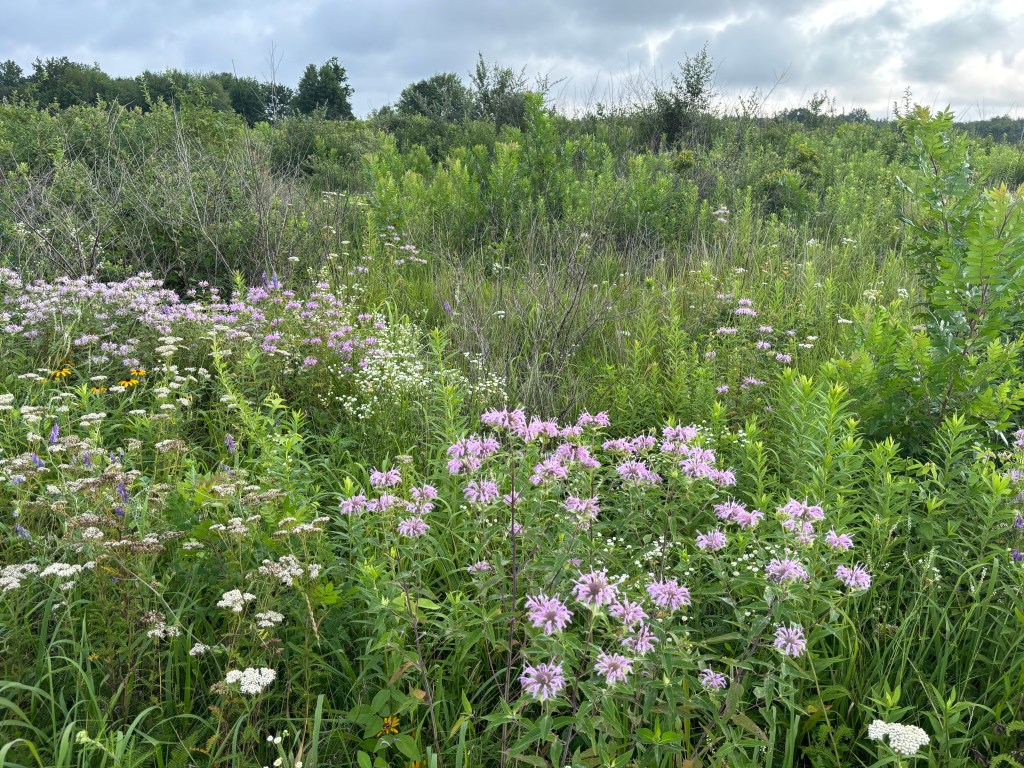
I took the steps up to the platform and sat on a small, triangular bench in one of the corners. My view tops this post, an unusual one in that I won’t include a photo of any birds or other critters.

Although I had my binoculars with me, I didn’t have my camera. I took one photo from my iPhone, the one topping this post that shows my view into the trees on the other side of the access road from the pond.

This turned out to be an almost exclusively aural outing, as I spent most of my time sitting and walked only a short distance.

What a joyful time it was. That Baltimore oriole kept singing for many minutes, after which a rose-breasted grosbeak took over on lead vocals. Both birds struck me as jazz singers, the Baltimore with its staggered whistling and the grosbeak with its near frantic, snazzy pace.

Purple martins squawked as they circled the pond, and red-winged blackbirds shouted their raucous cries. In between, song sparrows and Northern cardinals sang prettily.

Using the Merlin app on my iPhone, I recorded several stretches of birdsong. Alas, I only saved one, a jumble of noise not worth sharing here. Sorry I have nothing to share, but I do recommend doing an occasional “ears only” birding outing. It beats eating lunch at your desk. 🦅

A yellow warbler plays coy

Having missed the prothonotary warbler Sunday, I took a quick trip to the Dyson Tract this morning hoping to spot it. Again, however, a yellow warbler stole the show.

As I stood facing the swamp from the canal towpath, a yellow warbler flew down into some leaves clustered around the bottom of a telephone pole. I trained my camera there, hoping the bird would pop up.

A few moments later, the bird reappeared, poking itself up from the leaves. My favorite image, with the bird cocking its head, tops this post.

The bird then flew up into a tree on the edge of the swamp, perching in the sun and allowing me time to get a few more shots. It’s truly a beautiful specimen.

Yellow warbler perched atop a bare tree branch.
Sitting up high for me.

Eventually, the bird flew off, and I had the good fortune to catch that takeoff.

The yellow warbler heads skyward.

I looked at my watch and decided to stay a few more minutes, in hopes of catching the prothonotary warbler singing continuously from the swamp.

After a few minutes of scanning the bare trees studding the swamp, I spotted a blob of bright yellow near the top of one of the trees in the distance. A quick look through my binoculars confirmed I was seeing the prothonotary, although it was partially obscured. I pointed my camera and hoped for the best.

Although not a clear shot, I was happy to get this, the best of the images I was able to take. It doesn’t do the bird full justice. I might go back tomorrow and aim for something better. 🦅

Prothonotary warbler perched on a tree branch, partially obscured by between bird and photographer's line of vision.
Prothonotary warbler in profile.

In search of yellow birds, with bald eagles as a bonus

For weeks, I’ve been hearing yellow warblers on my birding jaunts but until this morning I hadn’t seen one. For days, I’ve been seeing reports of a prothonotary warbler nearby, and I hoped I might spot it today on my first attempt.

I went to the Dyson Tract along the Delaware and Raritan Canal with the prothonotary as my target. As soon as I stepped out of my car, Merlin picked up the bird’s wispy song. Gazing out into the swamp, I checked every tree within sight. But the warbler, which I kept hearing as I walked the permiter of the swamp, eluded me.

Birds abounded on my walk, and I logged 29 species on e-Bird. I headed south along the canal towpath, farther than I usually go, and was rewarded with the site of two mature bald eagles in a tree. One flew off after I’d taken a few photos, and the second stuck around for a good while.

Mature bald eagle perched on a tree branch, leaning forward slightly as it looks down.
Bald eagle No. 1, a minute or so before it flew off.
A bald eagle looks to its right from its perch on a tree branch.
Bald eagle No. 2, who gave me more time to shoot.

After taking several shots of the remaining eagle, I headed back toward my car, hoping my second pass by the swamp would turn up the prothonotary warbler.

It never did show, although a yellow warbler came by and landed on a tree just off the towpath. I was glad finally to get a clear shot at one, who tops this post.

I also got some nice looks at a Northern house wren that perched high up on a barren tree. Although I see house wrens routinely in my yard, it was fun to see this one in the swamp, warmed and well lit by the sun. 🦅

House wren singing from the top of a bare tree.
Northern house wren singing.

It pays to shoot, even when in doubt

Morning broke foggy in my part of the world. A couple of days of heavy rain left us soggy and humid conditions. I dodged puddles as I headed up the central trail at the Mercer Meadows Pole Farm this morning and spotted an American goldfinch ahead of me.

It was poking in the wet dirt for I’m not sure what. Having photographed many a goldfinch, for a moment I thought, why bother? But then I raised my camera and trained it on the bird. As I pressed the shutter, it flew off to my right.

I didn’t bother to check the image until I got home, and I was surprised to find I caught the bird with wings outstretched. I’m glad I decided to shoot, and I was surprised with an unusual perspective on a familiar bird that I see almost daily in my yard. 🦅

The glorious sights and sounds of Spring migration

It’s the most wonderful time of the year. So goes a well-known Christmas carol, but the tune plays in my head during Spring bird migration. It plays, that is, when it’s not drowned out by the abundant birdsong that fills the woods and fields on my birding outings.

This morning, I went to the Reed-Bryan side of the Mercer Meadows Pole Farm, a strategic decision less for the birds and more for my wife’s Mother’s Day request for bagels from the shop near the park.

I had a delightful morning outing. One of the highlights was watching the Baltimore oriole atop this post land high up in a tree, chasing off an indigo bunting that had already staked the spot out.

Inidgo bunting perched on a tree branch.
The indigo bunting, not aware that the oriole was about to jump its claim.

A short while later, I heard a rose-breasted grosbeak singing. It was high up in another tree, and I walked as quickly as I could to get into position to take its portrait. The sun was shining, and I was grateful for that. I was also grateful for the burst capacity on my Canon R-7 camera, which enabled me to catch shots of the bird with its big bill open as it sang.

Rose-breasted grosbeak singing from a tree with green leaves and buds.
The male rose-breasted grosbeak has a song that rivals its physical beauty.

Yesterday on my walk on the Pole Farm side of the park, I pulled out my iPhone and on Merlin recorded this 41-second clip of birds singing in the woods.

It’s a virtual symphony featuring (not in order of appearance) an ovenbird, red-eyed vireo, wood thrush, tufted titmouse, gray catbird and Eastern towhee. That’s what Merlin identified, although I can’t say I can pick out each of them. But it’s a wonderful (there’s that word again!) example of what Spring migration brings.

The oriole I saw today wasn’t singing, and I was so busy shooting photos that I didn’t record the grosbeak. I’ll save that for another day of good cheer. 🦅

My ‘Big Day’ gets off to a nice (red)start

I suffer from warbler deprivation syndrome. I head to the woods, hoping to find multiple migrants flitting above me or, even better, right in front of me. I was feeling particularly underserved by the warbler community as I headed to the Mercer Meadows Pole Farm early this morning.

While my Merlin app the last couple of weeks has tantilized — taunted? — me with reports of multiple warblers, I’d basically drawn a blank. No Blackburnians, no magnolias, not even a black and white. But today, when I had a limited opportunity to get out on Global Big Day, my luck turned.

An orchard oriole greeted me as I left the parking lot, although I couldn’t find the bird in the big, leafed out tree just off the trail. Same for the yellow warbler lurking just beyond.

But as I made my way down the trail and into the woods, I noticed a small bird in a tree 30 yards or so away. It had its back to me, but my pulse quickened when I saw the orange and black colors — an American redstart, by George! The bird turned about and I snapped a few frames, at least one of which I could tell was reasonably sharp. That image tops this post.

I believe I took a shot of a female redstart in a previous year, but this was, as far as I know, the first male I’d ever shot.

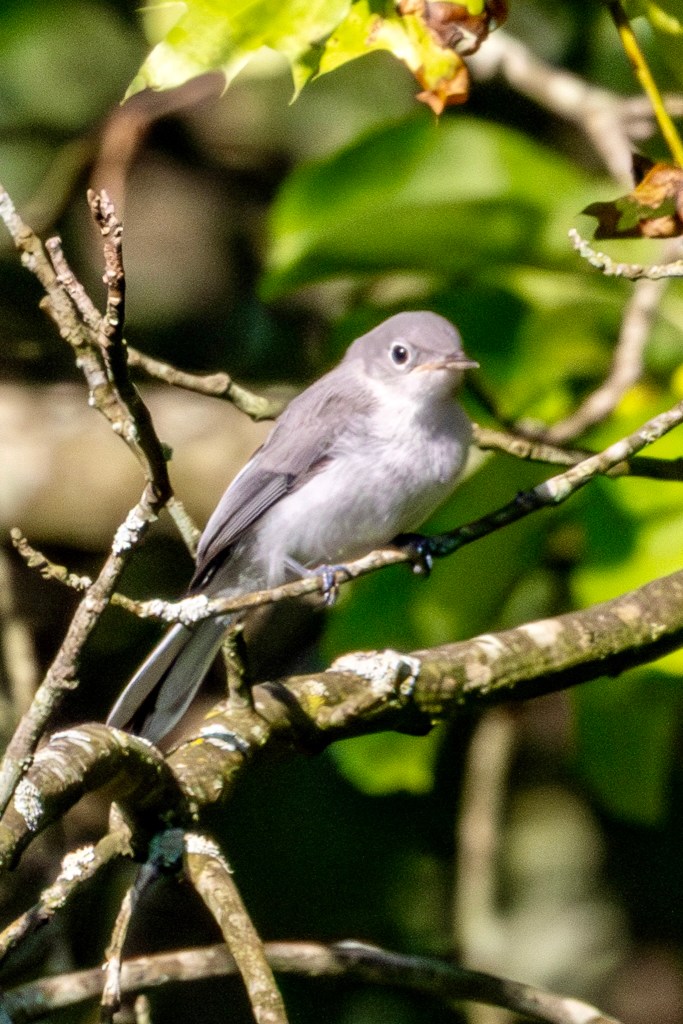
I continued on my favorite loop around the park, with Merlin again teasing me to warblers in my midst. But I wasn’t finding any until I got to the old AT&T Building One oval. I spotted a blue-gray gnatcatcher high up in the wall of trees behind the oval. He was putting on an acrobatic performance, I got several shots, including the right-side-up and upside-down poses below.

Blue-gray gnatcatcher perched on a leafy branch.
Blue-gray gnatcatcher, in a rare static position.
Blue-gray gnatcatcher reaching backward in a tree.
Same bird, different orientation.

My hour-plus ramble had me record 34 species, a nice haul for Global Big Day. They included a Northern parula that was perched only a few feet from the gnatcatcher at one of its brief stops.

I only had the one chance to get out birding, as my wife and I headed into New York City for a 1st birthday celebration for our youngest grandchild. The redstart was great, but the birthday party was the true highlight of the day. 🦅

Patience paid off: My first common yellowthroat photos of 2025

I’ve been hearing common yellowthroats for the past couple of weeks, and I’d managed to catch glimpses of them a couple of times. I knew that if I were patient, I’d eventually get a clear shot. That happened this morning, and in an unexpected way.

Common yellowthroats typically lurk in the grasses and often pop up to sing. I heard one as soon as I stepped out of my car this morning at the Mercer Meadows Pole Farm, but not in a typical spot. I parked in the lot on Blackwell Road that forms the northern border of the park, separating it from Rosedale Park.

I headed to the trail that parallels the road, hoping to catch sight of a yellow-breasted chat that had been recently reported and photographed there. I spent a good chunk of my 70-minute visit hearing a chat (as confirmed by my Merlin app) but never spotting it.

I wandered around the corner of the the trail, heading toward the heart of the Pole Farm. At one point, I looked up high at a bare tree and spotted a common yellowthroat at the top. I don’t know if I’ve ever seen one that far above ground before, but as the photo below shows, it was unmistakably a common yellowthroat.

Common yellowthroat perched and leaning forward atop a bare tree.
A common yellowthroat, way up high.

On my way back to my car, I heard another yellowthroat close by in the tall grasses. I spotted him and took a few shots before he flew off into the grass. I was able to track him as he eventually came closer into view, and I caught him mid-song. One of those photos tops this post.

I look forward to more close and photo-friendly encounters with common yellowthroats in the weeks ahead. Who knows — I may even get to get a shot of yellow-breasted chat! 🦅

A cuckoo surprise to start the day

Unpredictably is one of the true pleasures of birding. You simply have no clue when something unusual will appear.

So it was Saturday when I pulled into the Mercer Meadows Pole Farm parking lot around 7 o’clock in the morning. I had just put my car in park when Lee pulled in beside me.

I’d seen Lee on a couple of previous Pole Farm visits, and little did we know that we were in for a treat almost immediately on our walk. We left the lot, headed up the trail and quickly spotted a bird in the big tree to our left.

The tree is almost fully leafed out. It took us a while to get a fix on the bird, which would land for a few seconds, then pop over to another branch. The bird was long and slender with a pale belly and a vivid red eye ring, leading us to an unexpected conclusion: it was a cuckoo, a visitor that stops by briefly each spring.

But which cuckoo was it — black-billed or yellow-billed?

I had a devil of a time trying to focus on the bird, and Lee was giving it his best efforts, too. After a few minutes, the bird flew over to the alley of trees to the left of the main trail. Lee and I followed but lost sight of the bird.

I checked Merlin’s photos of cuckoos, and the red eye ring pointed us toward black-billed. Lee checked his camera, and he had a clear shot that showed a black bill. Without a doubt, we’d seen a black-billed cuckoo.

I didn’t bother to check my photos until I got home. The best of the lot tops this post, and it shows the bird’s black bill and the red rim on eye.

Lee and I came out of the tree alley and headed up the central path. There were plenty of birds, but few that popped into sight long enough for me to grab a shot. Eventually we reached the AT&T Building One oval, hoping to find a few warblers. No dice. We moved along toward the Lawrence Hopewell trail and as soon as we hit the pavement, we heard the rapid bub-bub-bub call of a cuckoo from the trees.

I whipped out my Merlin app. Within a few seconds, the screen lit up: “black-billed cuckoo.” I saved the recording but didn’t realize until I got home that I also caught a bit of Lee and me talking.

He’d been telling me about a relatively close encounter he’d had with a red-shouldered hawk, and we heard the cuckoo in about the same spot. Once we heard the cuckoo, we wanted to see it. I suggested looping around on a side trail, as you can hear on the recording.

When you hit play, you can heard the cuckoo calling faintly. You’ll hear Lee and me talking, then hear the bird again. The “good stuff” goes on for about 40 seconds, and the rest of the recording (which I didn’t have time to trim) plays itself out with the cuckoo thrumming and a mourning dove hooting in the distance.

Was it the same bird that we saw at the start of our walk? We’ll never know. The bird near the parking lot wasn’t calling, and we couldn’t see the second one (not that it would have made a difference. Birds don’t wear nametags!). I logged one cuckoo on e-Bird. Whether it was one or two, it was a treat, and it made our day. 🦅

Bird counts ramp up as the weather warms

There’s no denying that Spring brings out the birds. It was sunny and light-jacket warm this morning when I visited the Pole Farm, and I was hoping to get a few shots of the common yellowthroats that have returned to the fields.

I heard many but was only able to spot one, a male who inconveniently for me hunkered deep in the grasses. My camera couldn’t focus, yet I wasn’t concerned. I’ll have many chances to capture those black-and-gold beauties for many weeks to come.

I noticed the first catbird of the season on one of the feeders at home Tuesday evening, so I wasn’t surprised when I heard a couple of them today near the AT&T Building One oval. The first one I spotted was tucked into a newly blooming tree, singing while looking nearly straight at me.

Gray catbird, beak open to sing, while sitting on a branch surrounded by green leaves and pink blossoms.
Gray catbird, looking dead ahead while singing.

I also had some nice looks at several robins (note the top photo) and Eastern bluebirds. The first bluebird I spotted had its back turned to me, and at first glance I thought it was a blue grosbeak. But it’s too early for those, and I dutifully recorded bluebird No. 1 in my e-Bird app. I spotted a few other bluebirds later on my walk. They never cease to impress me with their stunning colors.

After so many barren months of winter, it’s a treat to see colorful birds set against the emerging leaves and blossoms of the trees on which they perch. Welcome to the wonderful world of vernal color! 🦅

Eastern bluebird perched on slender branch.
Eastern bluebird, sidelit by the morning sun.

Welcome back, lusty-voiced birds!

I love this time of year, when our seasonal visitors return. I had the pleasure of welcoming back two full-throated birds to the Mercer Meadows Pole Farm this morning.

After clearing the fields and reaching the woods, I was on alert for whatever migrants might be stopping by or arriving for a longer stay. Then I heard what at first I thought was a cardinal, but that wasn’t quite right. I had turned on Merlin, and there it was — ovenbird.

Ovenbird on tree branch, shot from below.
The ovenbird

The loud chip-chip-chip song was coming from nearby. I swiveled my head to find the bird silhouetted 20 feet or so above me on a tree branch. It took a couple of hops and finally came into a clear spot where I could focus.

Although I regularly hear ovenbirds at the Pole Farm, I don’t often spot them, let alone get to snap a photo of one. I’m grateful that I got a couple of shots so early in the season.

I continued through the woods on my two-mile loop. As I came into the clear on the central path to return to my car, I heard another familiar song — “ricky-ricky-ricky” — a common yellowthroat.

The bird was out of sight, deep in the grass, and only sang a couple of verses. Although I couldn’t get a shot, I moved on with a smile on my face. I’ll have plenty of chances to take photos of my little yellow-and-black friends as the warm weather comes on. 🦅