Birding before the heat wave rolls in

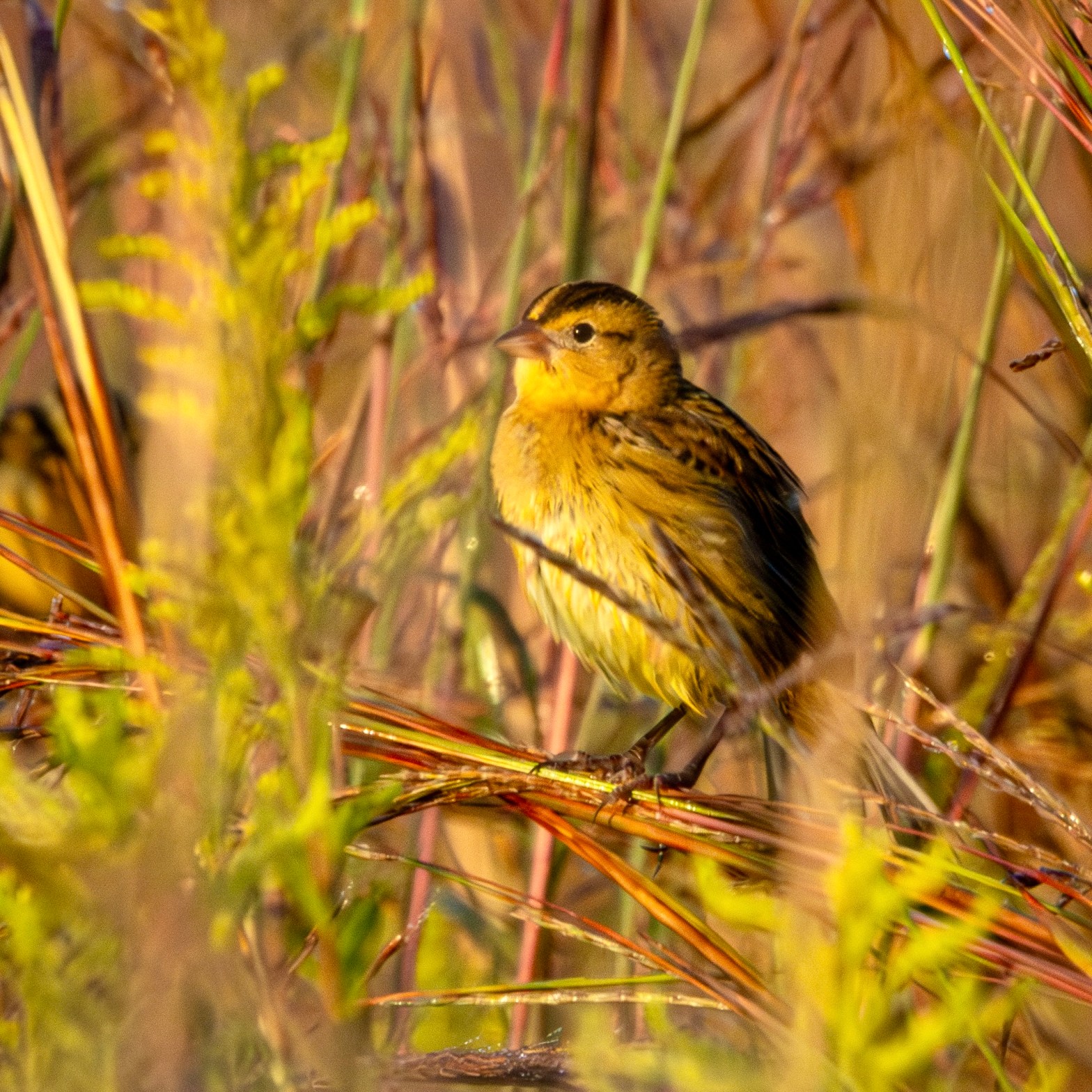
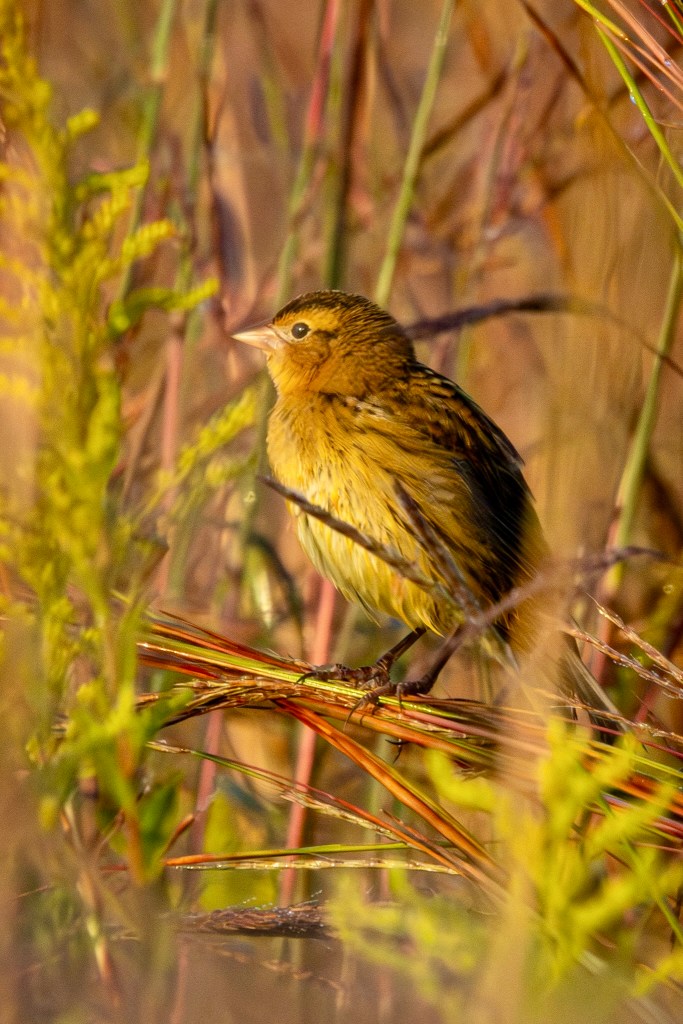
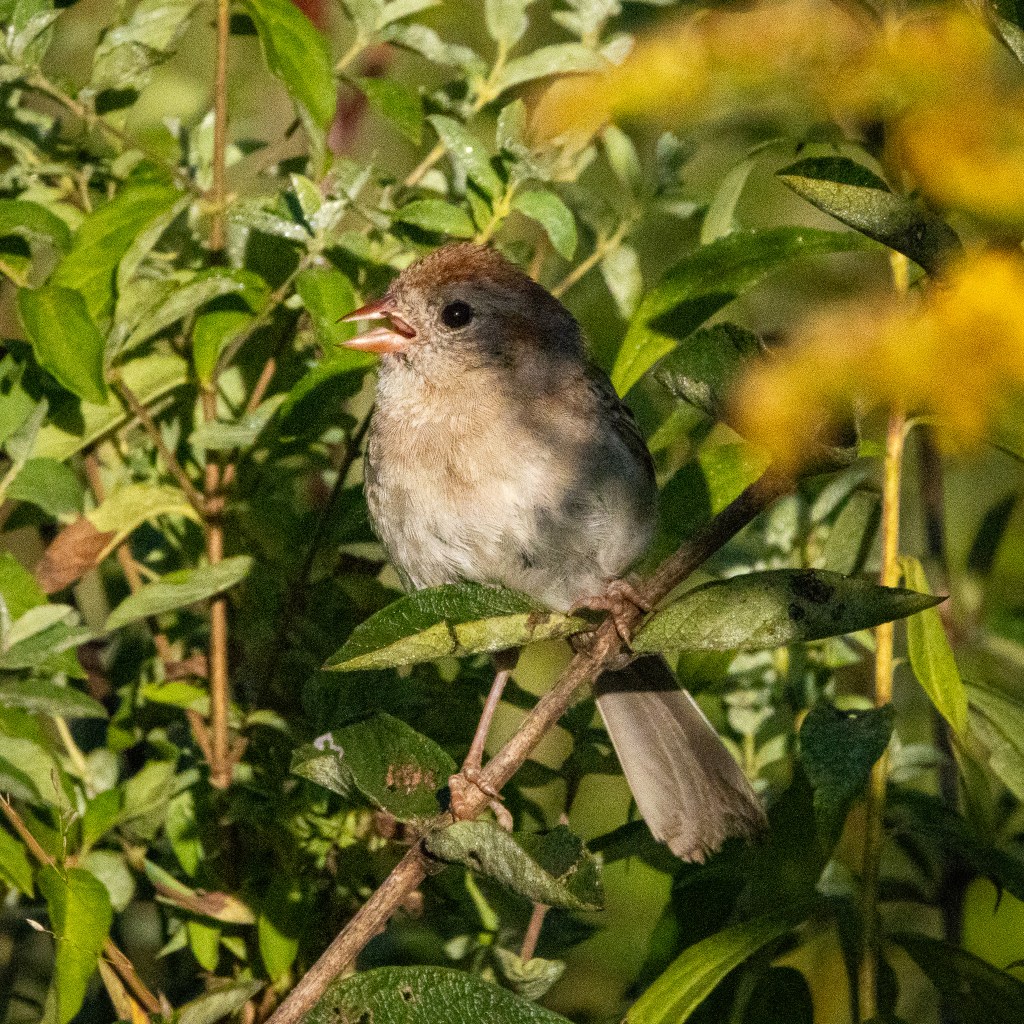
We’re headed for 100-degree temperatures the next few days. How do I feel about that? The facial expression of the common yellowthroat above is a reasonable interpretation.

I spotted Ms. Yellowthroat perched on some small branches Saturday morning on the Reed-Bryan Farm side of Mercer Meadows. I got a few shots of her in profile and was fortunate as she moved slightly to catch her as she opened her beak to sing.

On Sunday morning, I headed to the Millstone River Impoundment in Princeton. I was walking one of the footbridges when I spotted a great blue heron (probably the same one I see at the park on virtually every visit) standing across from me on the side of the lock channel.

It was a rare chance to be less than 20 feet from the bird, and I grabbed a few shots, marveling at how much its face filled the frame. I love the pattern of the feathers on the bird’s elegantly long neck.

Close-in shot of great blue heron from the neck up, showing a yellow eye and mostly yellow beak.
The great blue heron at the Millstone River Impoundment.

I knew on my walk that morning that the coming heat wave would cut down on my birding time, so I made an afternoon run to the Plainsboro Preserve. While plenty of birds were singing, I managed only a mediocre shot of an Eastern kingbird.

This morning, I got out the door early, arriving at the Pole Farm at 6:26 a.m. The weather was nice but became progressively warmer as I trod the trails. Having worked up a sweat, I ended my walk as 7:30 approached.

The highlight of that outing was another common yellowthroat shot, this one of a male. When I got home, I added fresh water to our bird bath. It’s one thing I can do to help the birds beat the heat. I’ll dump some ice into the bowl when I get home. 🦅

Male common yellowthroat in profile, sitting on a branch surrounded by green leaves.
Male common yellowthroat.

Farewell to a good birding friend

My friend Andy was one of the first birders I got to know when I began birding regularly about 6 years ago. I’m saddened to report that Andy died on June 6 at age 90.

Andy was a regular presence at Colonial Lake and at the Mercer Meadows Pole Farm, where we most often encountered one another.

It was Andy who kindly pointed out the pied-billed grebe that was floating on Colonial Lake one day, a “lifer” I might otherwise have missed. It was the first of many kindnesses he showed me.

Our friendship started with a few friendly greetings-in-passing, and at some point not long after we began walking sections of the trails together. Many times we were joined by Jim Parris, who’s recorded more bird species at the Pole Farm than anyone else. Andy and I often joked that following Jim was the best way to spot birds, because they always seemed to find him, not the other way around.

During migration seasons, Andy, Jim and I often spent up to half an hour scouring the wall of trees by the old AT&T Building One arches. We spotted many a warbler there and snapped them happily with our cameras.

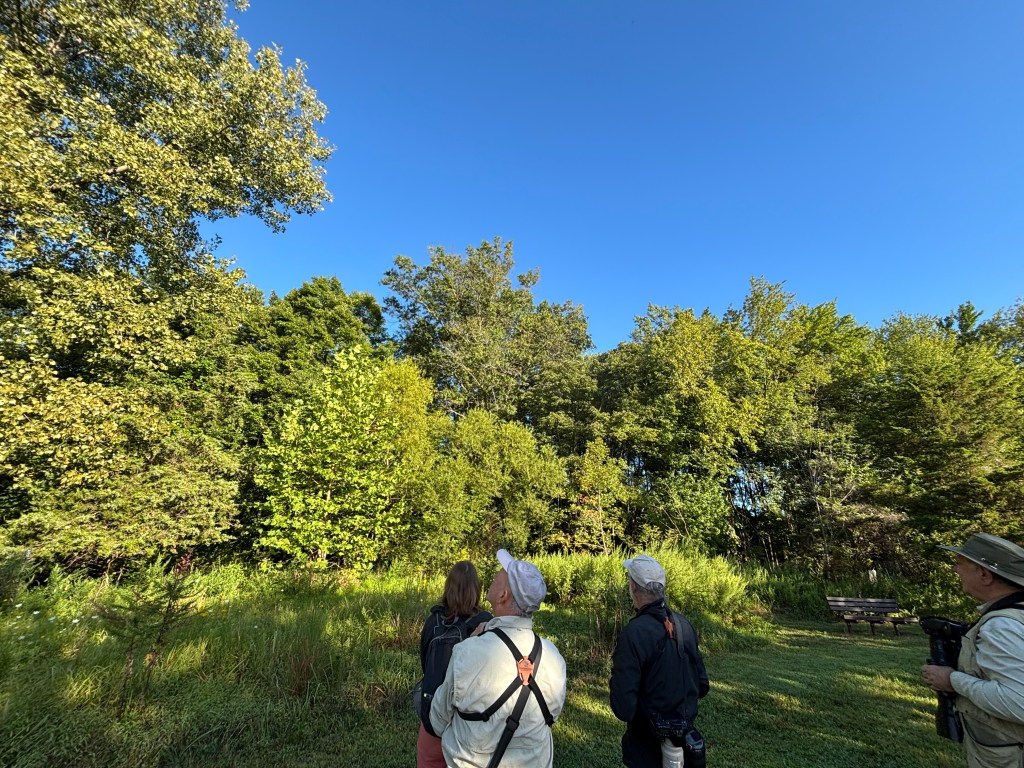
Andy had a long zoom lens on his Nikon and upgraded to a 700mm prime lens a couple of years back. The shot topping this post from July 2023 shows Andy aiming that 700 mm monster at a Dickcissel that hung out at the parking lot on the Reed Bryan Farm side of Mercer Meadows

Whichever lens he used, Andy took stunning images, capturing birds in flight or amid colorful floral backdrops. We often viewed each other’s shots on the displays on the backs of our cameras.

We staked out short-eared owls and Northern harriers. One of his best finds was a scarlet tanager nest on a wooded Pole Farm trail. He showed it to me one morning as the female poked her head out of the nest. Moments later, the male landed a few feet away from us on the trail. It took our breath away.

We shared many moments like that.

I should mention that Andy was in his mid-80s when we met, which made all the more remarkable his ability to lug a heavy camera rig on long walks in the woods and fields. I told him at least a few times that, at two decades younger than he was, I hoped to exhibit the same stamina in my upper years as he did.

Andy started slowing down maybe 18 months ago, limiting how far he’d head up the trail from the Pole Farm parking lot. He still managed to get great shots.

Andy had several grand-daughters, and he wore a different baseball cap Monday through Saturday, one for each of the colleges and graduate schools they attended. On Sundays, he often wore a cap from one of the many cruises he went on with his wife, who many times came to the Pole Farm with him and sat on a bench near the parking lot, patiently waiting for him to return.

Over the years, I picked up bits and pieces of Andy’s life, which brought him from his native China to Taiwan to the United States in the early 1960s. An engineer with a doctorate, he settled in New Jersey and worked for several major companies. His obituary has details.

I’m glad Andy found his way to the United States, and that we found each other.

Rest in peace, my good friend. 🦅

‘Soul Friend’ book: a love letter to birds and nature

In the book “Soul Friend,” released last month by Blackwater Press, my friend Sheila McEntee writes movingly of her affinity for nature. She draws insights from her experiences observing flora and fauna whether hiking deep in the Appalachian woods or merely looking out the windows of her West Virginia home.

Sheila and I were classmates at the College of the Holy Cross and worked together on the student newspaper. We lost touch for a few decades but reconnected and got to do some birding together last fall.

The essays in “Soul Friend and Other Love Notes to the Natural World” span 20 years, during which Sheila chronicles the changes in her life and how she finds solace in her woodland rambles. Most of her essays focus on birds, but other creatures are featured, such as the bear that spent several weeks prowling her neighborhood.

Sheila is a patient and keen observer of nature, whether it’s a jabbering jay or a sharp-dressed jack-in-the-pulpit. Most of Sheila’s essays are set in West Virginia, with a few from the Chesapeake Bay area. Her themes, though, are universal.

My favorite chapters are the poignant title essay in tribute to a hairy woodpecker she honored by burying it, and the moving account of how a flock of Northern cardinals gathered in a tree after Sheila’s mother died.

As befits a Holy Cross English major, Sheila’s prose is elegant, with touches of the poetic. Her insights are thought-provoking and profound, and she adds dashes of humor and irony to good effect.

Her book is available from the publisher, on Amazon.com and elsewhere. Sheila blogs about her current experiences on her website, which also notes the series of public readings she’s doing to promote the book. She recently did a livestreamed interview with the Writers Association of Northern Appalachia.

I encourage my followers to check out “Soul Friend.” I hope you find it as moving as I have. 🦅

An instant bluebird sighting

Rarely does a photo opportunity present itself so quickly as it did this afternoon when I stepped out of my car at the Mercer Meadows Pole Farm.

After a morning of rain, the sun shone weakly through an overcast sky late in the afternoon. I spotted a bird atop the park map sign at the edge of the parking lot, but the bird was in shadow and tough to identify. I moved to my left and pulled up my binoculars to discover it was an Eastern bluebird.

I quickly brought up my camera and fired off a couple of shots before the bird flew off. At 4 p.m., I wasn’t expecting to find many birds out and about, so I considered this quick spot a good omen.

There was plenty of activity by our feathered friends, it turned out, with lots of common yellowthroats, song sparrows and red-winged blackbirds populating the fields.

I was pleased to spot an Eastern kingbird perched in the grass ahead of me. It flew ahead a couple of times, and the best I could manage were a couple of shots of its backside, white tail tip visible but not much of the head showing.

Cedar waxwings were hanging out at the AT&T Building One oval, including one that didn’t seem to mind me approaching. Against the gray sky backdrop, I had trouble finding the bird through my viewfinder, but eventually I was able to focus and produce a fair shot.

A cedar waxwing perched in a tree, with its yellow tail tips on display.
Cedar waxwing, showing off its yellow breast and tail tips.

On my way back to the car, I spotted another bluebird (at least I think it was a different bird) perched on a stake. It flew off and I was able to catch it in motion, with a determined look on its face. At least that’s how I interpreted it from my human point of view.

It was nice of the bluebird(s) to bookend my walk, which I was able to take because I’m on vacation all week. Another wet morning is in store for early tomorrow, and I’m hoping to get back out with my camera once the rain stops. 🦅

Bluebird flying with wings pointing down.
Bluebird in flight.

Hanging at the Pole Farm ‘hot corner’

Every so often, I like to take a different tack when visiting my favorite birding spots. This morning at the Pole Farm, I headed to the Blackwell Road parking lot and crossed into Mercer Meadows. My hope was to get a few photos of indigo buntings, which often sing from the trees along the walking path.

Right away, I could hear a bunting singing its sweet song. It wasn’t long before I spotted one, backlit by the sun, on a tree set back from the trail. Those photos weren’t great, but I’d later get a fair pair as I headed up the path for the “hot corner.”

That’s the nickname I’ve given to the northeast corner of the park, an area of often intense bird activity that I typically reach on days when I have ample time to visit. On this day, I made the strategic choice to spend most of the visit in that part of the park, rather than trying to traverse a two- or three-mile stretch of trails.

The strategy paid off. I quickly heard a Baltimore oriole singing and eventually spotted it hopping from branch to branch of a tall tree. One of those photos tops this post.

Indigo bunting atop a tree branch, with blue sky in the background.
Indigo bunting

An indigo bunting also made an appearance, and lighting conditions were a bit better than on the first encounter.

I wandered down the trail a bit, with gray catbirds and common yellowthroats calling (to me, perhaps) and providing a nice sonic backdrop.

The trail crosses over a bridge that brings you to a wide open field on the right and woods on the left. Obligingly, wood thrushes and ovenbirds announced their presence, although they weren’t so bold as to show themselves.

Cedar waxwings also popped into view repeatedly, as I made my way toward the bridge and as I doubled back to the tree patch at the corner.

This day, my investment of time in a relatively limited area of the park paid dividends. There’s a lesson in that, I suppose. 🦅

It’s groundhog day at our place

Living on the edge of a golf course, we see a daily parade of birds and other critters, more than we would if we had a row of houses behind our lot. Among those critters are groundhogs, and they entertain us as they comb the ground for good things to eat.

Groundhogs are surprisingly fast, their land beaver bodies bolting across yards and fairways near our home. In a sprint, they’d give squirrels a good challenge, although they don’t seem built for anything beyond a 100-meter dash.

This is prime groundhog time, as these cousins of Punxsutawney Phil are long removed from hibernation and bringing their young ones out into the world. The groundhog atop this post has been hanging around the edge of our yard the past several days.

We have dubbed this presumed male of the species Alejandro and we call presumed females Esperanza, inspired by characters in the Antonio Banderas movie “Mask of Zorro.” (I know, I know. Zorro means fox. More on foxes later.)

We saw a mother leading a few babies along our property line the other day. I didn’t have my camera at the ready, so I’m offering a shot I took a couple of years ago.

A mother groundhog and three pups look ahead from the grass.
Mamma (we presume) and babies on an outing in our yard.

We’re glad these animals are thriving. We’re also grateful that none of them ever invaded our garden patch, which we paved over this spring in favor of raised plant beds. We hope that the groundhogs (or woodchucks, as they are known elsewhere) remain plentiful. That assures a good balance of nature in our environs and brightens our days with rodential antics. 🦅

A couple of yellowthroats. But are they a couple?

One of the joys of birding in my area is hearing and seeing common yellowthroats. My sightings of the males vastly outnumbered those of the females, and days when I get photos of both sexes are rare.

I’ve given the female yellowthroat top billing on this post. I spotted her amid the tall grasses near the observation deck on the Reed-Bryan Farm side of Mercer Meadows on Wednesday morning. Close by was a male yellowthroat, and I wondered if they were mates.

I’ll never know. I imagine they are doing their best to propagate their species, and I salute them for it. 🦅

Male common yellowthroat with an insect squished in its beak.
Male common yellowthroat with a bug squished in its beak.

I like small birds and I cannot lie

Get a good look at the willow flycatcher topping this post. What a sweet bird! He or she was flitting about the grasses on the Reed Bryan section of Mercer Meadows this morning. The bird paused between sorties for bugs to afford me a chance to catch its portrait.

I am smitten by these wee creatures with their buzzy calls. As with many birds, you hear them many more times than you see them. This time of year, I hear willow flycatchers most days at the Mercer Meadows Pole Farm. Occasionally, I’ll see one.

I hear and see fewer of them on the Reed Bryan side of the park, which makes this photo extra special to me. I hope you feel at least a smidge of the joy I feel from it. 🦅

Another yellow warbler brightens a gray day

For the past few years, yellow warblers have made a home in a group of trees about 100 yards up from the Cold Soil Road parking lot at the Mercer Meadows Pole Farm. From their arrival during Spring migration until their departure in Fall, I can count on hearing one of them in this same spot virtually every morning I visit the park.

Most often, though, they’re obscured by the leaves of the trees. If I’m lucky, sometimes they pop into view. I got lucky Friday.

A yellow warbler was singing repeatedly as I turned onto the path through the alley of trees. The bird was so close that I thought it was worth waiting a few minutes in the hope of spotting it.

Soon, under a heavy overcast gray sky, the bird emerged, clinging to a vertical branch sticking up from the top of one of the trees. The bird was backlit and appeared nearly black through my viewfinder. I took several shots, figuring that my Adobe Lightroom software would be able to bring up the yellow.

Indeed, Lightroom came through, as you can see from the photo topping this post. As I’ve noted here before, my photographic approach is journalistic, hoping to replicate through my photos what I saw in real life. That’s appropriate for car wrecks and other spot photos for a news organization, but over time I’ve come to rely more on editing software to bring out the highlights of birds and other critters that I encounter, especially when lighting conditions are unforgiving in the field.

Amidst a period of dreary weather, I consider that yellow warbler’s appearance a gift, one I’m happy to share with my readers.

As a side note, I’ve discovered that the people who follow my Bluesky social media account respond very well to my bird photos. It’s not a surprise that the prettier the bird, the greater the reaction. 🦅

A lesson in allofeeding

While doing my morning reading from my easy chair Wednesday, I looked up to see a pair of house sparrows perched on a plant hanger propped against one of our dining room windows.

One bird was feeding the other, zipping back and forth to the nearby tube feeder while the other stayed put. The birds happened to be perched near an orchid that is blooming on the window sill.

I watched this feeding ritual for several minutes, figuring that a male was feeding a female mate or potential mate. I also thought I ought to fetch my camera from the back room and get a photo framing the birds under the orchid blossoms.

I was able to take several shots, then moved to get a different vantage point. But the birds flew off. Having to get ready for work, I put the camera aside and decided to hold off on getting the images into my computer.

That I did this morning, and I was surprised to find that what I had observed was not a male feeding a female but a female feeding a young bird. The size differential is clear in the photo topping this post, and the larger bird on the right is female.

I hadn’t noticed those details when looking at and photographing them.

Their behavior did lead me to look up birds feeding birds on Google. I found several references to what’s called allofeeding, and this description on Wikipedia seemed to sum things up well.