This is a golden time for birding, with the fall color peaking and enough leaves falling to increase the odds of seeing more birds in the branches. This morning was a nice example, as my pal Jim and I headed to the Mercer Meadows Pole Farm.
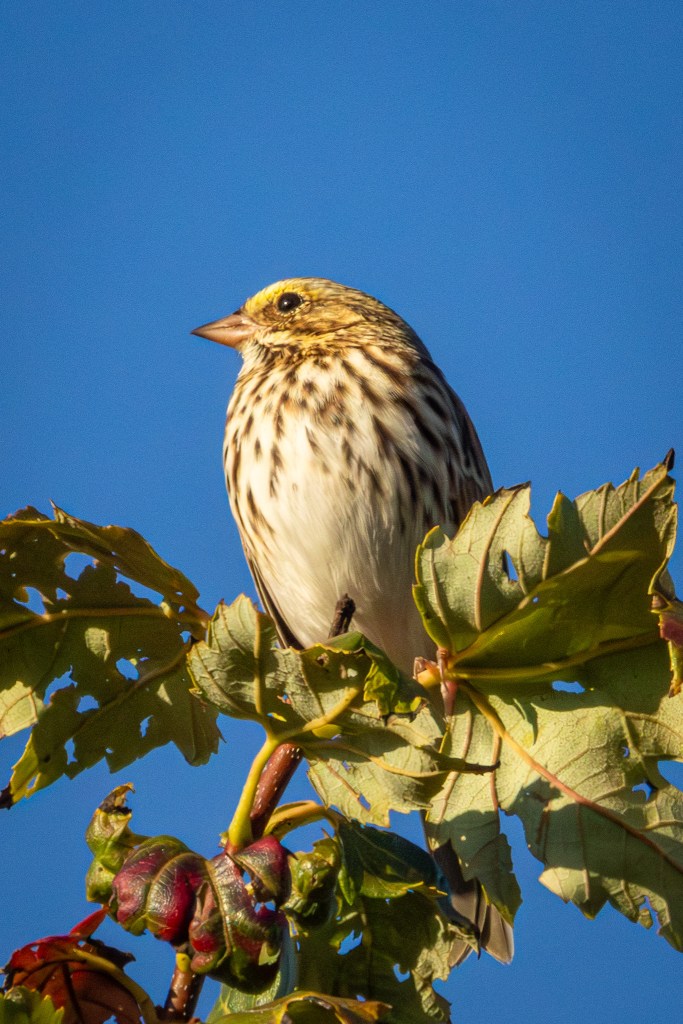
The sun was out in full, shining liberally on the song, swamp and Savannah sparrows flitting about the fields and woods. A Savannah sitting atop a cluster of red berries tops this post, my best shot of the day.
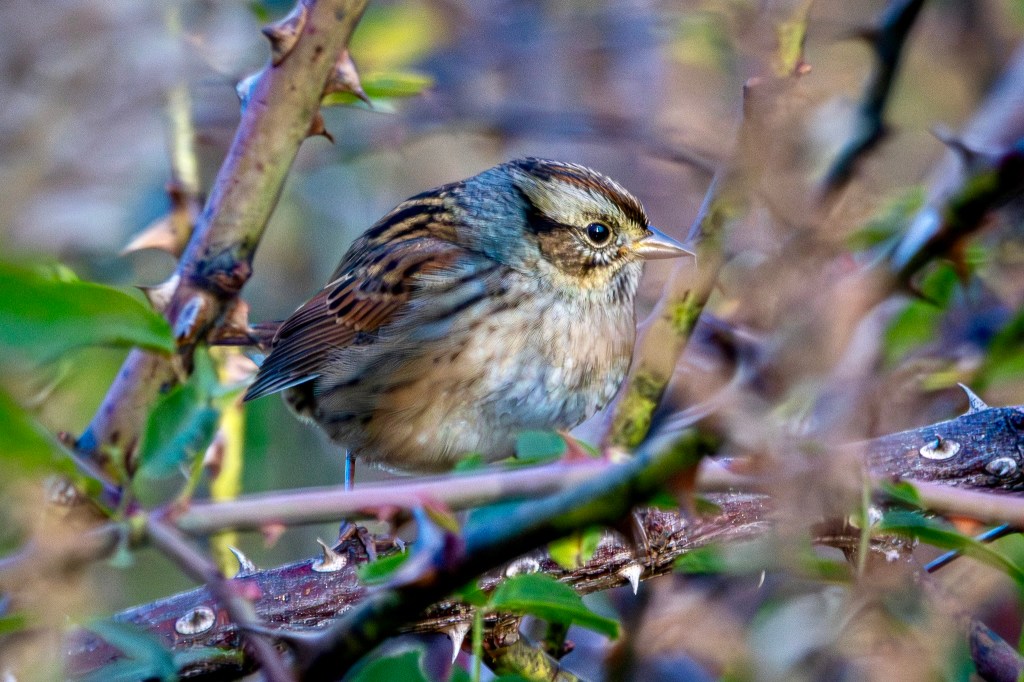
This handsome swamp sparrow was one of several we saw, but the only one I captured on camera.
Another favorite is this single frame I got of a raggedy-feathered blue jay surrounded by orange leaves, a split second before it flew off.
Blue jay about to launch.
Jim and I made a big loop around the park, and on our way back to the car we saw a lot of activity at a big puddle on the path to the old AT&T Building One site.
Of the hundreds of visits I’ve made to the Pole Farm, I can count on one hand the number of times I’ve seen more than a single bird cavorting in a puddle. Today, white-throated sparrows, yellow-rumped warblers and American robins were dipping in and out of the big puddle. Its water glowed a golden orange, the light reflected from trees in the background.
An American robin sips rom the puddle.
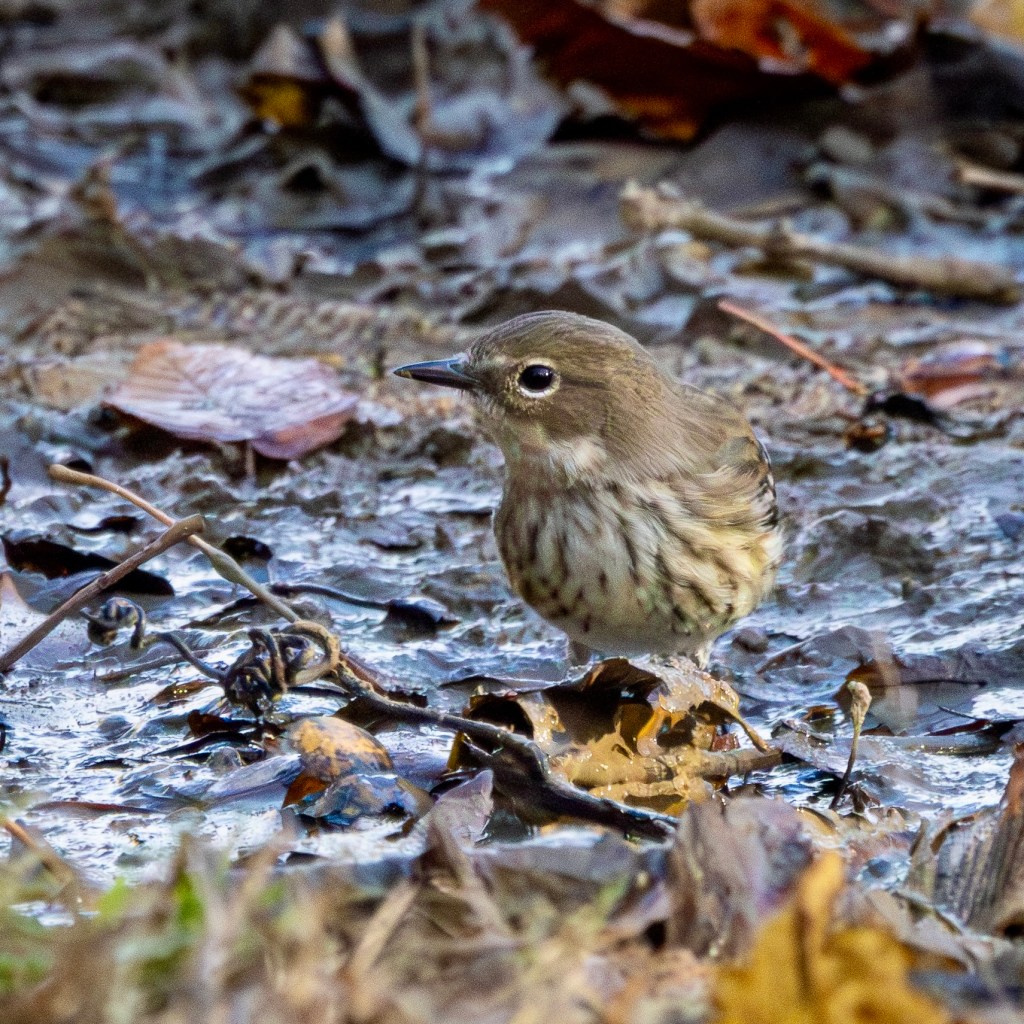
This is also the high season for yellow-rumped warblers. I got one shot of two of them just off the puddle, but it’s a bit dark and, um, muddy. So I’ll close with the following shot of one of the yellow-rumps that settled nearby in slightly better light. 🦅
Yellow-rumped warbler showing off its eye-ring, if not its “butter butt.”
We’ve had a beautiful fall weekend here in central New Jersey, with warmer-than-we-really-should-have temperatures poking into the upper 70s. I was able to get two good outings in at the Mercer Meadow Pole Farm, where sparrows took center stage.
Savannah sparrow
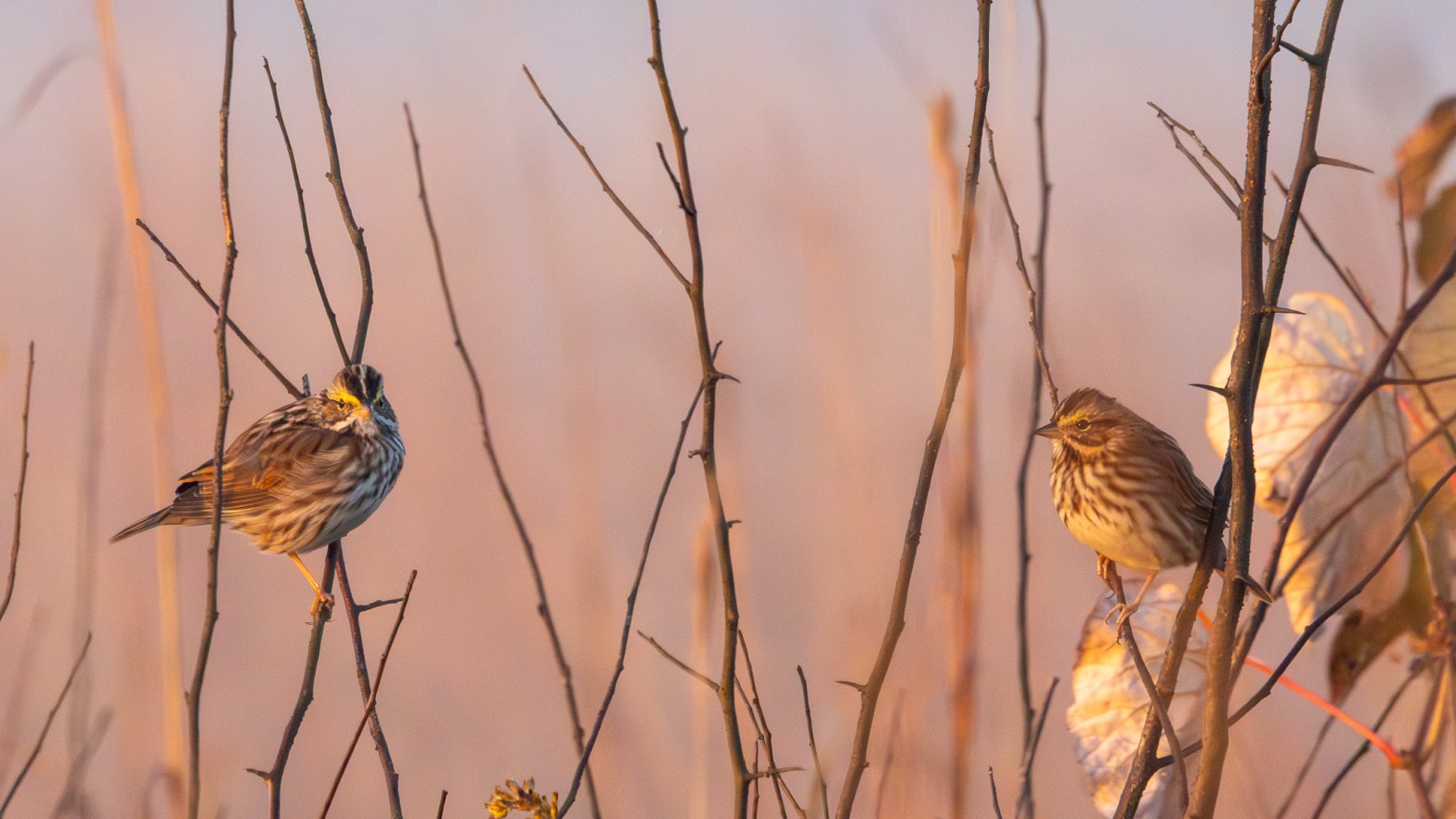
I’m leading the post with two of the Savannah sparrows I saw while walking up the Lawrence Hopewell Trail on Sunday morning. It was the beginning of a five-sparrow-species jaunt over just under three miles.
Savannahs show up in abundance during the fall, although I’ve seen fewer of them than I recall seeing in previous years. This weekend, that may have been in part because I reached the park a few minutes before dawn each day. Like many birds, the Savannahs like the light of day.
Next up in my viewfinder was a swamp sparrow, which was farther back in the grasses but lit nicely by the rising sun. Perhaps to keep balance in the universe, it seems the shortage of Savannahs is offset by a greater-than- previous showing of the swampers.
Swamp sparrow straddling tree branches. Note the drops of moisture on the red leaves above its head.
Once I reached the woods, white-throated sparrows serenaded me with their sweet, high-pitched song. I got a few peekaboo shots, but none of the birds had the courtesy to pose openly for me as the swamp sparrow above did.
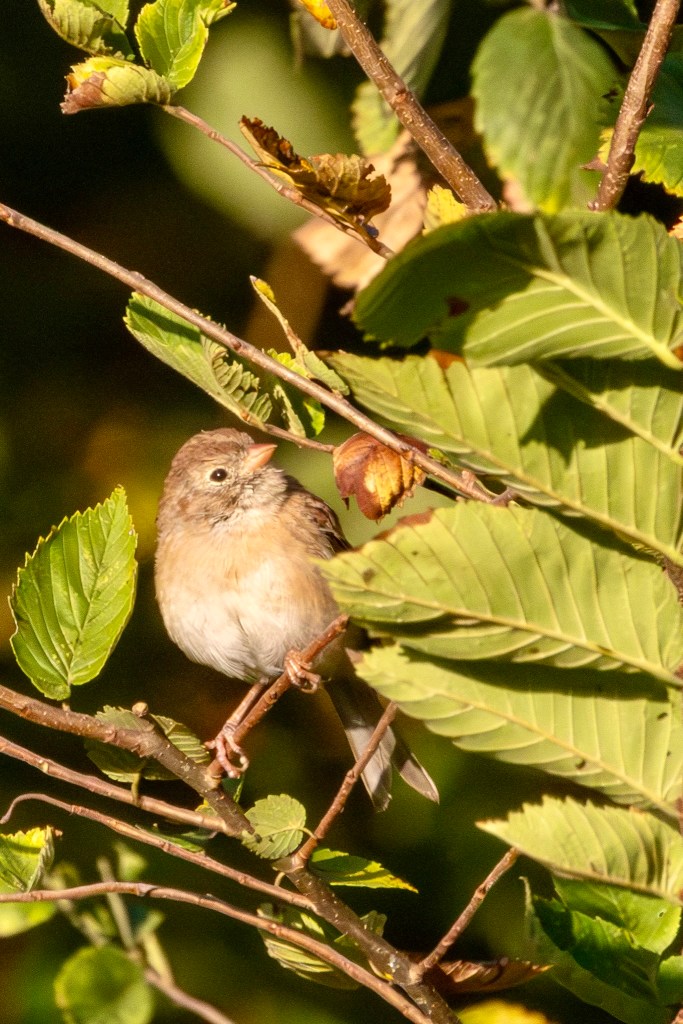
I also heard a couple of field sparrows each day, and on Saturday morning I managed a nice shot of one of them that was perched near the old AT&T Building One site.
This sweet little field sparrow stood still just long enough for me to focus.
Also on Saturday, I got my first chipping sparrow of the season. It was on the path near the parking lot at the Pole Farm. I got a soft shot that was sufficient to confirm its ID.
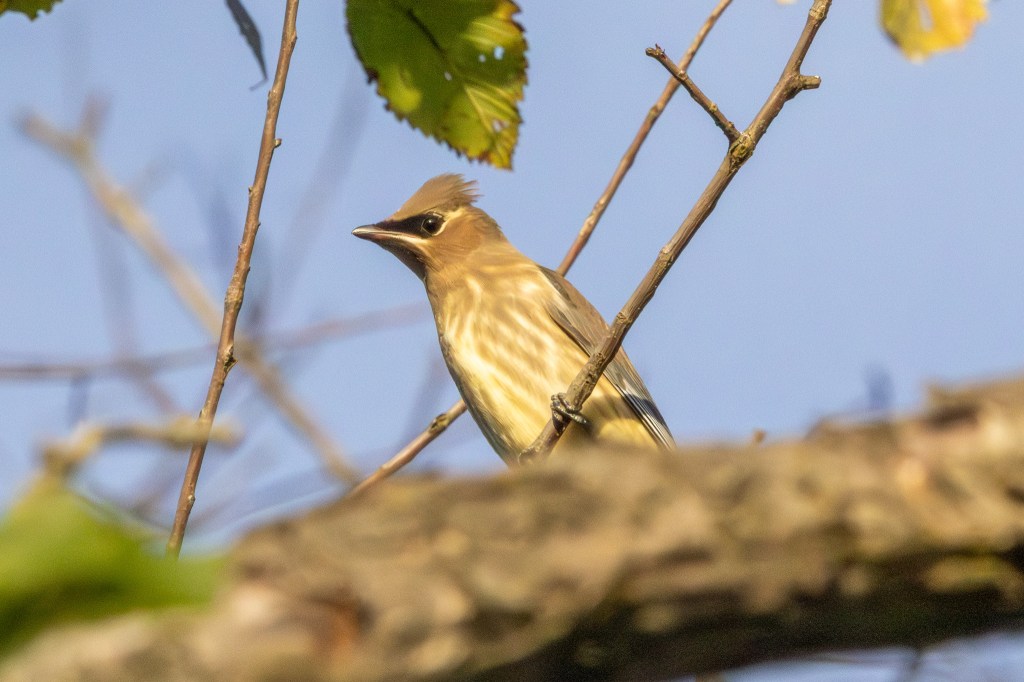
The weekend also brought some nice looks at yellow-rumped warblers, ruby-crowned kinglets and an Eastern phoebe. But the most unexpected joy over the two days was a flock of cedar waxwings that descended in the trees above me as I emerged from the woods to the central path on my way back to my car.
At first, I couldn’t figure out what the birds were. They were chasing each other and darting in the treetops, too quickly for my brain to react. But I was able to get a few clear shots, and from the camera’s playback screen I nailed the ID.
One of the many cedar waxwings that flew in above me Saturday. Their color has faded a bit, but they are still striking.
It seems some of our residents of recent months have flown the coop. I haven’t seen or heard a catbird in a few weeks, and I think the common yellowthroats have headed south. But I saw my first dark-eyed juncos of the season in New York’s Central Park on Saturday afternoon and spotted a couple at the Pole Farm on Sunday.
We’re seeing a changing of the guard, as it were, and that’s something to crow about. 🦅
On Sunday, I made my first stop at the Charles Rogers Preserve in Princeton, where other birders have been reporting good warbler traffic. As I stepped out of my car at the parking lot, plenty of birds were calling.
My warbler brain has not been challenged much this fall, and I struggled at first to make a positive ID on the first yellow-rumped/myrtle warbler I spotted in the bank of trees to the left of the small parking lot and along the front edge of the park’s pond.
My camera roll would leave no doubt that there were many yellow rumps cavorting in the tree tops. I managed several shots of them and put one atop this post.
I also managed to get my first shot of the fall of a white-throated sparrow. There were several off the short trail that leads to a blind in the not-so-swampy swamp opposite the pond.
White throated sparrow lurking in the branches.
Another sparrow has been frustrating me in recent weeks, the Lincoln’s sparrow. Other birders have spotted them at Mercer Meadows, and Merlin has been hearing them as I’ve walked the trails. But I had no sightings.
On Saturday morning, other birders I met on the Reed-Bryan side said there were some around. I struck out. But that would change as I crossed over to the Pole Farm side of the park.
At the old AT&T Building One site, I trained my camera on a sparrow sitting on a fence. As I looked through the viewfinder, I figured it was a swamp sparrow. At home, I called the photo up and seeing what appeared to be a buffy wash on the left side of the bird’s breast, my pulse quickened. It might be a Lincoln’s, I thought, A quick check on Apple photos and Merlin confirmed the sighting.
At last, I had a firm ID and a photo of a Lincoln’s sparrow.
As satisfying that was, it wasn’t the most memorable sighting of the weekend. And no, it wasn’t the rare greater white-fronted goose I spotted Sunday. Rather, it was a human sighting.
On the Reed-Bryan trail, I came upon a group of birders who were participating in the Wings Over Mercer birding competition, one in which I was too lax to enter. Another man was hanging back a bit, and he mentioned he was writing a story about the competition. To our surprise we discovered that he is the brother of one of my former Associated Press colleagues in California.
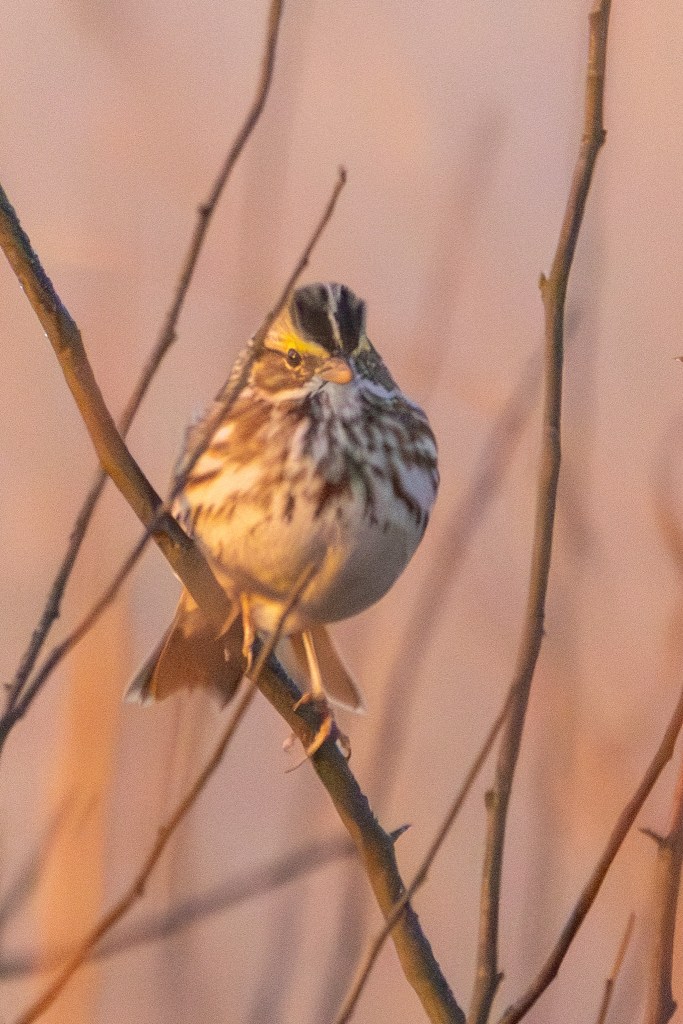
Savannah sparrow
Fast forward to this afternoon, and I decided to take a late-afternoon stroll at the Pole Farm in hopes of spotting a nighthawk. Reports on them there have come in over the last two weeks, and this would be my third try to find at least one flying overhead.
No dice.
But I was able to close out the week with a couple of photos of a Savannah sparrow sitting prettily atop a tree. 🦅
Where to begin? This weekend has offered a lot of birding thrills in addition to beautiful weather. The sun has been shining as I’ve made several stops at parks near home. The temperature reached the mid-80s Saturday and is expected to do so again today.
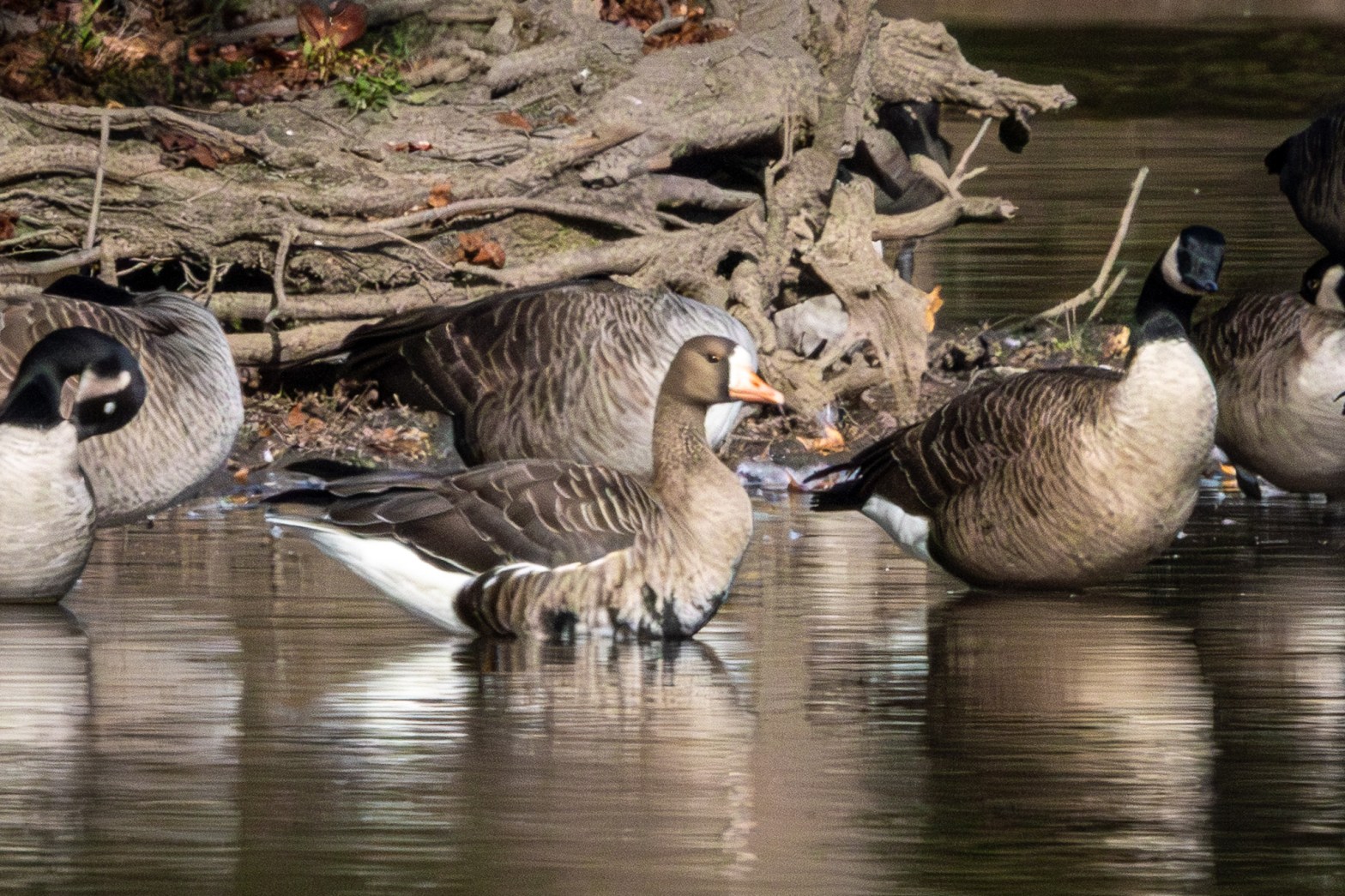
I’ll start with the rare bird that came Saturday to Veterans Park in Hamilton, a greater white-fronted goose. When the report that a GWFG — rare in these parts — was at the lake in the park, I headed down the highway Saturday afternoon to see if I could spot it.
Tipped in the parking lot by birders who had just seen it, I used my binoculars to scour the scores of Canada geese in clusters on the far side of the lake. It took me a while, but eventually the goose’s bright orange bill poked out from among the black-and-white Canadas. I had my second lifetime sighting of the greater white-fronted goose. I managed to get a couple of decent photos, too.
I’m pleased that I was able to crop into the greater white-fronted goose and still get a clear shot.
On the walk to find the goose, I heard slapping sounds coming from the lake and looked down to see a double-crested cormorant thrashing a fish in its beak. I blasted away with my camera and caught some peak nature-is-cruel action. After a struggle of roughly a minute and a half, the cormorant swallowed the fish whole.
Imagine what that fish was thinking at this moment, one its last.
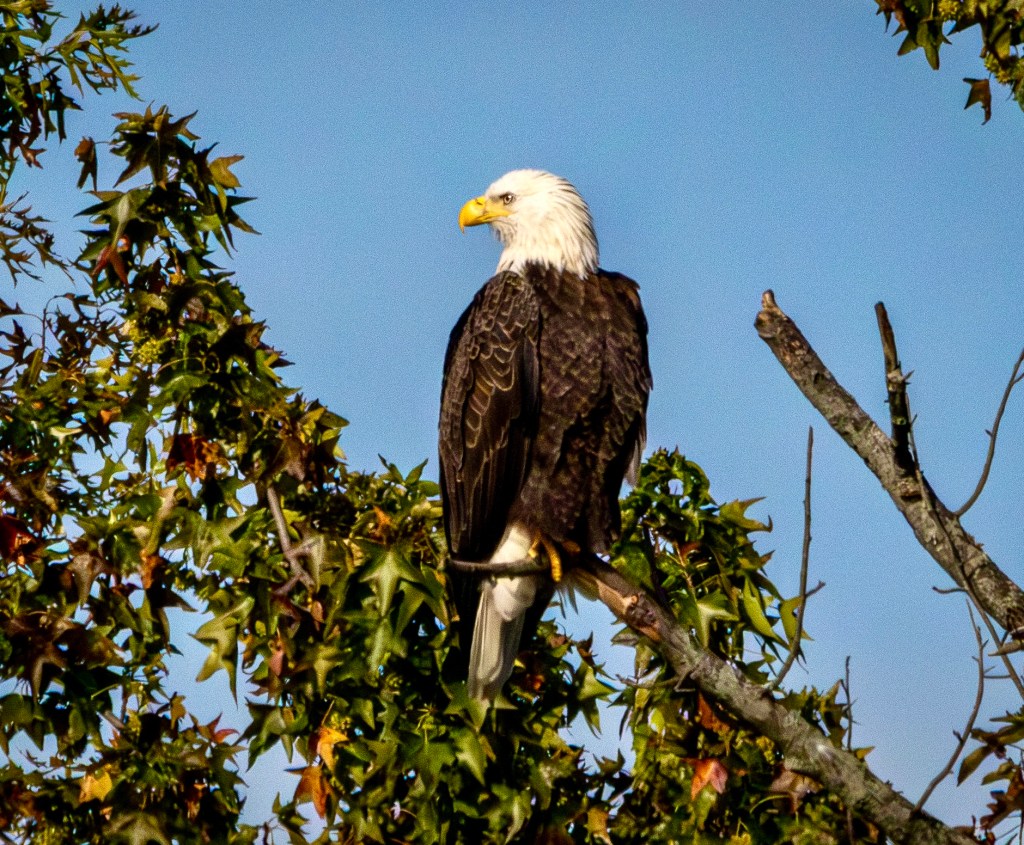
If that wasn’t enough excitement, a bald eagle came soaring over the lake and landed in a tree, not far from where the greater white-fronted goose was floating. I had plenty of chances to frame the big bird.
The bald eagle, surveying its domain at Veterans Park.
When I got home, I tackled the chore of removing the screens from our windows, as the window-washing crew is due to come by this week. From our patio, I could hear a red-breasted nuthatch calling. I made a quick recording (its call starts at 0:11) and went inside for my camera. I never did see the bird — only the third of its kind ever observed at our home in almost 10 years — but its visit added to the enjoyment of the weekend.
I may head out again this afternoon, and I have more to report in a second post to come. 🦅
Dawn arrived with a temperature of 43 degrees , our first truly Fall-feeling morning. I pulled on a green plaid jacket, turned on the heater in the car and headed to the Pole Farm.
At the parking lot, I heard the cry of a pileated woodpecker as I switched to my hiking shoes, figuring that was a sign of good things to come.
It was.
On the central path, I spotted a palm warbler in the grasses. I got a good look through my binoculars, but the bird flew off before I could switch to my camera. Nonetheless, my warbler drought was broken, and I took that as encouragement.
As I made my way up the trail and into the woods, I was startled to hear the hooting of a great horned owl. I had seen one once before at the Pole Farm, stock still on a tree near the old AT&T Building One site. I had just left there and had entered the woods when I heard the hooting that would persist desultorily for a few minutes.
What a joy that was.
Pressing on, I looped the park clockwise and returned to the central dirt trail on my way back to the parking lot. Suddenly, it was sparrow-palooza.
I was able to photograph field, swamp and Savannah sparrows in beautiful light. Here’s a gallery to underscore the point. Another swamp sparrow is up top. 🦅
My last two outings to Mercer Meadows brought lighting challenges and opportunities. Each morning started with heavy fog, with the sun ultimately breaking through and burning off the gray stuff.
Sometimes, the fog makes for interesting, moody shots. I went to the Reed-Bryan Farm side of the park today. The fog was heavy, and through it I saw many sparrows flying ahead of me as I walked down the path from the parking lot. Toward the bottom of the hill, I spotted a Savannah sparrow to my right, perched on a small tree.
Savannah sparrow through the fog, which was just starting to life.
I typically crop close to a bird to bring out its features, but I left this frame full for two reasons: one, I love the goldenrod behind the bird, and two, check out the wisps of spider string just above the bird and wrapped on the thorny branches at bottom right.
So much for fog and shadow. What always raises my hopes in the field is warm morning sunlight gushing through the clouds.
On Saturday, I started at the Pole Farm and walked to the northeast corner of the park, what I’ve been calling the “hot corner.” I’ve since learned from other birders that they call it the “chat corner” because yellow-breasted chats can be found there in season.
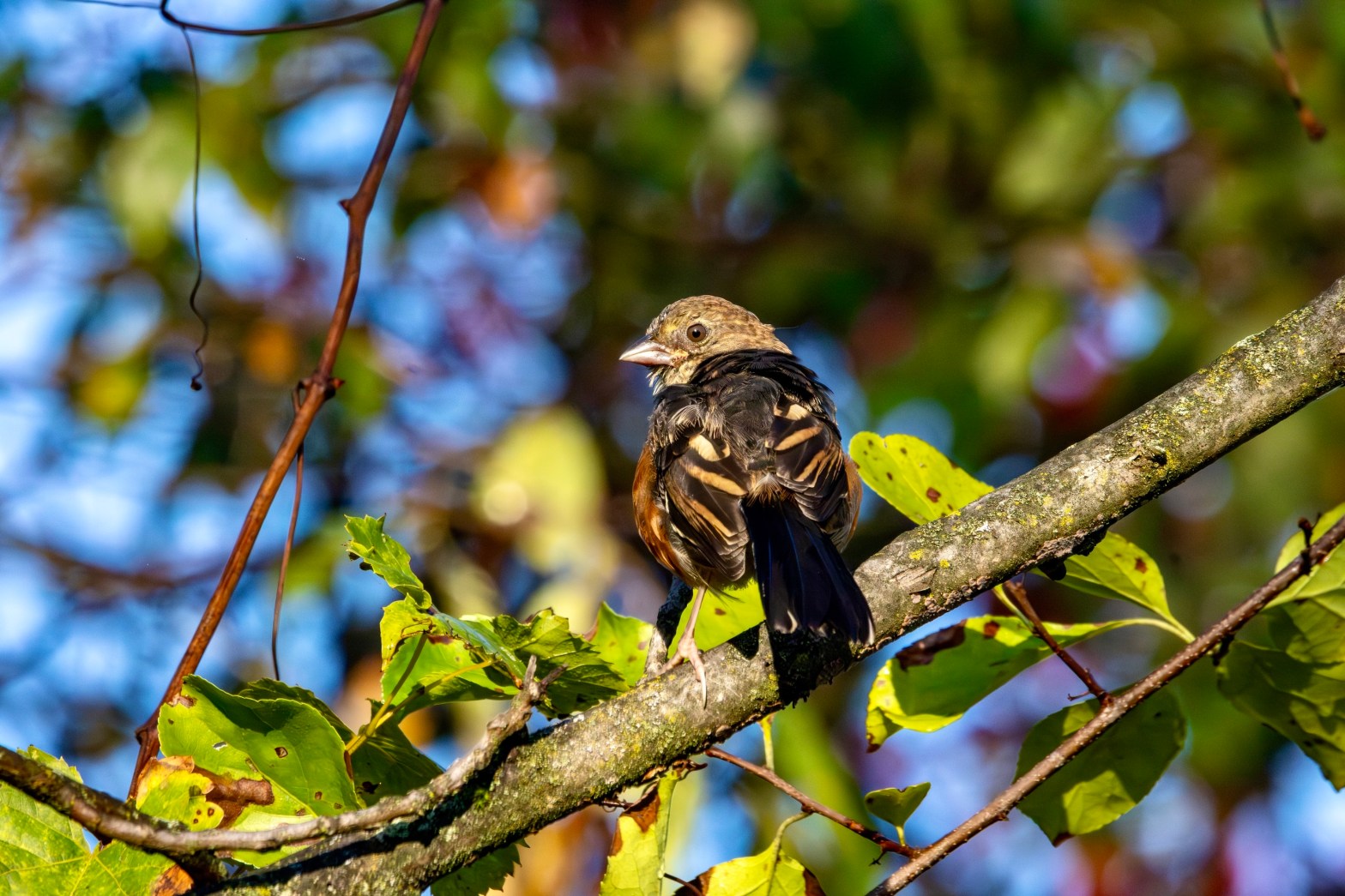
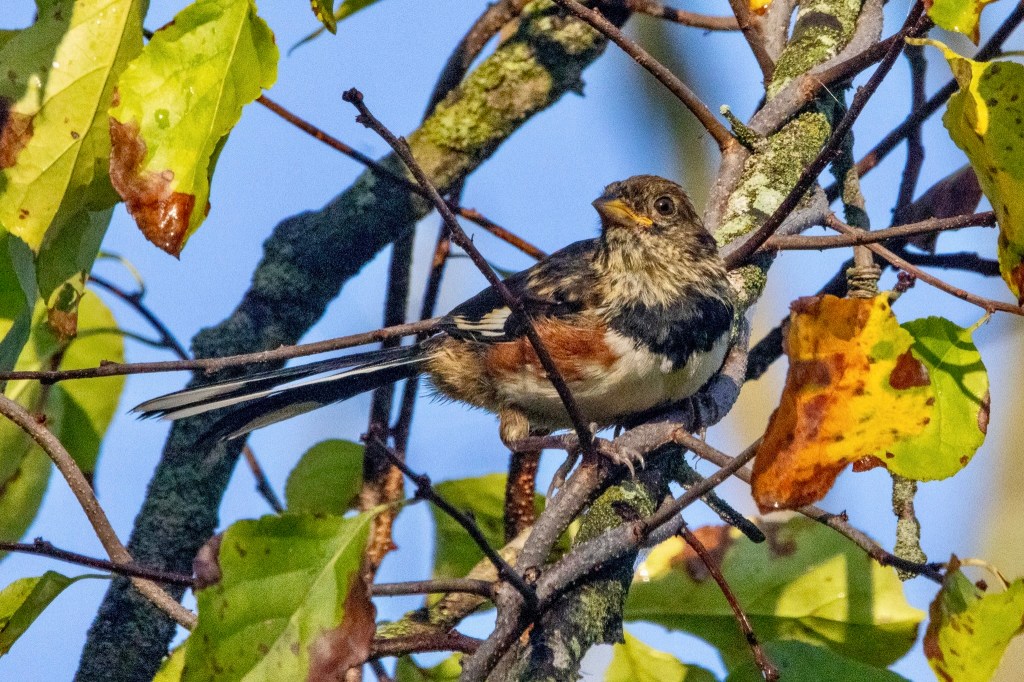
The sun was out, but the lower parts of the trees where I spotted a couple of Eastern towhees were in shadow. I took a few photos but the shots were mediocre. There wasn’t enough light on the birds’ dark heads.
Walking to the same corner today, I found several towhees. The trees they were in were beautifully lit by the sun. The photo topping this post is one of several shots I got. Here’s another:
Mr. Towhee blends nicely with the foliage around him.
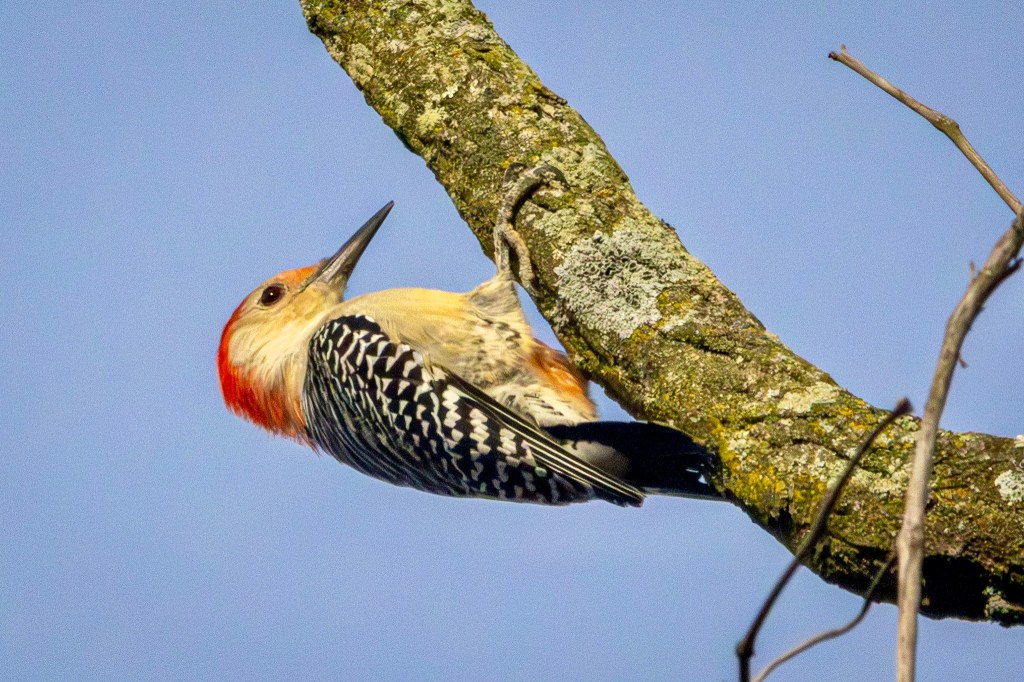
The sun did come out fully on Saturday, too. I took advantage of it when I spotted a a red-bellied woodpecker near the towhees. Higher up in the trees, the woodpecker was in bright light. perched upside down for a bit, then flying overhead.
The red-bellied woodpecker is illuminated by the sun.The woodpecker lifted off and flew overhead. I was a split second off from getting its full wingspan.
Given my druthers, I’d shoot in sunlight most of the time. But overcast and foggy days bring opportunities of a different sort, and it’s fun to meet the challenge. 🦅
With golden streaks on their brown and tan heads, Savannah sparrows are well matched to the their surroundings in the fields of the Mercer Meadows Pole Farm at this time of. year.
I had spotted an early arrival about two weeks ago, and other birders have been noting that more and more are arriving daily. This morning I trained my camera on what I thought was a song sparrow. The bird had a small blob at the center of its breast. When I called the image up on screen, I realized the “blob” was only slightly larger than the other streaks on its upper breast.
I also could see the golden tones along the bird’s face, cinching the ID as a Savannah.
The Savannah sparrow, sitting pretty at the Pole Farm.
The goldenrod plants are flourishing in the big fields these days, and they are joined by bright asters, wild senna and other yellow-blossomed plants. With a morning sun beaming down from a cloud-free sky, the fields light up.
A bit of fall color is starting to show on some of the trees, a red patch here, a yellow leaf there, fooling me frequently into thinking I might be seeing a bird.
A birder I passed on the trail this morning was staking out Lincoln’s sparrows just off the trail, but I pressed on without seeing any. The Lincoln’s, with a faint buffy yellow wash on their breasts, are another good fit for Fall. I haven’t seen one in a while, and I’ll keep looking in the coming days. 🦅
I made two visits to the Mercer Meadows Pole Farm today, and it was full of surprises. On a longer than usual three-mile walk in the morning, I finally added a red-headed woodpecker to my e-Bird reports. It was a lifer. Or was it?
I’ve been hoping to spot a red-headed woodpecker since I began birding seriously the last few years. I am reasonably certain that I saw red-headed woodpeckers in my neighborhood growing up, but I’m also aware that what we called red-headed woodpeckers in suburban Cleveland may have been red-bellied woodpeckers.
The red-headed woodpecker (or were there two?) that I spotted this morning didn’t have a red head. It was gray, signifying a juvenile. But the black and white pattern under its wing — as clearly shown by the photo topping this post — told me it really was a red-headed woodpecker.
My first? Who knows. But it’s the first on my official life list, which now totals 202 in New Jersey and 237 worldwide.
As I was looking at the red-head, a red-bellied woodpecker, a downy woodpecker and a Northern flicker were in trees close by. Then a pileated woodpecker flew in, making it a woodpecker party. Only a hairy woodpecker was missing.
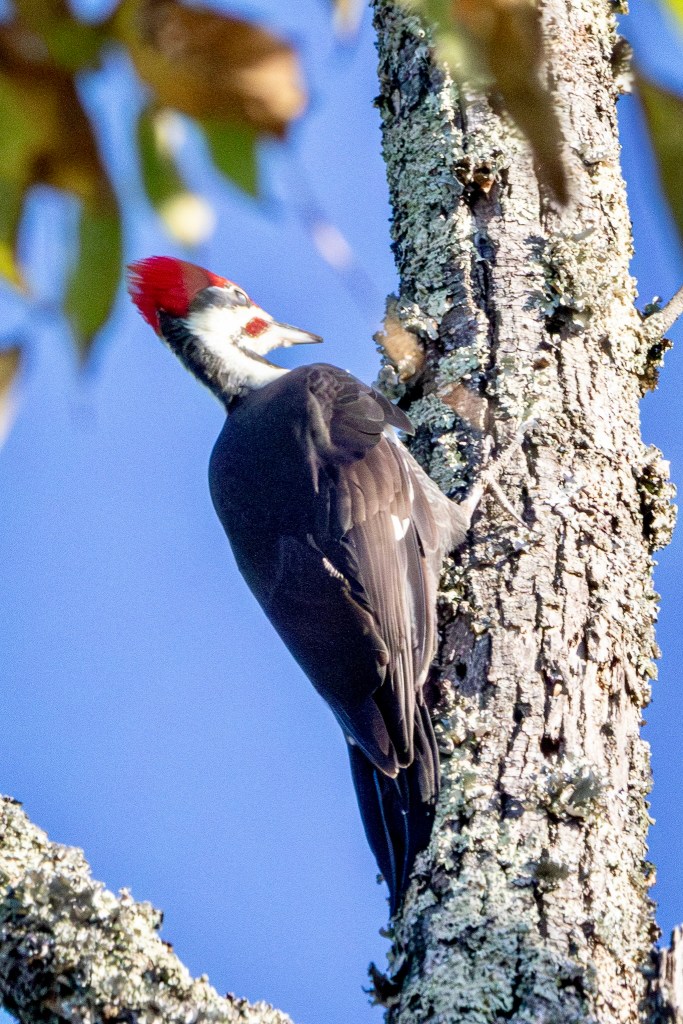
Mr. Pileated takes a gander at the tree.
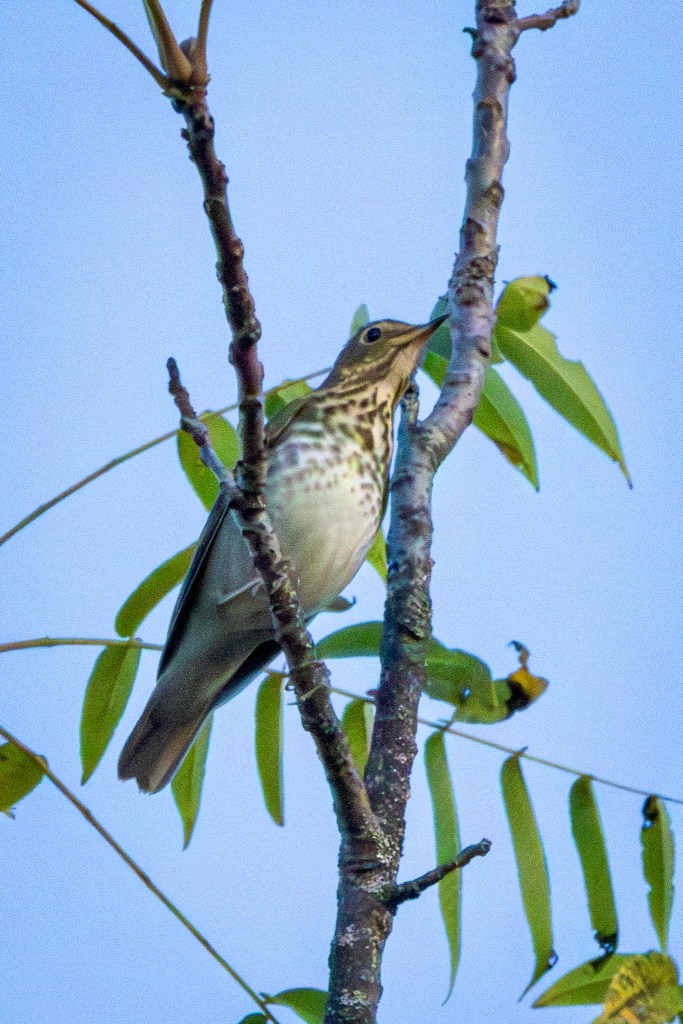
The redhead wasn’t the only surprise of the day. I caught a thrush in a tree as I was heading toward the northeast corner of the park, thinking it was either a wood thrush or a hermit thrush. It turned out to be a Swainson’s thrush, one I had not seen lately.
Swainson’s thrush, Note the eye ring.
I ran into my birding buddy Jim at some point, and he told me that the video he had posted on Facebook of some 30 common nighthawks he had seen at sunset yesterday were at the Pole Farm.
I went back about an hour before sunset and soon found Jim and another birder. The three of us walked up the Lawrence-Hopewell Trail and stopped short of the entrance to the central woods. We were in an ideal spot to see the nighthawks if they were to return,
While we were waiting, we watched a merlin harass an American kestrel and then spotted two Northern harriers, my first of the season. American crows and red-winged blackbirds flew overhead, but we never did see a nighthawk.
Such is birding: a few surprises and a disappointment, all in the span of 12 hours. 🦅
With their plain-Jane garb of brownish gray and drab white, female house finches don’t draw the eye the way their male companions do with their deep red feathers.
When the female finches show up at our feeders, I glance at them, make a mental note of their number and hope something brighter will fly in to the circular perch.
Yet in the woods the other day, I spotted the female finch topping this post and snapped her photo. I didn’t think much of it at the time and moved on, hoping to find something brighter.
When I brought the photo up on screen at home, I was struck by the bird’s unexpected beauty. It seems I caught her at her best — a regal pose in gentle light, the slightly blurred green leaves behind her providing a soft, feminine backdrop.
The experience of viewing that photo reminds me to look intently at the birds and other critters that share our human habitat. At a glance, they may appear boringly ordinary. But upon closer, open-minded examination, each has its charms: delicate feathers, perhaps one askew, maybe a silvery beak clutching a small seed.
I also offer a photo of a Northern house wren, a bird that presents a subdued brown color scheme, nothing with pizzaz. And yet look at this sweet little one perched at an angle on the branch of a small tree.
Northern house wren at the Mercer Meadows Pole Farm.
I find beauty in the variations in the coloring of the feathers of his or her breast, something I don’t notice when looking a wrens in the moment. The photo captures the nuances.
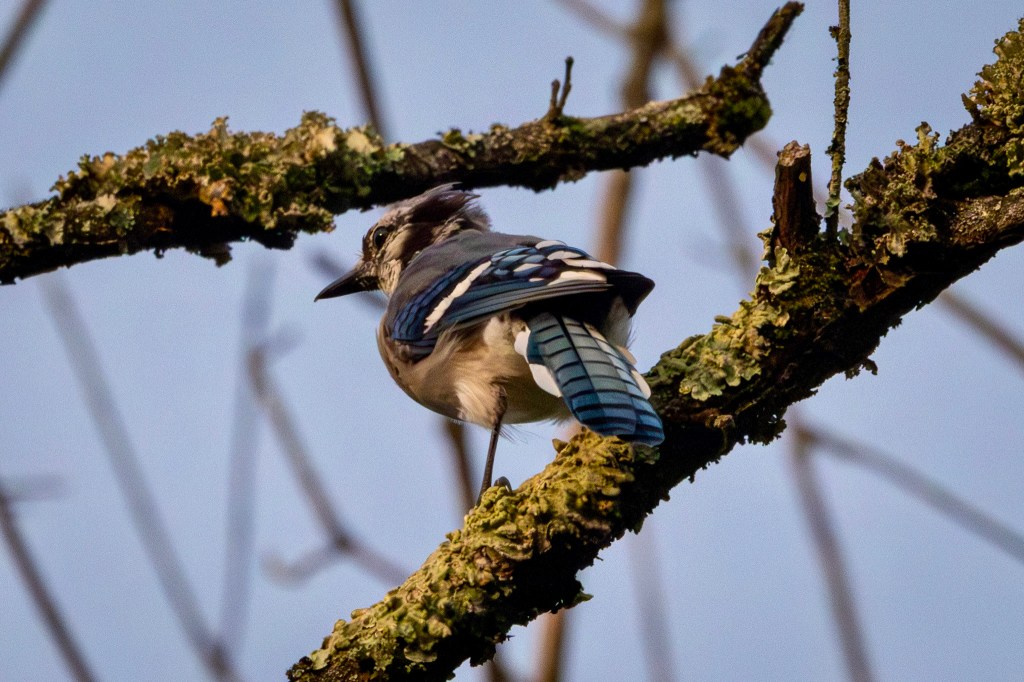
To provide a bit of color, I’m adding a photo of a blue jay I spotted at the Charles Rogers Preserve not long after I saw the house finch. Blue jays have striking looks, of course, especially when the sun lights up their blue coats.
Blue jay from the rear.
Most of the shots of blue jays I get are in profile or head-on, but this time I was behind the bird. On viewing the photo, I am struck by the near uniform rectangles on its tail feathers and the blue and white splotches on its primaries or wing tips.
I’ve seen thousands of blue jays over my lifetime, but how often do I look closely? Rarely. I’m glad I’ve discovered the joy of noticing the subtleties of these birds by looking at them more intently. It’s much easier to do so in viewing a photograph, but I’m committing myself to looking more intently at birds as they come into view. 🦅
When several hours of rain finally lapsed Sunday afternoon, my wife suggested I head out with my camera. I had not expected to have an opportunity to do any birding, so I jumped at the chance — promising to be back soon to help get things in order for dinner guests.
Because of all the rain from the overnight storm, I headed to the Dyson Tract along the Delaware and Raritan Canal. I figured it was a good bet for birds at mid-afternoon and a good match for the hour or so I could afford.
On the canal towpath, I heard a pileated woodpecker calling in the distance and hoped to catch sight of it. As I walked up the gravel path that’s perpendicular to the towpath, I heard the bird call loudly from close by. I couldn’t spot it, but then I noticed a big blob high in a tree at the back edge of the woods.
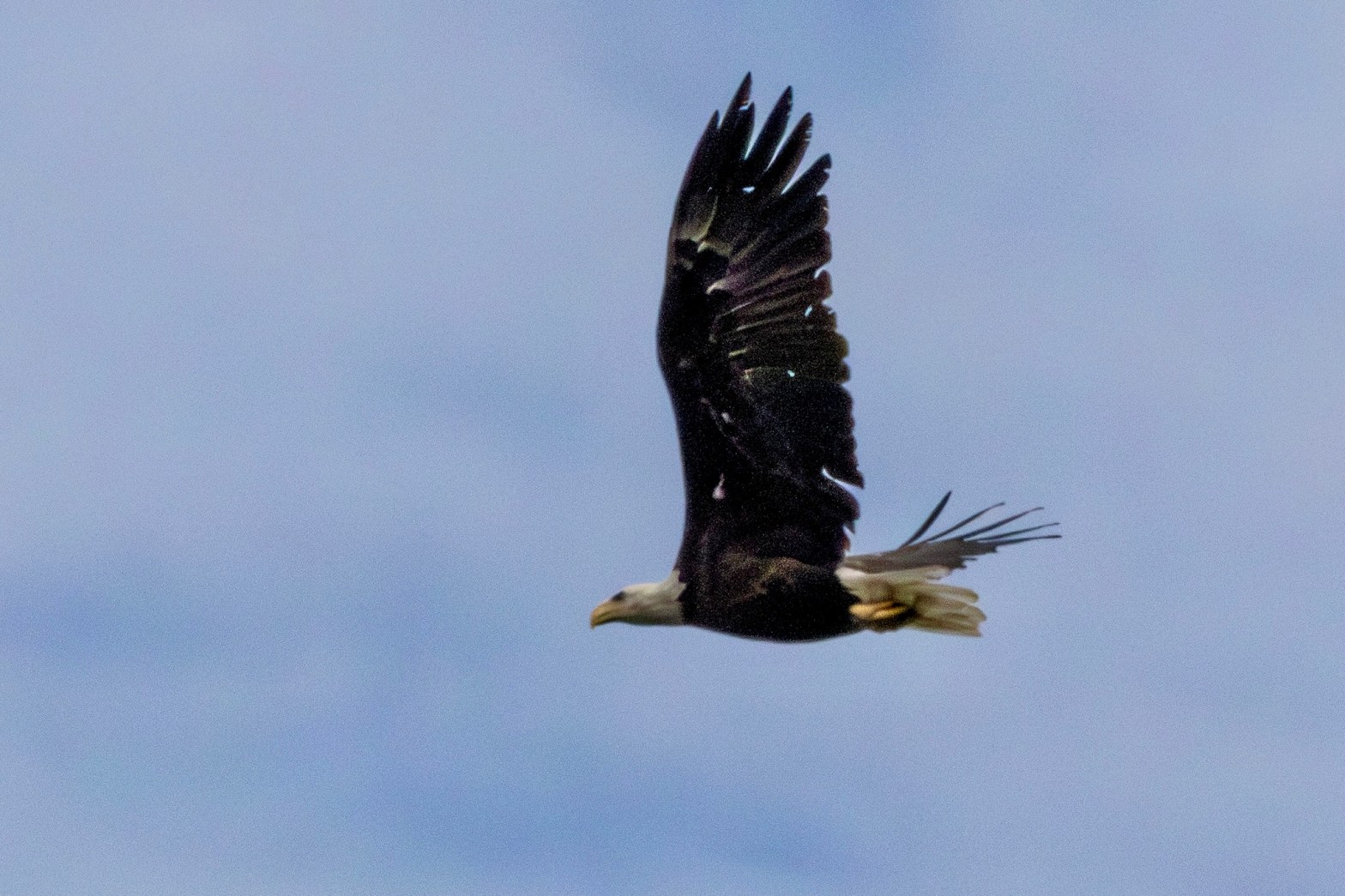
It was a mature bald eagle, and I was able to shoot through the trees along the trail from a couple of spots. Wanting to get closer for a better shot, I quick-walked up the trail until it stops in a clearing near a housing development.
Photographed from a distance, the bald eagle perches atop a tree at the edge of the woods.
The bird was in plain few, still a fair distance from me. As I started to reach for my camera, the eagle took off. I took a series of shots. While the first several were blurry, my Canon locked onto the bird as it flew away. I got a few decent frames, including the photo topping this post.
I was eager to get home and see the eagle photos, but the pileated woodpecker again cried out just off the trail. I had to find it. I looked and looked and looked, and after a couple more nearby calls I spotted it just as it flew off the top of a tree. I didn’t bother with the camera, content to watch the big bird streak away to the southwest.
I had my eagle shots. I’m hoping the pileated will give me a raincheck. 🦅


















 The Jersey Birder