A close encounter with a red-tailed hawk (and more)

My birding buddy Jim and I have walked the trails of the Mercer Meadows Pole Farm many times, but today was the first time we pulled into the parking lot almost simultaneously. Within a few minutes, a rare treat was in store.

We and other regular Pole farmers have been grousing of late about the relative scarcity of birds, but a few sparrows and juncos appeared as we left the parking lot. It was a good omen. We walked a short way up the paved trail when I looked ahead and spotted a red-tailed hawk perched on a sign post.

Jim and I each took a few shots from a distance, crept up a bit and then wondered: will the bird let us pass? As we walked along, the bird seemed unfazed, looking out into the fields and occasionally back toward the two non-avian creatures approaching.

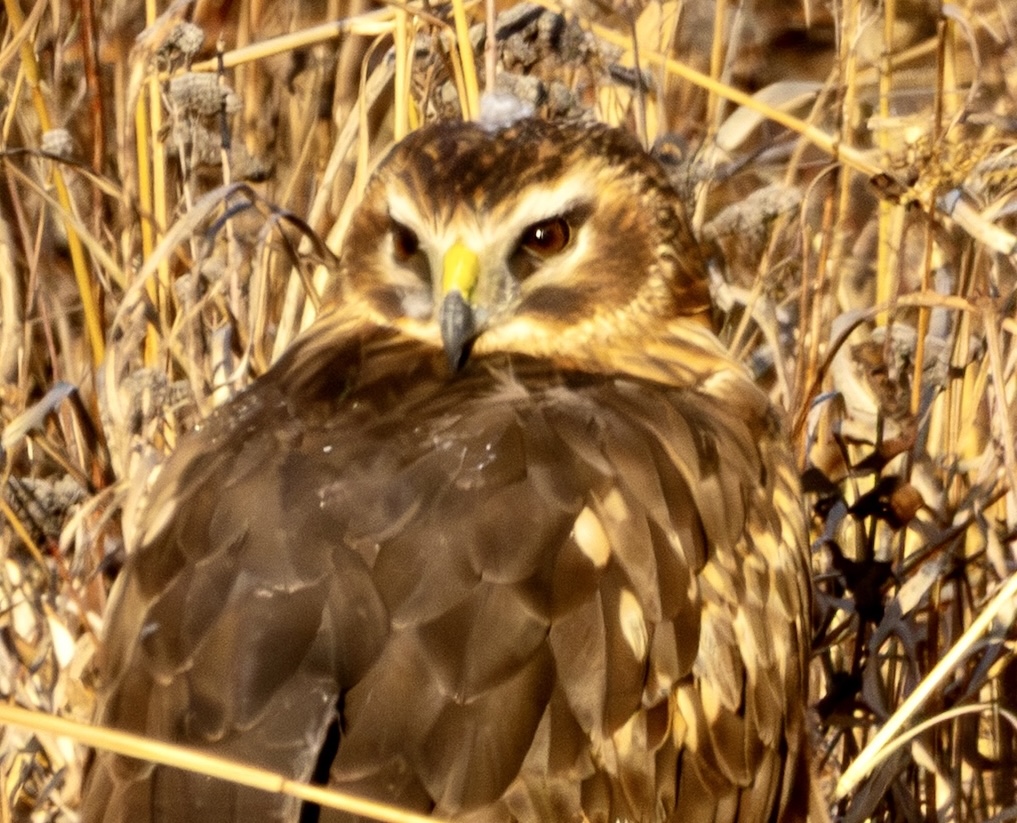
A red-tailed hawk sits atop a sign post, looking slightly away from the photogrpaher.
The hawk was so close, it almost felt as if it were a portrait studio setting. Mr. Red-tailed never did turn directly at me when I was at my closest point to shoot.

Jim and I stayed on the grass just off the path, and at the closest point we were no more than 12 feet from the bird. It remained on that perch, even as a walker a few minutes behind us stopped to pull out a cell phone and take a photo.

As we headed up the center dirt trail, song and savannah sparrows flitted about. Jim said American tree sparrows were back, and seemingly on cue one appeared.

Two purple finches cling to bare branches at the top of a tree.
Two of the purple finches. I focused on the one on the left.

As we entered the woods and turned toward the old AT&T Building One oval, we spotted some birds in trees to our right. I immediately picked out a purple finch, which I could see clearly through my binoculars. Jim pointed out several more, and the little flock soon flew off.

Jim and I milled about for a while, then headed back down toward the parking lot. I found an accommodating savannah sparrow that paused briefly in the grasses for me to take a nice close-up.

Jim hung out a little longer, and I headed off to finish a report of 19 species in an hour and a quarter. The sunlight was gorgeous today, and my photos were the better for it. 🦅

A savannah sparrow sits on a stalk of grass, with a bit of grain in the tip of its beak.
The savannah sparrow, my best (or at least my favorite) shot of the day.

Getting a good look at a long-eared owl

Owls have long fascinated humans, as attested by the ancient Greeks, who linked the birds to the goddess of wisdom, Athena. For those of us living in the modern world, owls remain a symbol of wisdom themselves.

I’ve had few opportunities to gaze into their soulful eyes, and I recently got the opportunity to see a long-eared owl. I won’t specify where or when, following the conventions of e-Bird, which considers the species sensitive and wants to protect the birds from intrusive observation.

A year ago, long-eared owls showed up at a local park, and one day I got the slimmest peek at a portion of the head and torso of one of them nestled in a cedar tree. It was a sighting but from afar through binoculars.

On a recent morning, a encountered a small group of birders loitering near a stand of cedars, and I immediately guessed they were near an owl, as word-of-mouth reports had been circulating.

A birder I’ve seen in passing a few times gestured up into the trees, and I looked for the owl but couldn’t spot it.

With a tug on my camera strap, the other birder whispered for me to crouch and look up. There was the owl, its long ears poking up, sitting about 25 feet high on a branch. Smaller branches defied me, and getting a clear shot with my camera was difficult. But no question, I was getting a true view of a LEO.

I texted my birder friend Laura, and we made plans to visit again the next day. Her husband and their dog came along, and we headed to the site where the owl had been the day before. There it was, in roughly the same spot, slightly more visible this time.

A group of birders and photographers was on scene. One of the shooters was using flash to take photos, and I didn’t have the nerve to scold him for it. Our mere presence stressed the owl, and a flash of light every now and then was obnoxious.

Long-eared owl sitting on a tree branch, its face partially obscured by a smaller branch crossing between its eyes.
The long-eared owl, partially obscured by a branch, stares toward me.

Laura kept her dog at a distance, and we stayed only briefly to observe the owl. I managed to get a few fair shots through the branches, and I’m pleased that I was able to do so.

I hope the other birders had the good sense to wrap up their viewing quickly and leave the owl in peace. That’s the wise way to go. 🦉

Humor and humility: Birding brings both

Besides a sharp eye and patience, a birder needs a sense of humor and a sense of humility. I keep that in mind, particularly with my photography, as I tread the fields and woods on my birding outings.

The photography certainly keeps me humble, as I review my photo cards and see the shots that didn’t quite pan out, like the one of two harriers playfully charging at one another over the fields at the Reed Bryan Farm side of Mercer Meadows late this afternoon.

As for the needed sense of humor, this afternoon’s outing made me chuckle.

The Pole Farm/Reed Bryan acreage has two, two-story observation decks, one each. I usually don’t stop at them because, it seems, I rarely see birds from them.

But today I spotted the two harriers flying near the Reed Bryan observation deck, so I walked up that way, climbed to the upper deck and took a seat. I figured on waiting a bit to see if at least one of them came near.

Sure enough, one of them came flying by, and I started tracking and shooting it. The bird was maybe 50 feet away at its closest point, and I got several almost-sharp shots. But one was sharp, and I am delighted to put it atop this post.

I’m laughing at myself because I got the shot after firmly thinking, “I never get anything good from the observation decks.” And yet I got one of the best harrier shots I’ve taken in a good while.

Go figure! 🦅

The challenge of capturing birds in flight

I’ve had my new camera for a few weeks and I’m starting to get the hang of it. The burst rate for this mirrorless Canon R7 is super fast, and I’m adjusting not only to that but to the advanced autofocus capabilities of the camera.

I have the camera set to focus on the eyes of whatever animals (there’s a people setting, too) that I see through the viewfinder. The camera locks onto a bird in flight, but it will lose the focus, the bird or both as I swing my Sigma lens to keep on target.

On Sunday afternoon, I stashed the R7 in the car as I ran a few errands in town. I stopped by Colonial Lake to see if there might be some waterbirds, and I wasn’t disappointed.

An estimated 100 ring-billed gulls were scattered about the lake, and every minute or so some of them were flying one way or another.

I also heard the chattering of a belted kingfisher and finally spotted it. Typically, kingfishers zoom in on a fish and high-tail it to the opposite side of the lake.

Today, I was lucky. The bird, a female, was nearby and flew out over the lake. To my surprise, she hovered for a few seconds before diving. I had two opportunities to catch her in flight, and I was fortunate to capture a couple of clean images.

Belted kingfisher hovers in the air while acquiring a target below in the lake.
A belted kingfisher hovers above Colonial Lake.

I didn’t get her as she hit the water, so I don’t know if she caught anything. But it was quite a kick to observe her and even more delightful to get a good shot.

After the kingfisher took a break, I practiced tracking some of the gulls in flight.

Ring-billed gull drops its feet as it lowers itself to land on the lake.
Note the gull’s feet as it prepares to land on the lake.. In the photo at the top of this post, the same bird has its feet tucked in before beginning its descent.

While I had plenty of misses, several images were sharp, and I’m growing in confidence in my ability to take advantage of the R7’s autofocus capabilities. I note also that I had plenty of sunlight this afternoon, which aided tracking of the birds. 🦅

A short walk for a big bird

Most days, I go out to the birds. Some days, they come to me.

Today was a case in point. Once the sun came up, I noticed that the tube feeder outside our dining room windows was empty. A Northern cardinal perched there briefly and looked around, seemingly puzzled that his breakfast had not been set before him.

Still in my bathrobe, I slipped on a pair of shoes and headed outside to refill the feeder. When I finished, I looked up and saw a big blob of a bird in the locust tree that anchors the back corner of our lot. The bird was a hawk, and I was pretty sure it was a red-tailed.

I slipped inside, turned on my camera and went out again. The sun was slanting in from the east, so I slowly circled out onto the 12th tee of the golf course that adjoins our property. With the bird getting a bit of sun on its belly-band, the ID was confirmed: red-tailed hawk.

I fired away for a minute or so before bidding the hawk a good day. 🦅

Red-tailed hawk gazes down from a tree limb.
The hawk takes a look at me and decides he’d rather go after a squirrel. I am grateful.

Awesome: Harriers in aerial maneuvers by the setting sun

What inspired man to take flight? I had a flash of inspiration this afternoon while watching two Northern harriers joust in the golden light of the setting sun at the Mercer Meadows Pole Farm.

Watching two female Northern harriers playing on the steady breeze over the main fields brought to mind Icarus, who in Greek mythology strapped on wax wings and took to the sky.

Icarus flew too high, and the sun melted his wings, sending him to his doom. The harriers today were not beset by such. They soared and dove, twisting around one another every few minutes as I watched in awe.

I had my camera trained on them for much of the time, most of it with them flying at a distance that outstripped my ability to get a crisp, well-lit shot. But I did manage to get a few shots of the two of them in one frame. At one point, they circled above me, but for most of my half-hour visit they flew in the distance.

Two Norrhern harriers fly in close proximity to one another.
Two female harriers fly overhead.

Three other harriers were dashing about, including a “gray ghost.” I managed one mediocre shot of him, but there was no doubting that I’d ID’d the male of the species.

The harriers were the only birds I spotted. Every other critter was hunkered down, as far as I could tell. But no matter — watching the harriers at play was worth the time. I took away a few mediocre photos and stirring memories. 🦅

Northern harrier turns in the sky.
Not great, but the best I could get in the diminishing sunlight.

Eastern drought seems bad for birds

Although we had some rain overnight Sunday into Monday, we’ve had an extended drought here in the New York-Philadelphia region. Wildfires are burning here and there at a time of year when they shouldn’t be a concern.

Not a puddle is to be had at the Mercer Meadows Pole Farm or many of my other birding haunts in and around Princeton. In the Dyson Tract along the Delaware and Raritan canal, the marsh that should be luring mallards and gadwalls back for the cold months is stunningly dry.

Fortunately, there’s Abbott Marsh on the Trenton-Hamilton border. I drove down there over the weekend and was able to spot and photograph a good number of mallards and Northern pintails, such as the one floating atop this post.

Three Canada geese standing in shallow water.
Drought or no, Canada geese are always with us. Here are three in Trenton marsh, where the water level is noticeably lower than it should be.

For a change of pace, I headed on Sunday morning to the Van Nest wildlife reserve, which is tucked in behind the dam that created Mercer Lake at Mercer County Park. I didn’t spot any waterfowl in the streams that run through the heavily wooded refuge, but white-throated sparrows were singing all around me and what may have been three pileated woodpeckers were chattering away.

On my way back to my car, a swamp fox sparrow perched just ahead of me and gave me an opportunity to take its portrait. [Editor’s note: My friend Mark just tipped me that I misidentified the bird below as a swamp sparrow when, in fact, it was a fox sparrow. That information blows up this next, concluding paragraph, but I’d rather be accurate than clever.]

While swamps themselves are suffering these days, it’s good to know that swamp sparrows are hanging around, hoping just as we humans are for a good drenching or two to chase away the drought. 🦅

Fox sparrow perched on a curved tree branch.
Fox sparrow at Van Nest Wildlife Refuge
Side view of fox sparrow showing streaking on its breast.
Here’s another look at that same fox sparrow. The streaking on its breast is one of the field marks that distinguishes it from a swamp sparrow, which has lighter streaking.

On standard time, a five-sparrow day

It was time to “fall back” today as the United States reverted to standard time, giving us an extra hour of sleep or an extra hour to seize or squander. I have been looking forward to the switch, which gives me more time in the morning to bird ahead of work.

I headed to the Mercer Meadows Pole Farm about 7:20 a.m., with the sun fully up and flooding the fields and trees. For the first 30 minutes, it seemed the birds were sleeping in. I saw not a one for the first half mile of my walk toward the old AT&T Building One site.

There, things perked up. With the high-pitched call of a white-throated sparrow sounding nearby, I trained my camera onto what I thought was another white-throated sparrow munching in the fronds in some tall grass. The bird was partially obscured, and I struggled to focus. When I checked my images at home, that bird turned out to be a swamp sparrow, and the best shot of the lot tops this post.

Birding buddy Bill showed up and soon spotted a fox sparrow in an evergreen tree. As I started pulling up my camera, off the bird went. Nearby, a field sparrow was in a cedar tree where a few cedar waxwings were picking at berries.

Spotting four sparrows is not unusual for me at the Pole Farm, with the most likely combination being song, savannah, white-throated and white crowned. Oddly, today I neither saw nor heard a song sparrow or savannah. I was content with those I did see.

At home I saw the usual gaggle of house sparrows fluttering at our tube feeder, and I saw the first white-throated sparrow of the season perched there, too.

While the swamp sparrow photo is sharp, most of the other images I took today were not. I’m still adjusting to my new Canon R7 camera, but I made an important discovery. Yesterday afternoon I took the Sigma telephoto lens off and switched to my old Canon kit zoom lens. Once that was on the adapter, the camera sprang to life when I tripped the “on” switch. A-ha! The problem with the camera taking multiple attempts to turn on must be a bug on the Sigma side.

Also, I headed out this morning with the camera battery at about 75 percent full. It died after about 45 minutes as Bill and I came upon three hermit thrushes in the woods. One was particularly cooperative, staying in front of us for several minutes. I had enough time to switch to a spare battery, which brought me the shot below. 🦅

Hermit thrush perched on a tree branch.
A hermit thrush perches on a tree branch.

Twitchers’ reward: a sandhill crane

Over the past several days, several birders have sighted a sandhill crane or two at the Miry Run area (a.k.a. Dam Site 21) that touches Hamilton, Robbinsville and West Windsor, New Jersey. The site is a 15-minute drive from home. When my friend Laura texted me that she was going to try to find the bird late this afternoon, I eagerly responded that I’d leave work early to pick her up.

After parking, we took the short walk up to where the dam embankment begins. We hadn’t even begun to climb when off to my right I spotted the crane in some tall grass.

We lost sight of it almost immediately, but Laura spied it again after she headed up the embankment. I lumbered up to join her and had a clear view of the bird. It was preening itself at the edge of small pond below the spillway.

The bird was in the shade, and I had trouble getting a clear shot at first. Eventually my camera latched onto the bird, and I managed to get a few decent shots.

This was my first sighting of a sandhill crane in New Jersey, as the birds only appear during migration and only scarcely. Although a lifer for Laura, this was not my first sandhill encounter.

On a business trip to Grand Island, Nebraska, about 40 years ago, I stopped along the Platte River during mid-March when the sandhills (named for the Sandhills to the north of the river) were congregating during migration. I saw hundreds of them, if not thousands. I didn’t have a camera or binoculars with me, but the sight and sound of them were overwhelming and unforgettable. Some day I’ll go back.

The crane’s species name is Antigone canadensis, referring to Canada and a tragic figure in Greek mythology. Sophocles’ play “Antigone” — rife with incest, family feuding and suicide — is nonetheless my favorite play from Greek literature. I’ve read that masterpiece in Greek, and my copy of the book containing it remains on my shelves today.

That got me to thinking. My collection of bird books is nearly equal in number to my old classics texts from college.

I was happy to add the crane to my New Jersey life list. I wasn’t able to get out this morning, but the crane is a good start to my sightings for November. For good measure, we also saw a Cooper’s hawk, great blue heron, two pied-billed grebes, a coot, some vultures and heard a belted kingfisher. 🦅

A rare capture of a common bird: the Carolina wren

While I can almost always count on hearing a Carolina wren on my visits to the Mercer Meadows Pole Farm, it’s a rare day when I see one and even rarer when I’m able to get a photo.

I routinely hear and see these tubby little birds at home. I have several photos of them eating at our feeders or perched on our patio furniture. I’m always impressed by the decibel-to-body size ratio of their beautiful song.

In the wild, that cheerful song carries far through the woods and over the fields. But to my eyes, these wrens offer only fleeting glimpses. I first recorded spotting a Carolina wren at the Pole Farm on Oct. 28, 2020. Over the past four years, I’ve recorded sightings of them 269 times, a total of 449 individuals.

This morning, I heard the last two in that count. The second one was singing in a young oak tree on the trail just past the observation deck. The bird was tucked in, sitting on a branch, surrounded by beautiful red leaves. I wasn’t positive it was a wren as I raised my camera, and I was able to get off a few shots before it flew off.

Carolina wren in a tree, surrounded by branches and red leaves.

I played the images back, and the bird’s curved bill and a strong eye line left no doubt that I’d captured a Carolina wren on my card. One wide shot tops this post, and a cropped version is inset.

These birds bring joy, and I thank this little one for staying still just long enough for me to preserve the memory in pixels. 🦅