
If you’re interested in becoming a birder, you’re probably wondering what gear you might need. In this post, I’ll offer some advice based on my experience. I aim to keep expenses reasonable and minimal.
For starters, all you need to do is look out the window of your home to see what birds show up. Or take a walk in a neighborhood park and make a note — mental, on paper or on a cell phone — of what you see.
It helps to have a guide book to consult when you spot an unfamiliar bird. I rely on two of the most popular, the Sibley and Peterson field guides, as well as a few other specialty books I’ve accumulated. You can also describe the bird in a search engine or AI query, and chances are good you’ll get a an answer with photos.
Looking about and consulting a guide book is what I’d call Stage One birding. To advance to the next step, I recommend two items. First is the Merlin birding app from the Cornell ornithology lab. It’s free and amazing. You turn it on to listen for birds and are alerted with IDs on whatever it hears. You can also answer a few prompts for characteristics of a bird you see, and the app will suggest what it might be.
Note that the app’s sound recognition ability is not perfect. Using it over time, you’ll know when to be skeptical and when to accept its reports, which is most of the time.
Essential tool: Binoculars
Second is a pair of binoculars, and here’s where budget considerations start coming in to play. My best advice is to buy what you can afford but don’t go super cheap. Many websites offer advice on the best bins for birding, and the most helpful sites and blogs are those that present choices in tiers of prices and capabilities.
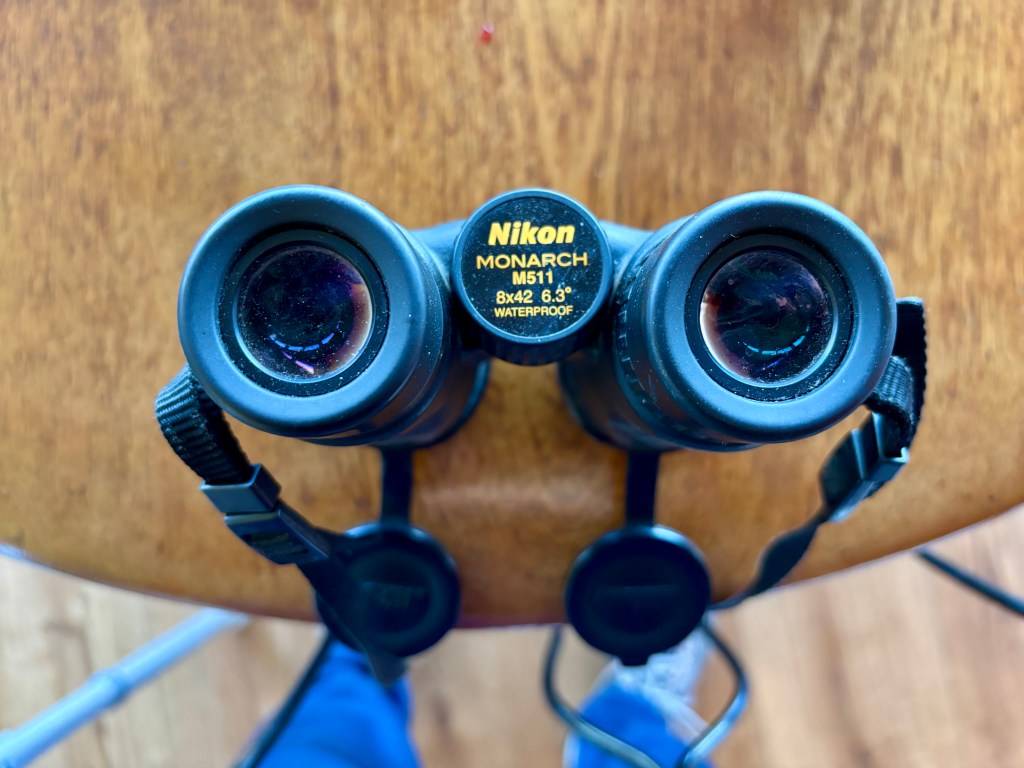
I spent around $300 on Nikon Monarch M5 8 x 42 binoculars, a solid all-around choice. They offer excellent range and color definition, and they do well in a wide range of lighting conditions. There are more pricey models from Zeiss, Swarovski and other manufacturers, and there are lower-priced brands that give good value. You might even be able to pick up a used pair.
Birding organizations often have promotional days when you can examine and buy binoculars from multiple makers, often with a discount. That’s a great way to not only see the products but also to get guidance from experts on site.
Logging your sightings
Once you get the hang of identifying the birds you observe, you likely will want to start keeping a list. I started by using the Notes app on my iPhone to keep a list of the species I spotted around our home.
When I began heading out to the fields and woods, I started using the e-Bird app to track the birds I’d see. I’m an inveterate list maker, recording every car I’ve owned and every flight leg I’ve flown. The e-Bird app tracks how far you’ve traveled and even makes a map of your route. I’m also a map lover, and the web version of e-Bird displays your birding adventures on several levels, from a county to the world.

Need a scope?
Spotting scopes are a useful tool for catching birds at a distance, such as gulls floating offshore at a lake or waterbirds on a spit or island far off from where you’re standing on the beach. As with binoculars, scopes range in capabilities and price, and they need tripods.
I haven’t plunked down money for a scope (yet), in part because a birding friend has one that we use if we head to the New Jersey shore. Besides, many birders with scopes that you’ll encounter will happily invite you to take a look at whatever they’ve spotted. A friendly “hello, what are you seeing?” approach usually does the trick.
Overall, binoculars are much more useful in most birding situations than spotting scopes. For most people, binoculars should be the first purchase. With experience, you may reach a point where a spotting scope becomes a compelling need.
What about a camera?
I was an enthusiastic amateur photographer long before I became a birder. When I started birding, I bought binoculars right away and almost immediately began slinging my camera over my shoulder on my outings.
At the time, I had a Canon Rebel XTi, a fairly low-end DSLR onto which I mounted a Canon 75-300 mm zoom lens that I’d bought second hand. I got many nice shots of birds, a few of them up close and a lot of wider “birds in their surroundings” images.
Seeing other photographers with long lenses, I developed lens envy and started plotting how to get one with longer reach. A colleague at work bought a Sigma 150-600 mm Contemporary zoom lens and showed me some of his bird photos, and that became the object of my desire.
A year or so later, I was out at the Mercer Meadows Pole Farm with a few other birders pointing their long lenses at a raptor up in a tree. They were getting close-in photos while I snapped a few landscape-like shots with my smaller lens. That afternoon, I went to the camera store, plunked down my credit card and bought the Sigma. I’ve not looked back.
Many birders I know have the same lens, some with Nikons and others with Canons like mine. If I were a rich man, I’d likely buy a 500 mm Canon prime lens, but I’m happy to shoot with my Sigma. It gives me excellent images. It can’t compete with a prime lens in low light, but I’m not often birding in such conditions.
A zoom lens like my Sigma affords a good range of composition options. Sometimes you want to narrow in on the bird and other times you want to pull back to get more of the bird’s surroundings.
As with binoculars, my lens choice was at the sweet spot between capability and affordability.
I’ve upgraded my camera body twice in recent years. I ordered a Canon SL2 to succeed the XTi. When the SL2 conked out, I ordered a mirrorless Canon R7, with which I am very happy. It has excellent video capabilities, but I rarely give that a try. With the long Sigma zoom attached, I need a tripod — which I don’t have — to keep the camera steady.
One of my birding buddies who’s an excellent photographer uses not a DSLR but a Nikon super-zoom camera for both still photos and video. He gets good results in both formats and doesn’t use a tripod. That type of camera is an excellent option and a good value.
If you don’t have the money or interest in getting a high-end camera, you can still take good photos and video with a cell phone. Zoom capabilities are limited, but you can get scenic shots of birds at a nearby feeder, in bushes or in trees. That may satisfy you. If you get hooked on birding, you may get bitten by the camera-and-lens bug.
Jpeg or RAW?
For the first couple of years of serious birding, I shot jpeg photos, not wanting to fuss with the more elaborate controls of advanced photo editing software.
About the time I upgraded to the Canon SL2, I tried shooting in RAW mode and editing the images in Adobe Lightroom. Just by using Lightroom’s auto edit function alone, I immediately saw the advantages of shooting RAW. Lightroom allowed me to lighten shadows and otherwise salvage images that were blown out or dark and muddy.
I’m still learning Lightroom, which now offers AI tools to improve photos at the click of a box. I have a light touch with the editing functions, striving to get a realistic representation of what I saw in the field.
As noted at the top of this post, you can enjoy birding with or without gear. For some, exercise is the main motivator for getting outdoors, and spotting birds and other wildlife is a bonus, no photos required or desired.
For me, photography is essential to my enjoyment. It’s a creative outlet and a critical contributor in my ability to identify birds. Often in the field, I’ll encounter a bird I don’t recognize. Back home, I’ll usually be able to make the ID by looking at the photo.
All the above is my basic advice on getting started and advancing in birding. I’ve been fortunate to get many tips from fellow birders, most of whom are more than happy to share what they know. This post is my way of paying that back. 🦅
 The Jersey Birder
I got into birding just by watching the woodpeckers out my kitchen window. I’ve honestly never owned a bird guidebook. When I started getting a little more serious, I downloaded Merlin ID and eBird and treated myself to a super-zoom lens for my Fuji. I’ve never used binoculars—and I don’t think I ever will.
LikeLike
Forgot to add. I am a photographer who got into birding, not a birder who got into photography.
LikeLike