Most days when I’m out birding, I’m a loner. I’ll stop to chat with passing birders, of course, sharing tips on what I’ve spotted and hoping they’ll share something I’d like to see. But I enjoy my own company, if you will, and I’m perfectly happy to pursue my birding in solitude.
But then there are mornings like today, when my friend Laura joined me on a visit to Mercer Meadows, on the Reed Bryan Farm side opposite the Pole Farm. Our mission: to make sure Laura spotted the well-traveled dickcissel that’s been hanging out at the parking lot for several days, singing up a storm.

The moment I opened the door to the car, we heard the bird. The little Pavarotti was predictably perched near the red barn at the head of the trail, singing loudly from bare branches at the top of the tree.
The instant find took a bit of drama out of the trip, but we were perfectly fine with that. We also noticed the gathering of European starlings in and around the big tree, and then Laura spotted something new. High up in the trunk of the tree was a round hole where starlings were nesting, with the parents flying in and out.

I’ve parked in that lot scores of times and seen hundreds of starlings in that tree, but I’d never noticed a nesting cavity. Score one for the eagle-eyed Laura, who was just warming up.
We walked downhill from the parking lot on a path bisecting two large fields. At the bottom of the hill is a footbridge over a small creek, and after crossing it you must turn left or right. We stopped at the intersection, looking around, hemming and hawing on which way to go.
A maple tree towers over the intersection, and at some point I spotted a yellow-breasted bird that flew into its branches about the time our Merlin sound apps lit up with “great-crested flycatcher.”
I can’t recall exactly how things played out, but it seemed there were two flycatchers coming in and out of the tree. Then Laura spotted a round opening in a dead spur of the trunk, about three-quarters of the way up the tree.
A nest!
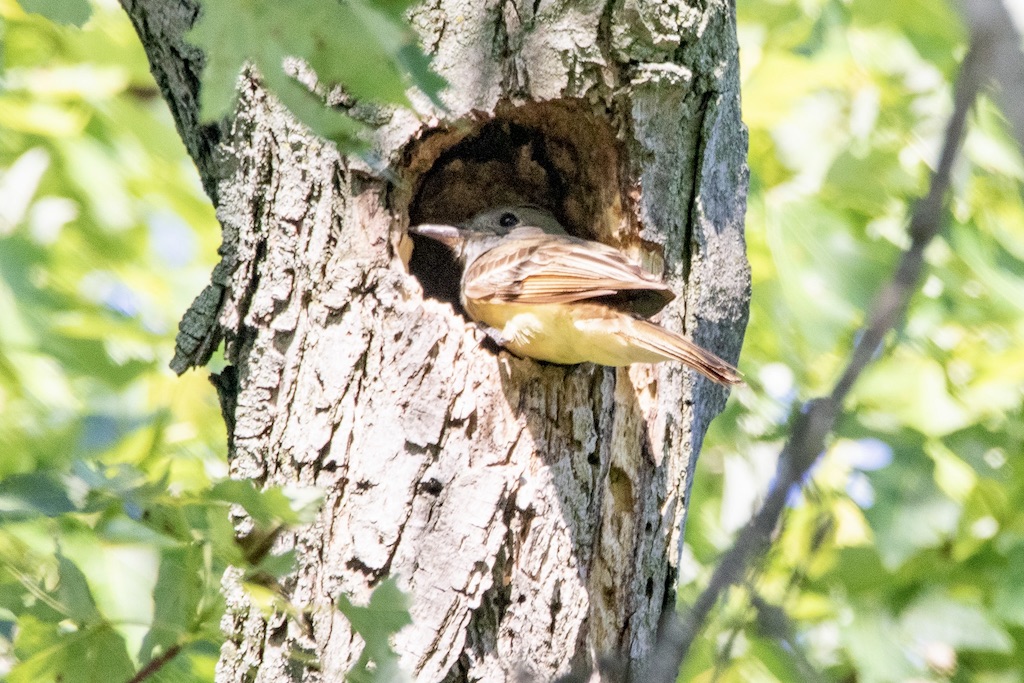
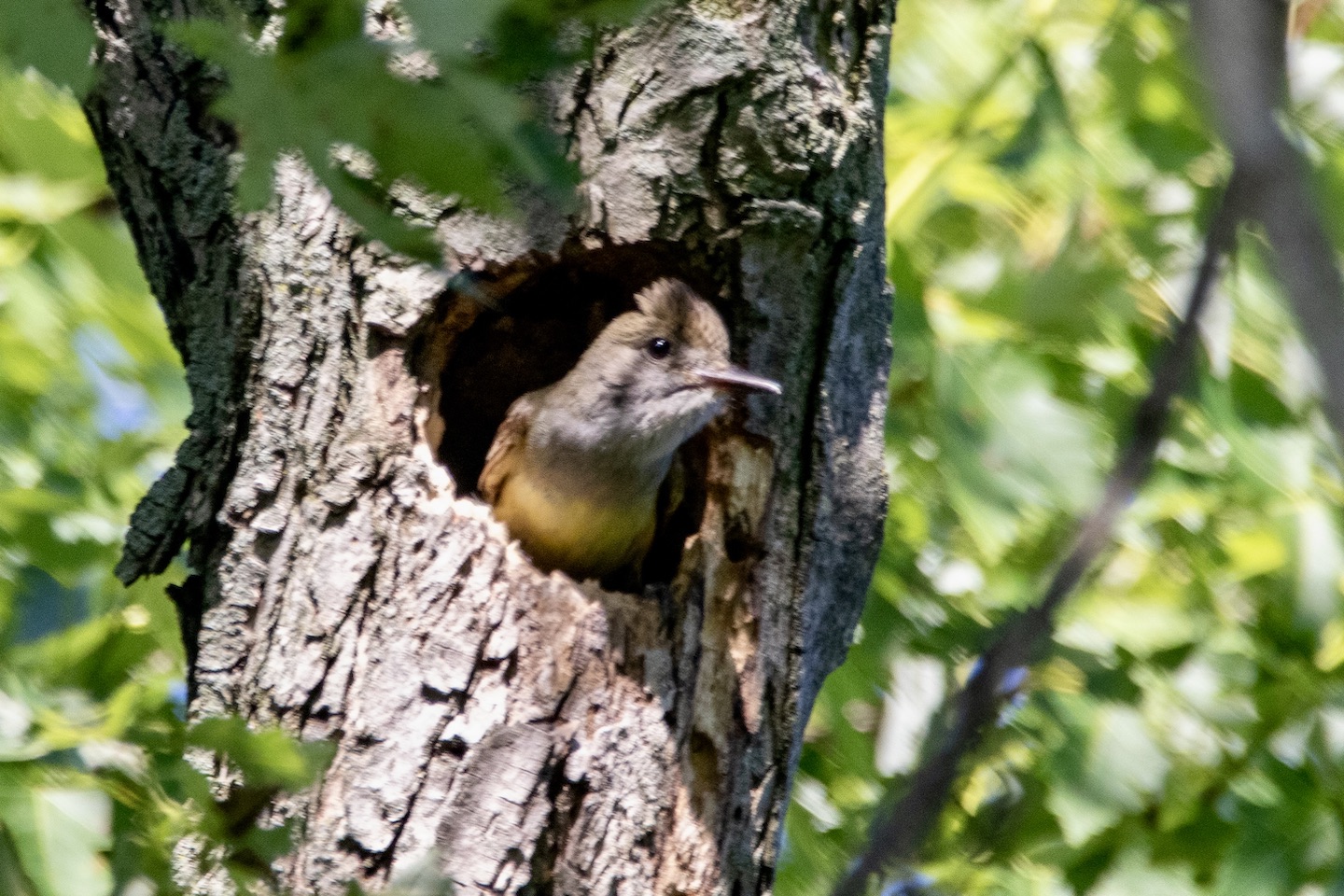
The flycatchers were coming in and out to feed their young. They flew off in a couple of directions to our right and would be gone a few minutes before reappearing and popping into the cavity in the tree. We couldn’t see the little ones, but it was obvious that the parent birds were carrying food and stooping down from the edge of the nest to feed their brood. I took several hilariously terrible photos of the back half of the body and the tail of one of the parents, but I’m quite pleased with the photo at the top of this post. You can see the crest on the bird’s head as it emerges from the nest.
Would I have spotted the flycatcher nest on my own? Almost certainly not. Impatient sort that I am, I would have been wondering what the yellow-breasted bird I’d seen was as I moved on, hoping to catch a glimpse down the trail.
The same went for the starling nest. Most times, I glance up at the tree, do a rough count of the starlings, enter it in eBird and head off in search of birds uncommon and more colorful.
The lesson here is obvious. Four eyes are better than two, especially when the extra set is peering through a pair of high-end binoculars. Just as my friend Andy helped me find a scarlet tanager nest, Laura was the one who spotted the two nests today.
Even without the nests, strolling together, straining to hear a wood thrush and tapping each other on the arm to say, “Is that a …?” makes the outing more enjoyable.

 The Jersey Birder
What a cool nest to find! I have a close friend who likes birds but is not a birder. However, like your friend Laura, she’s a great spotter. I always like having her along on a bird walk.
LikeLiked by 1 person